
Finding the best modern dollhouses for small spaces means balancing play value with the realities of a compact bedroom, apartment, classroom, or shared family room. A dollhouse can encourage imaginative play, storytelling, and careful decorating, but a large traditional design may quickly become awkward to store or use. Modern dollhouses often solve that problem with cleaner shapes, open fronts, fewer bulky details, and layouts that make better use of vertical space.
The difficult part is comparing dimensions, assembly requirements, materials, accessories, and age suitability when listings don’t always provide the same information. This guide explains what to look for, where compact designs work well, which trade-offs matter, and when a different type of dollhouse may be the smarter purchase.
What Makes a Dollhouse Suitable for a Small Space?
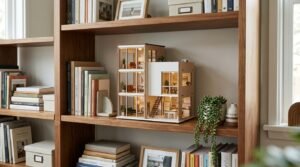
A small-space dollhouse is designed to offer imaginative play without demanding a large permanent footprint. It may be narrower than a traditional townhouse-style model, taller rather than wider, or open on one side so children can reach the rooms without needing to walk around the entire structure.
“Modern” describes more than appearance. Contemporary dollhouses often use simple architectural lines, neutral colours, open-plan rooms, minimalist furniture, or a design that looks comfortable in an adult living space.
Some are made for children, while others are intended for collectors and hobbyists. Those audiences have very different expectations.
Before buying, check the actual product dimensions rather than relying on photos. Images can make a dollhouse look smaller than it is, especially when it is photographed beside miniature furniture or placed in a large room.
- Width and depth: These determine whether the house will fit on a shelf, desk, dresser, or floor.
- Height: A tall design may save floor space but still be unsuitable beneath low shelving or in a child’s play area.
- Access: Open fronts and removable panels can make narrow layouts easier to use.
- Scale: Furniture, dolls, and accessories need to match the interior proportions.
- Storage: Small rooms still generate miniature accessories that need a home when play is finished.
Are Modern Dollhouses Worth Buying?
For many families, a compact dollhouse is worth considering because it can provide open-ended play while taking up less room than a large traditional model. It may also suit homes where toys need to remain visible and reasonably attractive rather than being packed away after every use.
The value depends on who will use it and how often. A child who enjoys arranging furniture, creating stories, and returning to the same play world may get lasting use from a well-built dollhouse. A child who prefers active toys or loses interest in small accessories may need a simpler, more portable option.
When a Compact Modern Dollhouse Makes Sense
- The available play area is limited.
- You want a house that can remain on a shelf, table, or narrow surface.
- The child enjoys pretend play, decorating, and role-play scenarios.
- You prefer a contemporary design that fits with existing home décor.
- You’re comfortable checking dimensions and assembling the product carefully.
When Another Option May Be Better
- A very young child may need a larger, simpler structure with fewer loose pieces.
- A collector may prefer a more detailed kit with a specific scale and stronger customisation potential.
- Families who move frequently may benefit from a foldable or portable dollhouse.
- Children who want to play with large fashion dolls may find compact rooms too restrictive.
- If there is no suitable storage location, a tabletop house may still create clutter despite its small footprint.
What to Check Before Buying
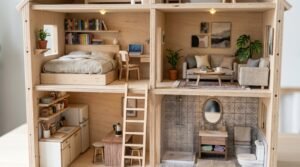
Build and Material Quality
Material quality affects stability, appearance, assembly, and long-term use. Wood-based panels can provide a substantial feel, but the exact construction varies widely. Some products use solid wood components, while others rely on engineered wood, laminated board, plastic, or a combination of materials.
Look closely at how the walls, floors, balconies, and roof sections connect. Edges should be finished cleanly, and the structure should not appear dependent on delicate decorative parts for stability. If the listing doesn’t identify the materials, treat that as a reason to investigate further rather than assuming a particular construction.
For children, smooth edges and secure fastenings matter more than an elaborate façade. For adult hobbyists, the quality of unfinished surfaces, trim, windows, and interior walls may be more important because those parts can affect painting and customisation.
Design and Appearance
Modern dollhouses commonly use restrained colour palettes, geometric windows, open balconies, flat roofs, or furniture with contemporary styling. That appearance can make the toy easier to place in a living room or bedroom, but design preferences are personal.
Consider whether the house is attractive because of its structure or because of removable decorations that may not be included. Product photography may show furniture, dolls, lighting, plants, or textiles sold separately. Confirm the contents before comparing two apparently similar designs.
Size and Fit
Measure the intended location in three directions: width, depth, and height. Leave enough room for a child’s hands to reach the back rooms and for doors or panels to open fully. A house that technically fits on a shelf may be frustrating if there isn’t enough space to play in front of it.
Also account for the assembly process. A flat-packed dollhouse can need more floor space during construction than it will occupy once finished. If the final home is a narrow shelf, check whether the finished depth includes protruding balconies, roof sections, or decorative features.
Features and Functionality
Small dollhouses don’t need every possible feature. In fact, too many fixed details can reduce usable play space. Practical features may include removable roofs, accessible rear panels, movable furniture, built-in storage, open sides, or rooms arranged so that several children can play at once.
Lighting can be appealing, especially in modern designs, but it introduces batteries, wires, switches, and maintenance. Ask whether lighting is included, whether it requires separate purchases, and whether the electrical parts are positioned safely away from frequent handling.
Assembly and Difficulty
Assembly can range from a short setup to a detailed construction project. The difficulty depends on the number of panels, fasteners, decorative pieces, and finishing steps. A product marketed for children may still require adult assembly.
Read the instructions before starting and organise the parts first. If the product has unclear diagrams, non-labelled components, or reviews mentioning misaligned holes, allow extra time and avoid rushing the build.
Accessories and Scale
A dollhouse without furniture may be good value for a hobbyist who wants to choose every item, but it can feel incomplete for a child expecting an immediately playable home. Check whether the listing includes furniture, figures, décor, kitchen items, bedding, or outdoor pieces.
Scale is equally important. Accessories from another set may not fit properly, even if they look similar in photographs. If you already own miniature furniture, compare its measurements with the interior rooms before buying.
Durability and Maintenance
Durability depends on the structure, the quality of the fasteners, how often the house is moved, and how the child plays with it. A lightweight design may be convenient in a small room but less stable if it is frequently picked up or bumped.
Dust can collect on ledges, balconies, and miniature furniture. Open-front models are easy to access but may need more regular cleaning. Painted or laminated surfaces are generally simpler to wipe than delicate paper details, fabric trim, or unfinished wood, though the manufacturer’s care instructions should take priority.
Customer Feedback and Common Complaints
Customer comments can help reveal practical issues that product photographs don’t show. Look for repeated themes rather than relying on one highly positive or negative review. Feedback may vary by seller, manufacturing batch, region, or version of the product.
Useful issues to investigate include:
- Parts missing from the package
- Instructions that are difficult to follow
- Panels that don’t align easily
- Furniture that is smaller or less substantial than expected
- Paint, laminate, or trim arriving marked or damaged
- A finished house that is less stable than expected
- Accessories shown in photos but not included
These reports don’t automatically make a product unsuitable. They do show where buyers may need to set realistic expectations or verify the seller’s returns process.
Comparing Small-Space Dollhouse Types
Because no specific product models or manufacturer specifications were supplied for this roundup, it would be misleading to invent a ranked list or assign unsupported scores. The table below compares the main design types shoppers are likely to encounter when searching for modern dollhouses for small spaces.
| Design Type | Best For | Typical Space Advantage | Main Feature | Potential Drawback | Overall Value Consideration |
|---|---|---|---|---|---|
| Vertical townhouse | Small rooms with available wall or shelf height | Uses height instead of a wide floor area | Several stacked rooms | Upper levels may be hard for younger children to reach | Useful when the footprint matters more than total height |
| Open-front modern house | Children who need easy access to rooms | Can sit close to a wall or on a narrow surface | Broad front opening | Less enclosed than a traditional house | Strong choice when play access is a priority |
| Portable or foldable house | Shared rooms, travel, or occasional play | Can be stored between sessions | Reduced storage footprint | May offer less room for furniture and accessories | Value comes from flexibility rather than display presence |
| Tabletop apartment-style model | Older children, collectors, and compact displays | Usually avoids a large floor footprint | Contemporary room layout | Small interiors may not suit larger dolls | Good if the scale matches existing accessories |
| Detailed miniature kit | Adults and experienced hobbyists | Often designed for a controlled display area | Customisation and fine detail | Assembly and finishing may be demanding | Worthwhile for a project, less suitable as an instant toy |
How to Choose by Buyer Type
For Beginners
Start with a structurally simple model that has clear instructions and a manageable number of parts. A design with open access is usually easier to furnish and play with than one filled with narrow corridors or delicate architectural details.
Beginners should also prioritise included furniture if they want the house to be usable soon after assembly. Buying a bare shell can cost more over time once compatible accessories are added.
For Small Bedrooms and Apartments
Measure first, then favour a narrow or vertical design that doesn’t interfere with walkways. A dollhouse with a clean rear surface may be easier to position against a wall, while a model with a wide balcony or side extension may occupy more room than the main measurements suggest.
If the house must be packed away regularly, portability matters as much as size. A slightly larger model that folds or stores efficiently may be more practical than a smaller fixed structure.
For Appearance-Focused Buyers
Look for consistent finishes, clean lines, and a colour scheme that works with the room. Modern styling can help a dollhouse blend into a shared living area, but don’t let appearance outweigh stability, accessibility, or scale.
Review photographs from different angles when possible. A front view may hide unfinished rear panels, shallow rooms, or decorative elements that extend beyond the stated footprint.
For Children Who Like Open-Ended Play
Choose a layout that leaves enough room for moving figures and furniture. A house with fewer fixed features may provide more creative freedom than a highly themed model that dictates how every room should be used.
Age guidance should be taken seriously. Small accessories can present a choking risk, and a product may need adult supervision even when its main structure is sturdy.
For Experienced Hobbyists
Experienced builders may prefer an unfinished or customisable model, particularly if they want to paint walls, install miniature lighting, or create bespoke furniture. In that case, check the quality and accessibility of the raw surfaces rather than focusing only on the finished product photograph.
Scale consistency is critical. A beautiful kit can become frustrating if compatible windows, furniture, figures, or flooring are difficult to source.
Common Mistakes to Avoid
- Buying from the photograph alone: Always verify finished dimensions and included contents.
- Ignoring depth: A narrow-looking house can still project far into a room.
- Assuming furniture is included: Staged photographs frequently contain optional accessories.
- Choosing detail over access: Tiny rooms and fixed features may reduce play value.
- Forgetting the child’s doll size: A compact miniature house may not fit larger dolls.
- Underestimating assembly: Check the number of parts and whether tools are required.
- Overlooking returns: This matters if panels arrive damaged or the scale is unsuitable.
- Skipping storage planning: Furniture and accessories need space even when the house itself is compact.
Safety and Practical Use
Inspect the finished structure before allowing regular play. Look for loose fasteners, sharp edges, unstable sections, peeling finishes, and small parts that may be unsuitable for younger children.
Place the dollhouse on a stable surface and avoid locations where it can be pulled down by a child. Tall models may require extra care because their centre of gravity is higher. Follow any anchoring or safety directions supplied by the manufacturer.
For shared play, consider whether two children can reach the rooms without pushing or pulling the structure. An open-front layout may work better than a deep house with a narrow entrance.
Frequently Asked Questions
What is the best size dollhouse for a small room?
There is no universal ideal size. Measure the intended location, then leave enough space in front for comfortable play and access. A vertical or narrow design often works better than a wide house, provided the height is suitable and the upper rooms can be reached safely.
Are modern dollhouses suitable for young children?
Some are, but suitability depends on the manufacturer’s age guidance, construction, and accessories. Small furniture and decorative parts may not be appropriate for toddlers. A simple, sturdy model with larger components is usually easier for younger children to use.
Do compact dollhouses include furniture?
It varies by product. Some are sold as complete play sets, while others include only the building. Check the contents list carefully and confirm whether furniture shown in product photographs is included or sold separately.
What should I do if I already own dollhouse furniture?
Compare the furniture’s measurements with the interior rooms before buying. Dollhouse scales are not always interchangeable, and a compact modern house may have rooms that are too small for larger figures or furnishings.
Are modern dollhouses difficult to assemble?
Difficulty varies considerably. Some require only basic construction, while others involve many panels, decorative parts, or finishing steps. Read the instructions and customer feedback where available, and plan for adult assembly unless the product clearly states otherwise.
Is a dollhouse better on the floor or a table?
A table or shelf can improve access and reduce the need to bend, but it must be stable and large enough for the full footprint. Floor placement may suit taller models or younger children, although the house should still be positioned away from walkways and secured if necessary.
Final Verdict
The best modern dollhouses for small spaces are not defined by appearance alone. The right choice combines a genuinely manageable footprint with accessible rooms, suitable scale, reliable construction, and an assembly process that matches the buyer’s patience and experience. A compact vertical, open-front, or portable model can be a smart purchase for families with limited room, while collectors may prefer a detailed kit that allows more customisation.
Before buying, measure the space, confirm what’s included, check age guidance, and investigate repeated customer complaints. If those details line up with the intended use, a modern dollhouse can deliver meaningful imaginative play without overwhelming the room. If they don’t, a simpler or foldable alternative may offer better value.