
Finding the best modern dollhouses for boys is less about choosing a toy by gender and more about matching the design, scale, materials, and play features to the child. Contemporary dollhouses can support imaginative play, storytelling, room planning, and open-ended building, whether a child fills them with figures, vehicles, animals, or homemade characters.
The difficult part is comparing houses that may look similar while differing substantially in size, assembly, durability, included furniture, and age suitability. This guide explains what to check before buying, which styles suit different play patterns, where common drawbacks appear, and when a traditional dollhouse alternative may make more sense.
What Makes a Modern Dollhouse Suitable for Boys?
A modern dollhouse is usually an open-front or open-back miniature home with a contemporary layout, simple lines, neutral colours, and spaces arranged for imaginative play. It may include several rooms, stairs, balconies, windows, furniture, or accessories, although the exact contents vary by model and seller.
The term “for boys” is mainly a search phrase rather than a technical product category. Children’s interests are individual. Some prefer realistic homes, while others want garages, workshops, space stations, animal shelters, construction scenes, or flexible rooms that can be redesigned repeatedly.
The most suitable option is therefore the one that supports the child’s preferred stories and fits the available play area. A house with a stylish appearance but little usable floor space may be less enjoyable than a simpler model with wide access and sturdy furniture.
Are Modern Dollhouses Worth Buying?
For many children, a modern dollhouse is worth buying because it creates a setting for play rather than limiting the child to a single activity. Children can arrange rooms, invent characters, act out everyday situations, and combine the house with figures or toys they already own.
These toys can also appeal to children who do not want traditionally decorated doll furniture. A minimalist house, open-plan layout, or neutral colour scheme may feel more compatible with building toys, animal figures, action figures, or small vehicles.
That said, a dollhouse isn’t automatically a good purchase for every child. It can take up more space than expected, require assembly, and include small pieces that are unsuitable for younger children. Some models are decorative rather than durable playsets, while others need additional furniture or figures before they feel complete.
A modern dollhouse is a good choice when:
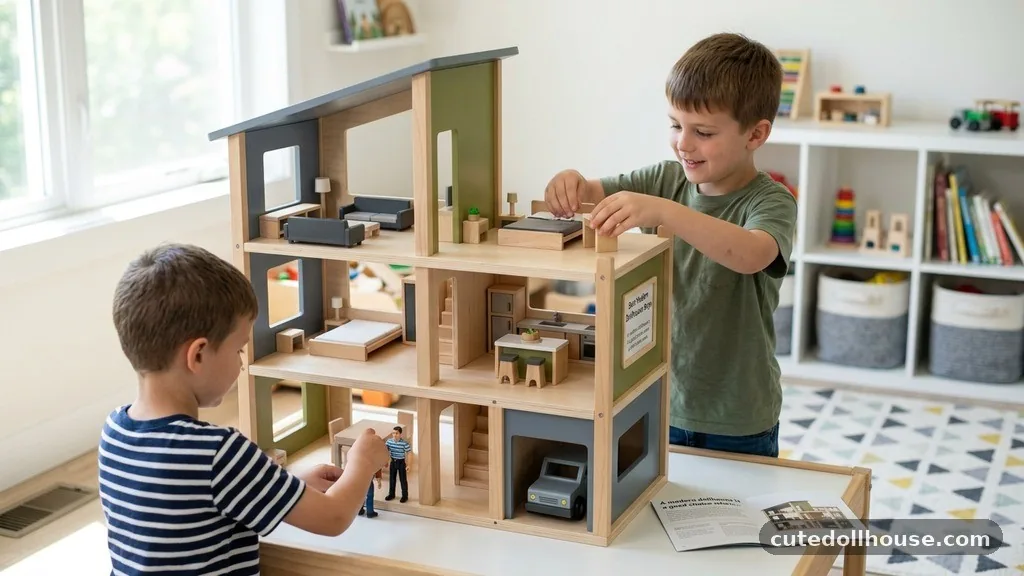
- The child enjoys imaginative, role-play, or room-arranging activities.
- There is a stable surface or dedicated area for the house.
- The house can accommodate the child’s existing figures and accessories.
- The buyer is comfortable checking age guidance and small-part warnings.
- The design offers enough open access for the child to reach the rooms.
Another toy may be better when:
- The child prefers construction, vehicles, puzzles, or active outdoor play.
- Storage space is limited.
- The product’s scale is incompatible with the figures the child already owns.
- The child is too young for loose miniature accessories.
- The house is mainly being purchased as room décor rather than for regular play.
Important Buying Criteria
Build and material quality
Wooden dollhouses are often chosen for their solid appearance and resistance to bending, but “wooden” can describe several different constructions. A product may use solid wood, plywood, engineered wood, or wood-based panels. These materials can perform differently depending on thickness, joints, paint, and hardware.
Plastic houses may be lighter and easier to clean. They can also be practical for younger children or playrooms where spills are likely. Their quality varies too, so inspect the thickness of the plastic, the stability of the base, and whether doors or stair sections feel securely attached.
For any material, check for:
- Rounded or smoothly finished edges.
- Stable walls and floors that don’t flex excessively.
- Securely fitted windows, doors, rails, and decorative parts.
- Paint or surface finishes appropriate for children’s toys.
- Clear information about materials and safety testing.
Product descriptions may use broad terms such as “premium wood” or “sturdy construction.” Treat those phrases as manufacturer claims unless the listing provides useful construction details or consistent customer feedback supports them.
Design and appearance
Modern dollhouses commonly use white, grey, beige, black, or natural wood tones instead of highly themed colour schemes. This makes them easier to fit into a bedroom or family room, but appearance should not outweigh playability.
Look beyond the photographs. A narrow balcony may look attractive but add little play value.
Small windows can make rooms difficult to reach. A roof that opens, a removable wall, or a wide front opening may be more useful than elaborate exterior decoration.
Neutral styling can be an advantage for children who want to create their own setting. It leaves room for a farm, city apartment, family home, clubhouse, or fantasy base without forcing one story onto the toy.
Size and fit
Dimensions need careful attention because dollhouses can appear smaller in product photographs. Check the assembled height, width, depth, and floor-to-floor clearance. Also measure the space where the house will be used, including room for children to sit or stand in front of it.
Scale is just as important as external size. A large house may not work with small figures, while a compact house may not fit larger dolls or action figures. If the manufacturer provides internal measurements, compare them with the figures and furniture already in the child’s collection.
Before buying, verify:
- Overall assembled dimensions rather than package dimensions.
- Room height and doorway width.
- Available floor area in each room.
- Whether the structure can be moved through doorways after assembly.
- Storage space for furniture, figures, and accessories.
Features and functionality
Useful features are those that make play easier or expand the possible stories. Open access, movable furniture, removable roofs, wide rooms, and multiple entry points can have more practical value than decorative details.
Some dollhouses include kitchens, beds, tables, bathrooms, lighting, elevators, or outdoor areas. These additions may increase play value, but they can also add small parts, batteries, assembly steps, and replacement concerns.
A feature deserves extra scrutiny if it is central to the product’s appeal. For example, if a house includes lights, confirm whether batteries are supplied, whether the lights are controlled easily, and whether replacement parts are available. Details like these can vary by seller or production batch.
Ease of assembly
Many modern dollhouses arrive flat-packed. Assembly time and difficulty are not always obvious from a short product listing. A house with several floors, railings, decorative panels, and accessory pieces may require more patience than a simpler open-frame design.
Read the assembly information if it is available. Look for details about the recommended tools, number of components, instructions, and whether two adults are advised. Customer feedback can help identify unclear instructions or holes that do not align, but individual assembly experiences can differ.
After assembly, check every connection before giving the house to a child. The structure should sit level, and stairs, balconies, rails, and furniture should not detach under ordinary handling.
Durability and maintenance
A dollhouse used every day needs to withstand moving furniture, placing figures, leaning, and occasional knocks. Heavier construction may improve stability, but it can make the house harder to relocate. Lighter models are easier to store but may need to be placed against a wall or on a non-slip surface.
Maintenance is usually straightforward. Dust can collect on ledges and miniature furniture, while fabric accessories may need more careful cleaning. Wooden finishes should be kept away from excessive moisture unless the manufacturer specifically states otherwise.
Replacement parts matter too. Ask whether missing furniture, damaged panels, or lost screws can be replaced. If no information is available, keep the receipt and packaging until the product has been assembled and checked.
Included accessories
Some listings show a fully furnished room but include only the house. Others provide furniture, figures, rugs, plants, lamps, or kitchen accessories. The photographs may not always make the difference clear.
Read the included-items list carefully. A lower-priced house may need a separate accessory set, while a more complete package may offer better value even if its initial cost is higher. Don’t assume that every object shown in promotional images is included.
Safety and age suitability
Small furniture and miniature accessories create a choking risk for young children. Age recommendations should be treated as an important safety instruction, not just a marketing label. Buyers should also consider whether the child still puts small objects in their mouth or is likely to pull on balconies and loose fittings.
For general toy-safety information, consult the U.S. Consumer Product Safety Commission’s toy safety guidance. Local safety rules may differ by country, so buyers outside the United States should also check the relevant national guidance.
Modern Dollhouse Styles to Consider
Open-frame contemporary houses
These models usually have broad front access and visible rooms. They suit children who like rearranging furniture or playing with several characters at once. The main trade-off is that an open structure may collect dust and offer less protection for accessories during storage.
Compact townhouse designs
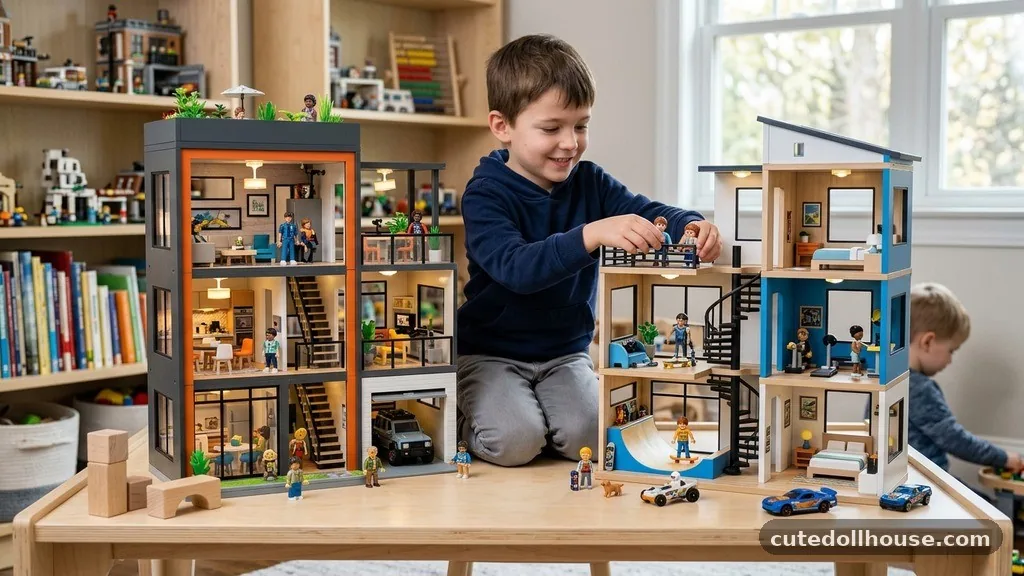
Townhouse-style houses use vertical space rather than a wide footprint. They can work well in smaller rooms, although upper floors may be difficult for shorter children to reach. Check whether the top level is genuinely playable or mostly decorative.
Large wooden playhouses
Wooden models can provide a substantial centrepiece for imaginative play. They may feel more furniture-like and remain stable on the floor, but assembly, weight, and maintenance deserve close attention. “Wooden” alone doesn’t confirm how durable the construction will be.
Neutral or minimalist houses
Minimalist designs appeal to families who want a toy that blends with modern interiors. Their simple appearance can encourage children to create their own themes. However, a sparse house may need separate accessories to become engaging, particularly if the child prefers highly detailed playsets.
Multi-purpose play structures
Some contemporary designs can be used as homes, shops, studios, garages, or imaginative bases. Flexible layouts are valuable for children whose interests change quickly. Confirm that the rooms are large enough for the figures and accessories intended for use.
Comparison of Key Dollhouse Types
| Type | Best For | Typical Strength | Possible Drawback | What to Verify |
|---|---|---|---|---|
| Open-frame contemporary house | Shared play and easy room access | Good visibility and reach | Less enclosed storage | Stability and floor spacing |
| Compact townhouse | Smaller rooms | Uses vertical space | Upper floors may be harder to reach | Height and access to top levels |
| Large wooden house | Long-term imaginative play | Substantial feel and visual presence | Heavier and often more demanding to assemble | Panel construction and finish |
| Minimalist design | Neutral décor and flexible storytelling | Adaptable appearance | May include fewer accessories | What comes in the box |
| Multi-purpose play structure | Children with changing interests | Supports several play themes | May not suit one specific figure scale | Room dimensions and compatibility |
How to Read Customer Feedback
Reviews are useful for identifying patterns, but they shouldn’t be treated as a substitute for product specifications. One buyer’s “small” may be another buyer’s space-saving solution, and assembly difficulty can depend on tools, experience, and the condition of the package.
Look for repeated comments about the same issue. Several reports of missing hardware, weak railings, difficult instructions, or chipped panels deserve attention. Isolated complaints may still matter, especially if they involve safety or a structural component, but they may not describe every unit.
Useful review signals
- Repeated comments about the same missing or fragile part.
- Photos showing the assembled scale in a real room.
- Clear descriptions of assembly time and instruction quality.
- Feedback about compatibility with common figures or furniture.
- Reports about how the house held up after regular play.
Feedback that needs caution
- Reviews discussing a different size, colour, or seller.
- Comments that judge size without listing measurements.
- Claims based only on promotional photographs.
- Complaints about accessories that were never advertised as included.
- Older reviews for a product that may have changed production batches.
Recommendations by Buyer Type
For beginners
Choose a house with wide access, clear dimensions, straightforward assembly, and a manageable number of parts. A simpler structure is often easier to enjoy than a highly detailed model that becomes frustrating to build.
For children who like open-ended play
Prioritise neutral styling, movable furniture, and rooms that can serve several purposes. A flexible house can become a home one day and a shop, animal clinic, or clubhouse the next.
For appearance-focused buyers
Modern colours and clean lines can make a dollhouse easier to place in a shared room. Still, confirm that the design remains practical. Attractive balconies, narrow staircases, and tiny decorative elements should not take away from usable play space.
For value-focused buyers
Compare the complete package rather than the house alone. Include the cost of furniture, figures, storage, and possible replacement parts. A basic house with no accessories may be reasonable if the child already owns compatible toys; otherwise, a more complete set may offer better overall value.
For buyers choosing a long-term playset
Look for sturdy joints, replaceable or standard-size accessories, a finish that can be cleaned safely, and a layout that won’t be outgrown quickly. Avoid choosing solely on current appearance if the child’s play preferences are likely to change.
Common Reasons to Consider an Alternative
A modern dollhouse may not be the right fit if the child has no interest in miniature role-play. Construction sets, modular building systems, vehicle garages, puppet theatres, or open-ended storage crates may provide a better match for children who prefer making, movement, or larger-scale play.
Very young children may also benefit from a larger, simpler pretend-play setup with fewer detachable pieces. Families with limited space might prefer a foldable or compact house, provided the reduced dimensions still allow comfortable access.
Adults buying primarily for décor should distinguish between a display model and a toy designed for active use. A visually refined house may have fragile details or limited room access. If children will play with it regularly, practical construction should lead the decision.
Questions to Ask Before Buying
- What are the exact assembled dimensions?
- Will the child’s existing figures fit the rooms and doors?
- Which furniture and accessories are included?
- Is assembly required, and what tools are needed?
- Does the product contain small parts unsuitable for the intended child?
- Can damaged or missing components be replaced?
- Will the house have a stable, accessible place to stay assembled?
- Are the product photographs showing the actual included configuration?
FAQ About the Best Modern Dollhouses for Boys
Are dollhouses suitable for boys?
Yes. Dollhouses are imaginative-play environments, not toys limited to one gender. Boys may use them for family stories, vehicle scenes, animal play, building projects, fantasy settings, or any other scenario they invent.
What is the equivalent of a dollhouse for boys?
There is no single equivalent. A modern dollhouse, garage, workshop, clubhouse, animal shelter, or modular play structure can serve the same purpose: providing a setting for storytelling and pretend play.
Are wooden dollhouses better than plastic ones?
Not automatically. Wooden houses may feel more substantial, while plastic models can be lighter and easier to clean. Construction quality, stability, finish, size, and intended use matter more than the material label alone.
What age is suitable for a modern dollhouse?
Suitability depends on the specific model and its small parts. Always follow the manufacturer’s age guidance and consider the child’s ability to play safely with miniature furniture, figures, batteries, and detachable accessories.
What should I do if a dollhouse listing does not state what is included?
Contact the seller before buying or choose a listing with a clear contents description. Don’t assume that furniture, figures, lighting, or accessories shown in photographs are included.
How can I tell whether a dollhouse will fit existing toys?
Compare the internal room dimensions, doorways, and furniture scale with the child’s figures. If the manufacturer does not provide measurements, treat compatibility as uncertain rather than assuming standard sizing.
Final Verdict
The best modern dollhouses for boys are the ones that fit the child’s interests, available space, existing figures, and ability to handle small accessories safely. Neutral styling can make a house more flexible, but durability, access, scale, assembly, and included contents are more important than appearance alone. Buyers should compare the complete play package and read repeated customer feedback carefully rather than relying on polished photographs.
Modern dollhouses are worth buying for children who enjoy imaginative scenes and rearranging miniature spaces. Before ordering, verify the dimensions, materials, age guidance, accessories, and return options. Those checks make it much easier to choose a practical playset instead of a house that looks appealing but rarely gets used.