Choosing the best Wooden Dollhouses for Boys is less about finding a toy with a particular colour or theme and more about matching the house to a child’s age, interests, space, and play style. A well-designed wooden dollhouse can support imaginative storytelling, role-play, arranging, and open-ended play without dictating what the child should do with it.
The challenge is that dollhouses vary widely in size, assembly requirements, materials, furniture, and age suitability. This guide explains what to look for, which features matter most, when a wooden dollhouse is worth buying, and when another type of toy may be a better fit.
What Makes a Wooden Dollhouse Suitable for Boys?
A wooden dollhouse is a small-scale play environment with rooms, levels, openings, or furniture that children can use for pretend play. It may represent a family home, apartment, farmhouse, modern building, garage, shop, or another setting. Some are supplied with furniture and figures, while others are sold as a basic structure that children furnish themselves.
There isn’t a separate technical category called a “boy’s dollhouse.” Children may prefer houses with vehicles, workshops, animals, outdoor spaces, bold colours, or open rooms, but preferences vary from one child to another. The most suitable choice is the one that reflects the individual child’s interests rather than relying on traditional gender labels.
Wooden models are often chosen because they can feel substantial and visually appealing. Their weight can also make them less likely to move during play, although that same weight may make them harder to relocate or store. Construction quality varies, so buyers should inspect the material description, joinery, finish, dimensions, and safety information before ordering.
Are Wooden Dollhouses Worth Buying?
A wooden dollhouse can be a worthwhile purchase for a child who enjoys pretend play, arranging small objects, building stories, or returning to the same toy over time. It may also work well in a shared playroom because the structure creates a defined setting for independent or cooperative play.
The purchase is less convincing if the child prefers active outdoor play, large construction toys, electronic games, or toys that require little setup. A large dollhouse can take up significant floor or shelf space, and some models require adult assembly before they can be used.
Value depends on more than the initial purchase price. Consider how long the child is likely to use it, whether compatible furniture or figures are easy to find, how much room it occupies, and whether it can adapt as interests change.
A wooden dollhouse may be a good choice if:
- The child enjoys imaginative, social, or role-playing activities.
- There is a stable place to display and use the house.
- The design includes enough open space for the child’s preferred figures and accessories.
- An adult can safely complete any required assembly.
- The construction and finish appear suitable for regular play.
An alternative may be better if:
- The child is too young for small furniture, figures, or detachable parts.
- Storage space is limited.
- The child prefers portable toys that can be packed away quickly.
- The dollhouse uses a scale that does not match accessories already owned.
- The child has shown little interest in pretend-play toys.
Important Buying Criteria
Build and material quality
“Wooden” can describe anything from a carefully finished solid-wood structure to a panel-based product made with engineered wood. Neither description alone proves that a model is well made. Look for clear information about the material, edge treatment, surface finish, and hardware.
Panels should appear straight and securely joined. Openings should have smooth edges, and doors or moving parts should not appear flimsy. If the seller does not provide useful construction details, treat that as a reason to investigate further rather than assuming the product is durable.
Design and appearance
Appearance matters because a dollhouse often stays visible in a bedroom or playroom. However, visual style should support play rather than reduce it. A house with open rooms, accessible floors, and flexible spaces may offer more long-term use than a highly themed design that only suits one type of story.
For children who enjoy vehicles, building, animals, or adventure themes, consider designs that leave room for garages, workshops, barns, ramps, outdoor areas, or larger figures. These features may be more relevant than pastel colours or traditional miniature furniture.
Size and fit
Check the assembled dimensions, not just the package size. A tall house may be impressive but difficult for a young child to reach.
A wide model may offer better access but require more floor space. Measure the intended location and leave enough room for the child to sit, stand, and move figures around the structure.
Also check the scale. Dollhouse furniture and figures are not universally interchangeable. A child may become frustrated if existing accessories do not fit through doors, stand properly in rooms, or match the height of the furniture.
Features and functionality
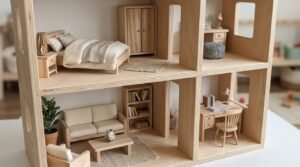
Useful features include accessible room openings, stable floors, movable shutters, removable roofs, balconies, garages, and spaces that can be rearranged. More features are not automatically better. A complicated design can create extra assembly points and more parts that may loosen or break.
Think about how the child plays. A child who likes arranging interiors may benefit from large rooms and furniture. Someone who creates action-based stories may prefer open spaces, wide entrances, and room for vehicles or animal figures.
Ease of assembly
Many wooden dollhouses arrive flat-packed. Assembly time and difficulty can vary according to the number of panels, fasteners, doors, roof sections, and decorative parts. Buyers should read the instructions and product reviews carefully, especially if the house is intended as a gift.
Before purchasing, verify:
- Whether adult assembly is required.
- Which tools are needed.
- Whether all hardware is included.
- Whether the structure must be secured to a wall or another surface.
- Whether the assembled dimensions match the available space.
Do not allow a child to play with a partly assembled structure or loose hardware. Assembly should take place away from children, with the finished house checked for stability before use.
Durability and maintenance
A wooden dollhouse should withstand ordinary handling, but no miniature structure is indestructible. Repeated moving, climbing, dropping accessories onto surfaces, or forcing doors can cause damage. A heavier model may remain steadier during play, but it may also be more difficult to relocate.
Maintenance is usually simple: dust with a soft, dry cloth and follow the manufacturer’s cleaning instructions. Avoid soaking unfinished or poorly sealed surfaces. If paint begins to chip, stop using the affected component until it has been assessed and repaired or replaced appropriately.
Included accessories
Furniture and figures can make a dollhouse ready to play with immediately, but included accessories should not be judged by quantity alone. Look at the usefulness, scale, finish, and durability of the pieces. A smaller set of well-matched furniture may be more valuable than a large collection of tiny items that are easy to lose.
Check whether accessories are included at all. Product photographs may show decorated rooms or figures that are optional, sold separately, or used only for illustration. The written contents list is more reliable than the images.
Safety and age suitability
Age guidance should be treated as a minimum-use recommendation, not a complete safety assessment. Consider the child’s ability to handle small parts, understand safe play, and use the structure without climbing on it.
For general information about toy hazards and recalls, consult the U.S. Consumer Product Safety Commission’s toy safety guidance. Buyers outside the United States should also check the safety rules and recall information applicable in their own region.
Look for clear information about small parts, coatings, sharp edges, stability, and recommended age. If safety details are missing or contradictory, contact the seller or choose a product with more transparent documentation.
Comparison: Which Type of Wooden Dollhouse Fits Best?
| Type of Dollhouse | Best For | Difficulty | Useful Feature | Main Drawback | Overall Value Consideration |
|---|---|---|---|---|---|
| Compact open-front house | Smaller rooms and younger children who need easy access | Often simpler, but seller details vary | Accessible rooms and straightforward play | Limited space for larger figures or furniture | Good when storage and reach are priorities |
| Tall multi-level house | Children who enjoy arranging several rooms | May require more assembly | Multiple play zones and display space | Upper floors may be difficult to reach | Useful if the child will play with it regularly |
| Garage, workshop, or vehicle-themed house | Children interested in vehicles, tools, or building play | Depends on structure and accessories | Spaces that support broader storylines | Theme may feel restrictive over time | Strong choice when the theme matches existing interests |
| Basic unfurnished wooden house | Families who already own compatible accessories | May be simple to assemble | Flexible decorating and furnishing | May not be ready for immediate play | Can be economical if accessories are already available |
| Large display-style house | Older children or shared play spaces with room to spare | Often more demanding to assemble and move | More room for detailed scenes | Higher space, storage, and handling demands | Worth considering only when the size is practical |
How to Read Customer Feedback Carefully
Customer reviews can reveal issues that product descriptions leave out, particularly around assembly, missing parts, damaged panels, scale, and stability. They should still be read with context. A complaint about size may reflect an unrealistic expectation, while a complaint about a missing part may concern a single shipment rather than every unit.
Look for patterns rather than isolated comments. Repeated reports of unclear instructions, weak fasteners, poor finish, or inaccurate dimensions deserve attention. Also separate comments about the product itself from complaints about delivery or packaging.
Questions worth asking while reading reviews include:
- Do several buyers mention the same assembly problem?
- Are the listed dimensions consistent with photographs and customer images?
- Do users say that the furniture fits the rooms?
- Are doors, shutters, or other moving pieces described as secure?
- Do complaints concern normal wear or an apparent manufacturing fault?
- Does the seller explain how missing or damaged parts are handled?
Product information can change by seller, production batch, region, or model revision. Verify the current contents, dimensions, age guidance, and return terms before placing an order.
Recommendations by Buyer Type
For beginners
Choose a compact, open-front design with clear instructions and fewer complicated moving parts. A basic house can be a sensible starting point because it leaves room to add furniture gradually rather than requiring a large accessory collection immediately.
For children who enjoy vehicles or building
Prioritise open floor space, wide access points, garages, workshops, ramps, or outdoor areas where available. A traditional room-by-room layout may not be as engaging if the child’s stories centre on transport, construction, rescue play, or exploration.
For appearance-focused buyers
Check the finish, colour consistency, visible hardware, and how the house will look in its intended location. Remember that a highly decorative model can still be impractical if rooms are hard to reach or the house does not match the child’s accessories.
For value-focused buyers
Compare the complete setup, not just the house. A cheaper unfurnished structure may cost more overall if compatible furniture and figures must be purchased separately. Conversely, an included accessory set may have less value if the pieces are too small, fragile, or poorly matched.
For buyers wanting long-term flexibility
Select neutral rooms and a scale that supports widely available accessories. Flexible designs are less likely to become obsolete when a child’s interests change. Removable furniture and open spaces can help the house serve different stories over time.
Common Mistakes to Avoid
Choosing by colour alone
Colour may influence a child’s first reaction, but access, stability, scale, and room layout affect everyday play much more. A visually striking house can become frustrating if children cannot comfortably reach the upper levels.
Ignoring the assembled footprint
Large dollhouses need more than a display surface. Children need space to sit or stand nearby, and adults need enough access to clean, move, or inspect the structure. Measure before ordering.
Assuming every accessory will fit
Miniature furniture comes in different scales. Check measurements whenever possible, especially if the child already owns figures, vehicles, animals, or furniture from another brand.
Overlooking the return policy
Wooden panels can occasionally arrive damaged, and some buyers may find the finished size different from what they expected. A clear return or replacement policy provides useful protection, particularly for larger products.
Buying more complexity than the child needs
Extra balconies, hinged doors, decorative panels, and small accessories may add visual appeal but also increase assembly and maintenance demands. Match the design to the child’s play habits rather than choosing the most elaborate option available.
Frequently Asked Questions
Is there a boy version of a dollhouse?
There is no separate standard category that makes a dollhouse specifically for boys. Designs with garages, workshops, vehicles, animals, outdoor spaces, or neutral colours may appeal to some children, but interests are individual. Choose by play style and age rather than gender labels.
What are good wooden dollhouses for children?
Good options generally combine stable construction, smooth accessible surfaces, practical room layouts, suitable scale, clear age guidance, and manageable assembly. The right choice depends on the child’s age, available space, preferred figures, and interest in pretend play.
What age is suitable for a wooden dollhouse?
Suitability depends on the specific model and its small parts. Always follow the manufacturer’s age guidance and consider the child’s developmental abilities. A toddler may need a simple, sturdy structure with larger accessories, while older children may enjoy detailed rooms and smaller furniture.
Are wooden dollhouses difficult to assemble?
Some are straightforward, while larger multi-level models can involve numerous panels, fasteners, and decorative pieces. Check the instructions, tool requirements, assembly reviews, and completed dimensions before buying. Adult assembly is commonly required for flat-packed products.
Do wooden dollhouses come with furniture?
Some include furniture, figures, or themed accessories, while others contain only the main structure. Never rely solely on product photographs. Check the written contents list and confirm whether pictured accessories are included or sold separately.
How can buyers make sure accessories will fit?
Compare the dimensions of the rooms, doors, furniture, and figures. Products from different manufacturers may use different scales, so existing accessories may not fit even when they look similar in photographs.
Final Verdict
The best Wooden Dollhouses for Boys are not defined by a particular colour or theme. They are the models that suit a child’s interests, offer safe and accessible play, fit the available space, and provide enough flexibility to remain useful as those interests develop. A wooden dollhouse is worth buying for children who enjoy imaginative play and for families prepared to manage assembly, storage, and occasional maintenance.
Before ordering, verify the current dimensions, materials, included accessories, age guidance, and return policy. If the child prefers vehicles, construction, animals, or adventure stories, choose a layout that supports those activities rather than a purely decorative house. With those checks in place, a well-matched wooden dollhouse can become a durable setting for creative play.