
Choosing among the best wooden dollhouses for imaginative play is less about finding the most elaborate model and more about matching the house to a child’s age, space, interests, and ability to use it safely. A well-designed dollhouse can support open-ended storytelling, role-play, language development, and shared play without requiring batteries or screens. The difficulty is that listings often differ in scale, materials, assembly requirements, accessories, and safety information.
Some are compact and simple; others are large projects intended for older children. This guide explains what to check before buying, which features matter most, where wooden dollhouses can disappoint, and when another type of playset may be a better fit.
What Is a Wooden Dollhouse?
A wooden dollhouse is a miniature home designed for pretend play. Children can arrange furniture, move figures through rooms, create family stories, and use the structure as a setting for imaginative games. Depending on the model, it may include rooms, doors, windows, stairs, furniture, figures, or decorative details.
Some dollhouses arrive largely assembled, while others require ad
ult construction. The term “wooden” can also describe several different products, from houses made mostly from solid wood to models that combine wood-based panels with plastic accessories, fabric pieces, or printed surfaces. Buyers should read the materials list rather than assuming every component is wooden.
Scale matters, too. A dollhouse designed for small figures may not fit furniture or dolls from another brand. If a child already owns miniature people or accessories, check the stated dimensio
ns and doorway heights before purchasing.
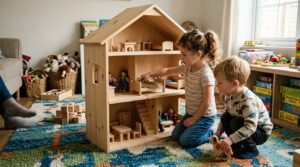
Are Wooden Dollhouses Worth Buying?
Wooden dollhouses can be a worthwhile purchase for children who enjoy open-ended pretend play and have enough room to access the house comfortably. Unlike many single-purpose toys, a dollhouse can change as a child’s stories change. One day it may be a family home; the next, it can become a shop, school, hotel, or animal
clinic.
The value depends heavily on construction and usability. A beautiful house that is difficult to reach, awkward to assemble, or too delicate for regular play may be less useful than a simpler model with accessible rooms and sturdy components.
When a Wooden Dollhouse Makes Sense
- The child enjoys role-play, storytelling, arranging objects
, or small-world play. - There is a stable location where the house can remain set up.
- The child can safely handle the included figures and accessories.
- The family wants a screen-free toy that can support independent or shared play.
- Adults are comfortable checking assembly requirements and supervising younger children.
When Another Toy May Be Better
A wooden dollhouse may not be the best choice for a child who prefers active, large-scale play or quickly loses interest in miniature activities. It can also be inconvenient in a small room, especially if the house has a deep footprint and needs open access from the front or back.
For toddlers, a large-scale pretend-play home with oversized pieces may be safer and easier to handle than a traditional dollhouse containing small accessories. For families that move frequently or have limited storage, a foldable playset, fabric house, or compact wooden structure may be more practical.
What to Check Before Buying
Build and Material Quality
Look for clear information about the main structural materials, panel thickness, finish, and hardware. A wooden dollhouse does not need to be made entirely from solid timber to be useful, but the description should make it clear which parts are wood, engineered board, plastic, or another material.
Pay attention to exposed edges, painted surfaces, joints, and the way larger panels are supported. Photos can help, but they do not always show how firmly the floors, roof, or walls connect. If product details are vague, verify the construction information with the seller before ordering.
Design and Appearance
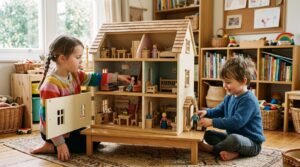
Appearance matters because a dollhouse often stays visible in a bedroom, playroom, or family living space. Open-front designs make rooms easier to reach and display. Houses with a back panel can feel more enclosed but may provide fewer angles for play.
Decorative features should support play rather than interfere with it. Fixed room dividers, narrow windows, or deep interior spaces may look attractive but make it harder for children to place furniture and figures. A less ornate layout can sometimes offer more creative freedom.
Size and Fit
Measure both the available floor area and the height of the location where the dollhouse will stand. Leave enough room for a child to sit, reach into the rooms, and move around the structure without knocking it over.
Check these dimensions before buying:
- Overall height, width, and depth
- Interior room height
- Door and window dimensions
- Available floor space for furniture
- Clearance needed for opening panels or moving the house
- Compatibility with existing dolls, figures, and accessories
Features and Functionality
Common features include multiple levels, removable roofs, opening doors, balconies, elevators, staircases, movable furniture, and themed rooms. None is automatically essential. The right choice depends on whether the feature improves access and play or simply adds complexity.
For younger children, large rooms and fewer delicate parts may be more useful than a highly detailed interior. Older children may appreciate adjustable furniture, a larger number of rooms, and a design that allows them to create their own layouts.
Ease of Assembly
Assembly is one of the biggest practical differences between dollhouses. A model with many panels, small fasteners, or unclear instructions can take considerably more adult time than a simpler house. Sellers may not always describe assembly difficulty consistently, so read the manual if it is available.
Before purchasing, check whether the listing specifies:
- Whether adult assembly is required
- Which tools are needed
- Whether screws, fasteners, or adhesives are included
- How many parts need to be attached
- Whether furniture and accessories arrive assembled
- Whether replacement parts are available
Safety and Age Suitability
Always follow the manufacturer’s stated age guidance, warnings, and assembly instructions. A dollhouse may be suitable for imaginative play while its small furniture, miniature figures, or loose accessories are not suitable for very young children.
Inspect the finished structure for sharp edges, loose hardware, unstable sections, and peeling finish. Place taller models on a stable surface and consider whether the product needs to be secured to prevent tipping. Safety details can vary by model, seller, and region, so do not rely only on a general product category description.
Durability and Maintenance
Wooden play furniture usually benefits from gentle handling and dry or slightly damp cleaning, but the correct method depends on the finish. Keep liquids away from unfinished or poorly sealed surfaces, and avoid harsh cleaners unless the manufacturer specifically recommends them.
Durability is influenced by more than the material. A well-designed house with reinforced joints and replaceable parts may last longer than a thicker-looking model with weak connections. Customer feedback can be useful here, particularly comments about loose floors, chipped paint, missing hardware, or difficult repairs.
Comparison by Buyer Need
Because no specific product models or verified specifications were supplied for this article, the table below compares the main dollhouse design approaches rather than ranking individual products. Treat it as a starting point and confirm the details on the current product listing.
| Type of Dollhouse | Best For | Difficulty | Key Feature | Main Drawback | Overall Value Consideration |
|---|---|---|---|---|---|
| Compact wooden house | Small rooms and occasional play | Often simpler, but model dependent | Smaller footprint | Limited room and furniture space | Useful when storage is more important than scale |
| Large multi-level house | Shared play and older children | May require more assembly | Several rooms and play areas | Needs significant floor space | Can offer more play possibilities if used regularly |
| Open-front dollhouse | Accessible everyday play | Varies by construction | Easy reach into rooms | May have less enclosed detail | Practical for children who rearrange furniture often |
| Highly detailed model | Appearance-focused buyers and older children | May be more involved | Decorative finishes and accessories | Small or delicate components may limit rough play | Worth considering only if the detail will be used |
| Expandable or customizable house | Longer-term play and changing interests | Depends on the base and add-ons | Room for future additions | Compatible accessories may cost extra | Potentially flexible, but check total ownership cost |
How to Assess Customer Feedback
Reviews are most useful when they describe a specific problem or benefit rather than simply saying a product is “great” or “bad.” Look for repeated comments across multiple listings or retailers, especially when the same issue concerns assembly, stability, dimensions, or missing parts.
Some complaints may reflect a mismatch between expectations and the product rather than a manufacturing defect. For example, a compact house may be criticized for being small even though its listed measurements were accurate. A model that requires adult assembly may also receive negative feedback from buyers who expected it to arrive ready to play.
Useful review details include:
- Whether the finished house feels stable on its intended surface
- How clearly the instructions explain the assembly process
- Whether the rooms can be reached by the intended age group
- How well furniture fits inside the rooms
- Whether paint, decals, or decorative finishes remain intact
- How the seller handles missing or damaged components
Availability, accessories, packaging, and customer support may change by seller, country, and production batch. Verify current details before committing to a purchase.
Recommendations by Buyer Type
For Beginners and Younger Players
Prioritize a stable, accessible layout with larger rooms and uncomplicated furniture. Avoid choosing solely by the number of accessories. A child is more likely to use a house regularly if the main structure is easy to reach and the pieces are manageable.
For Older Children and Experienced Dollhouse Players
Older children may benefit from more rooms, greater interior space, and compatibility with existing miniature furniture or figures. A customizable design can also support longer-term play, particularly if the child enjoys decorating and rearranging.
For Small Homes
Measure first. A narrow or compact wooden dollhouse can be a better choice than a large multi-level model that must be packed away after every play session. Consider whether the house can be stored upright without becoming unstable.
For Appearance-Focused Buyers
Check the finish, color accuracy, decorative panels, and visible hardware in customer photographs. Product images may be professionally styled, so real-world photos can provide a better indication of scale and surface appearance.
For Value-Focused Buyers
Compare the complete package rather than the headline price. A less expensive house may require separate furniture, figures, tools, or replacement parts. Conversely, a simpler model may offer better value if it includes the pieces a child will actually use.
For Premium Buyers
Look for transparent construction details, thoughtful access to rooms, dependable hardware, and a finish that can be maintained. Extra decoration is less important than a design that remains functional after years of rearranging and play.
Common Reasons a Dollhouse Disappoints
Many problems can be avoided by checking the listing carefully. A dollhouse may look substantial in photographs but be too small for the furniture a buyer already owns. Another may include attractive accessories that are fragile, difficult to store, or unsuitable for the intended child.
- The overall dimensions were not checked before purchase.
- The house is difficult for children to reach inside.
- Assembly takes more time or uses more tools than expected.
- Included furniture does not match the advertised scale.
- The structure is too delicate for the child’s play style.
- Small parts create a safety concern for younger siblings.
- The available space cannot accommodate the house comfortably.
- Replacement parts or customer support are unclear.
Frequently Asked Questions
What is the best-rated wooden dollhouse?
There is no single best-rated option for every child. Ratings can vary by retailer, region, product batch, and the expectations of individual buyers. A better choice is the model that matches the child’s age, available space, preferred play style, and existing accessories.
How do I choose the right wooden dollhouse?
Start with dimensions, age guidance, material information, room access, and assembly requirements. Then check whether the house fits the child’s figures and whether it can remain safely and comfortably set up in your home.
What are good wooden dollhouses for kids?
Good options generally have a stable structure, smooth accessible interiors, clear instructions, and age-appropriate accessories. The ideal level of detail depends on the child. Younger children often benefit from simplicity, while older children may enjoy more rooms and customization.
Is a wooden dollhouse suitable for a three-year-old?
It can be, but suitability depends on the specific model and its accessories. Check the manufacturer’s age recommendation and inspect whether the set includes small parts. Choose a sturdy, accessible design and supervise play when necessary.
Are dollhouses suitable for toddlers?
Traditional dollhouses may contain small furniture, figures, or detachable decorations that are not appropriate for toddlers. A larger-scale pretend-play house with oversized components may be a safer alternative, provided it is designed for that age group.
At what age do children stop playing with dollhouses?
There is no fixed age. Some children move on to other interests during primary school, while others continue using dollhouses for storytelling, collecting, decorating, or creative writing. A flexible design can remain useful longer than a narrowly themed set.
Final Verdict
Wooden dollhouses are worth considering for children who enjoy imaginative, hands-on play and for families with enough space to keep a miniature home accessible. The best wooden dollhouses for imaginative play are not necessarily the largest or most decorated; they are the ones with a suitable scale, stable construction, clear safety information, and rooms children can actually use.
Before buying, measure the space, confirm the materials and age guidance, examine assembly requirements, and check whether accessories match the intended play style. If the house seems too delicate, too small, or too difficult to store, a simpler or larger-scale alternative may offer better value. Compare current specifications and seller support carefully, then choose the design your child is most likely to return to.