
For collectors, the best premium wooden dollhouses are more than miniature play spaces. They can be carefully finished display pieces, long-term hobby projects, or foundations for detailed interiors and custom scenes. The challenge is that “premium” isn’t a fixed technical standard: one model may prioritise architectural detail, another may offer better access for decorating, while a third may be easier to assemble and maintain.
Size, scale, materials, lighting, room layout, and the quality of the instructions all affect the buying decision. This guide explains what to inspect before purchasing, which compromises matter most, and when a high-end wooden dollhouse is a sensible investment rather than an expensive display box.
What Makes a Wooden Dollhouse Premium?
A premium wooden dollhouse is generally a miniature house made from cut wood panels or engineered wood components, designed for display, collecting, furnishing, and sometimes customisation. Unlike a simple children’s toy, it may be built around a particular architectural style, scale, room arrangement, or level of realism.
The word premium usually refers to a combination of factors rather than one specification. Better models may have cleaner panel cutting, more convincing exterior details, stronger joints, improved windows and doors, better interior access, or more thoughtful provisions for lighting and decoration. However, these features vary considerably by manufacturer and seller.
Collectors should also separate the house itself from the accessories shown in promotional photographs. Furniture, wallpaper, figures, lighting systems, landscaping, and decorative items may be sold separately. Always check the contents list, finished dimensions, scale, assembly requirements, and whether the pictured interior is included.
Are Premium Wooden Dollhouses Worth Buying?
For the right buyer, a well-made wooden dollhouse can justify its higher cost because it offers a durable base for a collection and leaves room for personalisation. A serious collector may value the structure, proportions, material feel, and display presence more than a ready-to-play set that includes many inexpensive accessories.
It isn’t automatically the best choice for everyone. A large kit can require considerable assembly, painting, wiring, sanding, and problem-solving.
Someone who wants an immediately finished scene may be happier with a preassembled display model or a smaller furnished kit. Likewise, collectors with limited space should measure carefully before choosing a multi-storey house.
A premium kit is most likely to be worthwhile when you enjoy the building process, intend to keep the house for years, and have a clear plan for its scale and location. It may be poor value if you don’t want to assemble it, cannot source compatible furnishings, or are paying for decorative features that don’t suit your collection.
What to Check Before Buying
Build and Material Quality
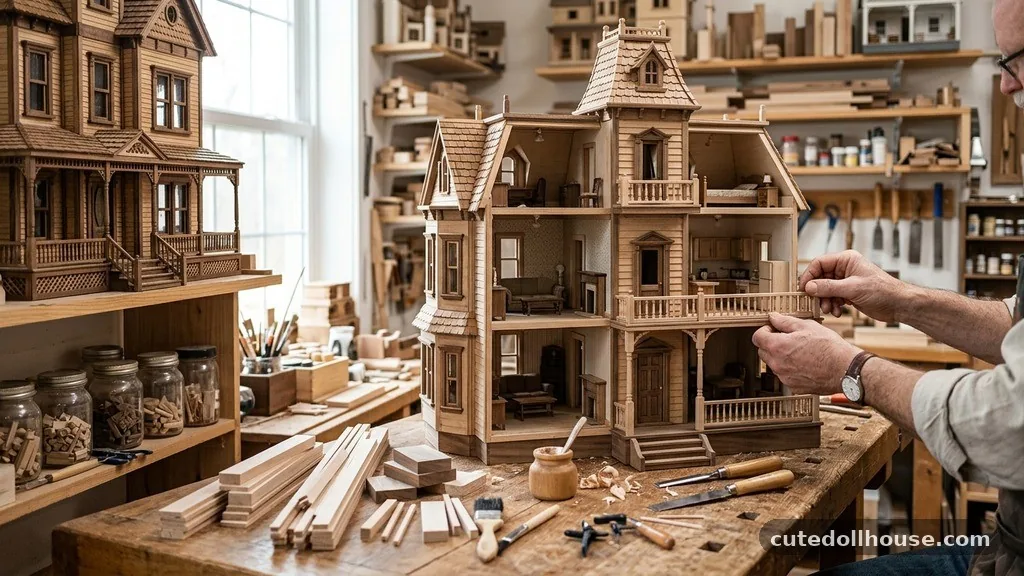
Look for clear information about the main structural material. Solid wood, plywood, MDF, and composite panels each have different characteristics. Plywood can offer useful stability and strength, while MDF may provide smooth surfaces that are easy to paint but can be vulnerable to swelling if exposed to moisture. “Wooden” alone doesn’t tell you enough.
Examine photographs for straight edges, even openings, clean trim, and consistent panel thickness. Product descriptions should explain how the walls, floors, stairs, roof, and partitions connect. If the listing provides no useful material information, treat that as a reason to contact the seller before ordering.
Design and Appearance
A collector’s house needs to look convincing from the angles where it will be displayed. Consider the architectural style, window proportions, roofline, exterior finish, and how much of the interior remains visible after the house is furnished.
- Display presence: A taller or wider design may look impressive but demands more floor, shelf, or cabinet space.
- Interior visibility: Open-front designs are easier to decorate and view, while enclosed rooms may look more architectural.
- Customisation: Plain walls and floors can be useful if you plan to paint, wallpaper, or install your own finishes.
- Style consistency: Victorian, contemporary, cottage, townhouse, and fantasy designs suit different collections.
- Photography accuracy: Check whether promotional images show the actual structure or a heavily modified example.
Scale and Size
Scale affects almost every later purchase. A house designed for 1:12 scale furniture won’t necessarily work well with 1:24 or 1:48 accessories, and even products described with the same scale may differ in room height, door width, or usable floor area.
Measure the available display location in three dimensions. Leave space for doors, removable roofs, rear access, wiring, dusting, and future furniture. A house that fits the shelf on paper may become impractical once you need to reach the rooms or remove a roof section.
Ask the seller for the external dimensions and, if available, internal room dimensions. The number of rooms is less useful than the usable floor area and the position of stairs, partitions, and windows.
Features and Functionality
Premium collectors often care about access and long-term usability as much as appearance. A removable roof, hinged rear panel, lift-off section, or wide front opening can make decorating much easier. Lighting compatibility is also important if you plan to create illuminated scenes.
Before buying, verify:
- Whether the roof or rear wall can be removed
- Whether doors and windows open or are fixed
- Whether floors are strong enough for the intended furnishings
- Whether wiring channels or lighting holes are provided
- Whether stairs and room dividers are permanent
- Whether the house can be secured against tipping
- Whether replacement parts are available
Lighting may involve low-voltage components, batteries, plugs, or separate wiring kits. Don’t assume that a house photographed with illuminated rooms includes the electrical system.
Assembly Difficulty
Wooden dollhouse kits range from relatively straightforward builds to demanding projects that resemble miniature carpentry and model-making. Difficulty depends on the number of pieces, precision of the fit, quality of the instructions, surface preparation, painting, and the amount of custom finishing you want to add.
Assembly is only part of the work. A collector may also need to fill seams, sand edges, paint trim, apply wallpaper, install flooring, fit lighting, and protect delicate details. If the manufacturer gives an assembly time, regard it as an estimate rather than a guarantee; experience, tools, and the desired finish can change the project substantially.
Included Accessories
Some listings show a fully decorated house even though the package contains only the shell and basic architectural parts. Make a checklist before buying:
- Structural panels and roof components
- Windows, doors, stairs, railings, and trim
- Flooring, wallpaper, or exterior finishing materials
- Furniture and miniature accessories
- Lighting, wiring, batteries, or connectors
- Tools, glue, paint, and other consumables
- Instructions and a parts inventory
For historic or collectible displays, scale compatibility is especially important. A generous accessory bundle is not necessarily good value if the items are poorly matched to the house or difficult to replace.
Durability and Maintenance
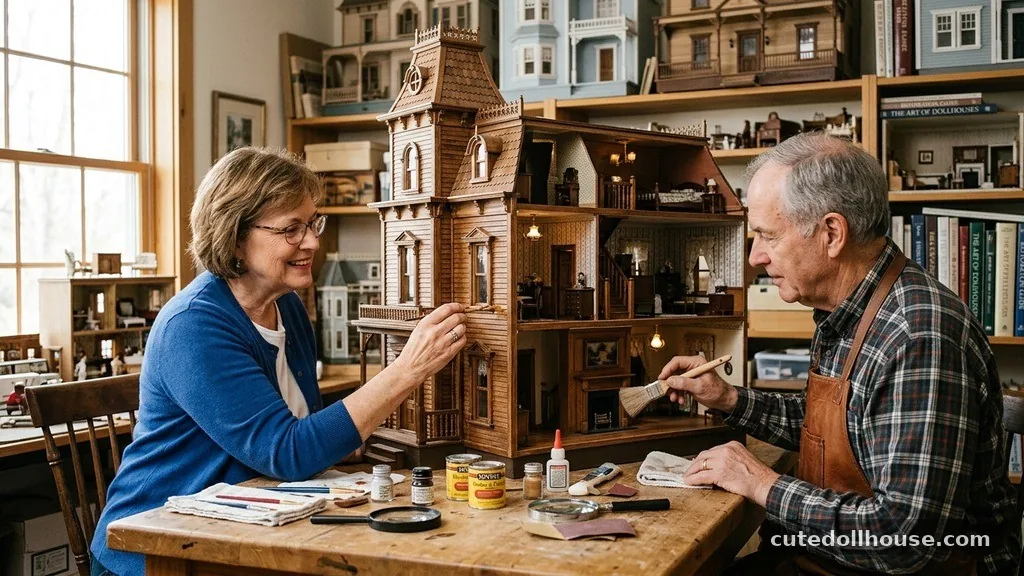
Wooden miniatures need protection from direct sunlight, damp rooms, heat sources, and rough handling. Dust can accumulate quickly around railings, trim, roof shingles, and miniature furnishings, so an accessible layout is easier to maintain than a densely packed one.
Ask whether the finish is sealed and whether the materials are suitable for painting or refinishing. Keep in mind that later modifications can make repairs harder. A glued-in wall may improve rigidity but prevent access to wiring or hidden damage.
For background on how museums care for small historic objects and why environmental conditions matter, the Victoria and Albert Museum’s collection-care guidance offers useful general principles. A modern wooden dollhouse does not need museum-level conservation, but stable conditions and careful handling still help.
Customer Feedback and Common Complaints
Reviews can reveal issues that product photographs don’t show, but they should be read with context. A complaint about difficulty may reflect an ambitious kit rather than a defective one, while comments about missing pieces may relate to a particular batch or seller.
Pay attention to repeated patterns rather than isolated comments. Useful warning signs include:
- Panels arriving warped, cracked, or poorly labelled
- Instructions that omit steps or use unclear diagrams
- Windows and doors that don’t align with the openings
- Decorative parts that are too fragile for the intended display
- Photos that show accessories not included in the package
- Unclear replacement-parts or customer-service policies
Feedback can vary by region, seller, production batch, and shipping method. Check the most recent reviews and confirm the exact model number before relying on comments about quality or contents.
Comparison by Collector Type
| Buyer type | Most suitable design | Priority feature | Main trade-off | What to verify |
|---|---|---|---|---|
| First-time adult builder | Moderate-size kit with clear instructions | Accessible rooms and manageable part count | May offer less architectural drama | Assembly difficulty and included materials |
| Experienced miniature maker | Detailed shell with customisation potential | Accurate structure and removable access panels | More finishing work and tool requirements | Scale, panel dimensions, and replacement parts |
| Display-focused collector | Architecturally distinctive house | Exterior finish and viewing angles | Interior access may be limited | Finished size, lighting, and dust protection |
| Furniture and scene collector | Open-front or wide-access layout | Usable room depth and scale compatibility | Less realistic from certain angles | Door widths, ceiling height, and floor area |
| Value-conscious buyer | Plain kit with fewer decorative extras | Strong base for personal finishing | Requires more of your own materials | What is included and the cost of missing components |
Choosing Between a Kit and a Finished Dollhouse
A wooden dollhouse kit gives you more control over the result. You can select colours, flooring, wallpaper, furniture, lighting, and exterior details. It may also be easier to repair or modify because you understand how the structure was assembled.
The downside is time. Even a well-designed kit can become a long project once painting and interior decoration are included. If your main goal is to display miniatures immediately, a completed house may be the more practical option, although it can offer less personalisation and may be harder to transport or repair.
There is also a middle ground: a partially finished shell or a basic structure with selected accessories. This can suit collectors who enjoy interior design but don’t want to cut every panel or build every architectural detail from scratch.
Alternatives Worth Considering
Smaller Wooden Dollhouses
A compact model is easier to display, move, light, and protect from dust. It may be a better choice for a first project or a collection built around a single room, shop, café, or townhouse.
Modular Room Boxes
Room boxes allow collectors to create focused scenes without committing to a full house. They’re useful for experimenting with scale, lighting, flooring, and furniture. They also make storage and transport simpler.
Plastic or Composite Display Models
These may offer consistent moulded details and quicker assembly, but they often provide a different visual character from painted or stained wood. Choose them when repeatability, lower maintenance, or lighter weight matters more than traditional materials.
Preassembled Collectible Houses
A finished model avoids the construction stage and can be appealing to display-first buyers. Check its packaging, access points, structural integrity, and ability to pass through doors or fit into a cabinet before ordering.
Who Should Buy a Premium Wooden Dollhouse?
Premium wooden dollhouses are best suited to adults and experienced hobbyists who enjoy miniature architecture, interior decoration, collecting, or long-form creative projects. They’re particularly appealing when the buyer has a stable display area and a clear preference for a particular scale or style.
They may also suit collectors building a themed environment, provided the house can accommodate compatible furniture and figures. A carefully chosen structure can become the anchor for a wider miniature collection rather than a one-time purchase.
Who Should Consider Something Else?
- Buyers who want instant display: Consider a finished model instead of a kit.
- People with limited space: Look at room boxes or compact single-storey designs.
- Young children: Check age guidance and choose a model designed for safe play rather than a fragile collector’s kit.
- Shoppers with no interest in customisation: Avoid a bare shell that requires paint, flooring, and furniture.
- Collectors with an established scale: Don’t buy until the new house has been compared with existing furnishings and figures.
Practical Buying Checklist
Before placing an order, save the product listing and confirm the details that matter most. Listings can change, and photographs may not show the exact contents of every package.
- Measure the intended display area, including depth and access space.
- Confirm the scale and compare it with furniture already owned.
- Check the external dimensions and ask for internal measurements where necessary.
- Read the full contents list rather than relying on staged photographs.
- Find out whether paint, glue, lighting, tools, or furnishings are separate purchases.
- Review the assembly instructions or request a sample page from the seller.
- Inspect recent feedback for damage, missing parts, and fit problems.
- Confirm shipping protection, returns, and replacement-part support.
- Plan how the completed model will be dusted, lit, moved, and secured.
Frequently Asked Questions
What is the best scale for a collector’s dollhouse?
There is no single best scale. A larger scale usually makes furnishing and detailing easier, while a smaller scale saves space and can support broader scenes. Choose the scale that matches your existing collection and available display area.
Are premium wooden dollhouses difficult to assemble?
Some are manageable for beginners, while detailed kits can require sanding, painting, precise alignment, and miniature finishing skills. Check the part count, instruction quality, required tools, and whether the model is sold as a shell or a complete kit.
Do wooden dollhouse kits include furniture?
Not always. Many kits contain the structural house only, while staged photographs show furniture, lighting, wallpaper, and accessories purchased separately. Confirm the package contents before comparing value.
How can a wooden dollhouse be protected from damage?
Keep it away from dampness, strong sunlight, heat, and unnecessary handling. Use gentle dusting tools, support the structure from underneath when moving it, and consider a display cabinet or cover if the design allows one.
Is a ready-made house better than a dollhouse kit?
A ready-made model is better for immediate display and buyers who don’t enjoy construction. A kit is usually more suitable for collectors who want to customise the finish, learn the building process, or create a house around their own furniture and accessories.
Final Verdict
The best premium wooden dollhouses for collectors are worth buying when material quality, scale, access, and included components match the intended project. Focus less on the word “premium” and more on the evidence: clear dimensions, dependable construction details, useful instructions, compatible accessories, and a realistic understanding of the finishing work.
Choose a detailed kit if the build is part of the enjoyment; choose a finished or smaller model if display convenience matters more. Before ordering, verify the exact contents and recent seller feedback. That extra check can turn an expensive miniature into a lasting collection piece rather than an impractical project.