
Finding the best compact wooden dollhouses for small spaces takes more thought than simply choosing the smallest model on the shelf. A dollhouse needs enough room for imaginative play, yet it also has to fit comfortably on a bookcase, desk, playroom shelf, or bedroom corner. Wooden construction can provide a more substantial feel than lightweight plastic, but size, assembly, access, and storage vary widely between designs.
The right choice depends on who will use it, how much room is available, and whether the house is intended for everyday play or display. This guide explains the main styles, features, trade-offs, and safety points to consider before buying.
What Makes a Wooden Dollhouse Compact?
A compact wooden dollhouse is a scaled-down playhouse designed to occupy less floor and shelf space than a large multi-storey model. It may have fewer rooms, a narrower footprint, a single main level, or a design that can be stored against a wall when not in use.
Compact doesn’t necessarily mean basic. Some smaller dollhouses include multiple rooms, stairs, windows, furniture, or decorative details. Others are deliberately simple, leaving children or adult hobbyists to add their own miniature furniture, wallpaper, lighting, and accessories.
Before purchasing, check the product’s assembled dimensions rather than relying on photographs. Wide-angle product images can make a dollhouse appear smaller than it is. Depth matters just as much as height, especially if the house will sit on a shallow shelf.
Are Compact Wooden Dollhouses Worth Buying?
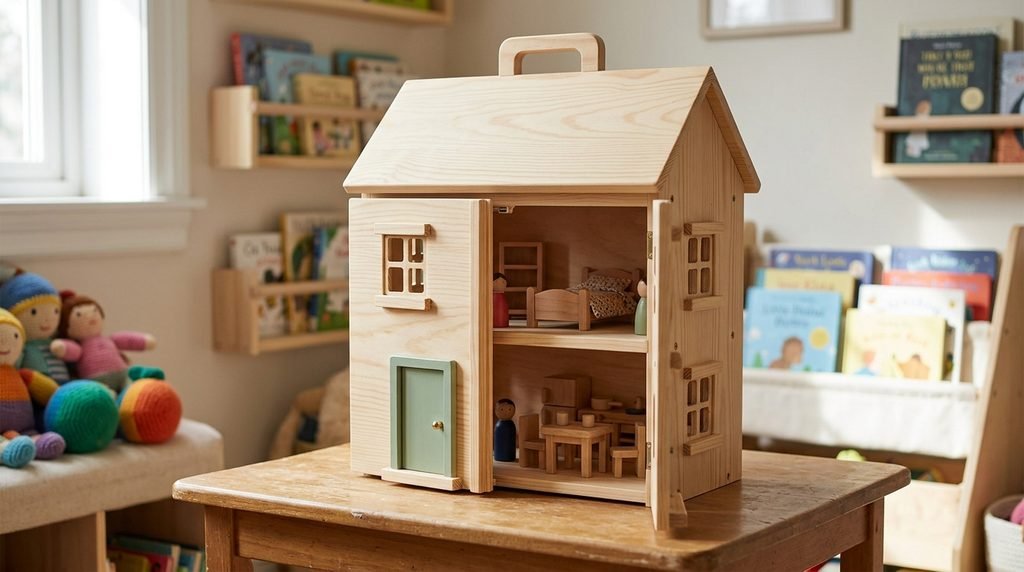
For many households, a compact wooden dollhouse is a practical compromise between a full-size playset and a small plastic toy. It can encourage open-ended storytelling without taking over an entire room. A wooden model may also suit families who prefer natural-looking toys or want a display piece that blends with existing furniture.
The category is most appealing when floor space is limited, storage is important, or the buyer wants a dollhouse that can remain accessible without becoming the main feature of the room. Smaller houses can also be easier for children to reach, although the available play space may be more restricted.
There are situations where another option makes more sense. A large dollhouse may be better for several children playing together.
A plastic model may be more suitable for very young children or messy environments, depending on its construction and cleaning requirements. Adults building a detailed miniature scene may prefer a specialist kit with more scale accuracy and customization potential.
Reasons to Choose One
- It fits more easily on a shelf, table, or narrow play surface.
- It generally requires less storage space than a full-size dollhouse.
- Its smaller scale may be easier for young children to reach.
- Wooden designs can have a warmer, more furniture-like appearance.
- A simple layout may be less intimidating for first-time dollhouse owners.
- It can support imaginative play without requiring a dedicated playroom.
Reasons to Consider an Alternative
- Limited room may make group play difficult.
- Some compact designs have small openings that make interior play awkward.
- Wooden parts may require assembly, care, and occasional tightening.
- Accessories may be sold separately, increasing the total cost.
- Small decorative parts may not be appropriate for young children.
Compact Wooden Dollhouse Styles Compared
There is no single layout that suits every small room. The most useful way to compare compact dollhouses is by the way they use space and support play.
| Style | Best For | Typical Space Advantage | Main Strength | Potential Drawback |
|---|---|---|---|---|
| Single-level dollhouse | Young children and simple play | Lower overall height | Easy to reach and arrange | Fewer rooms and less vertical play space |
| Narrow multi-level house | Buyers with limited floor width | Uses height instead of width | Offers several play areas in a small footprint | Upper rooms may be hard to reach |
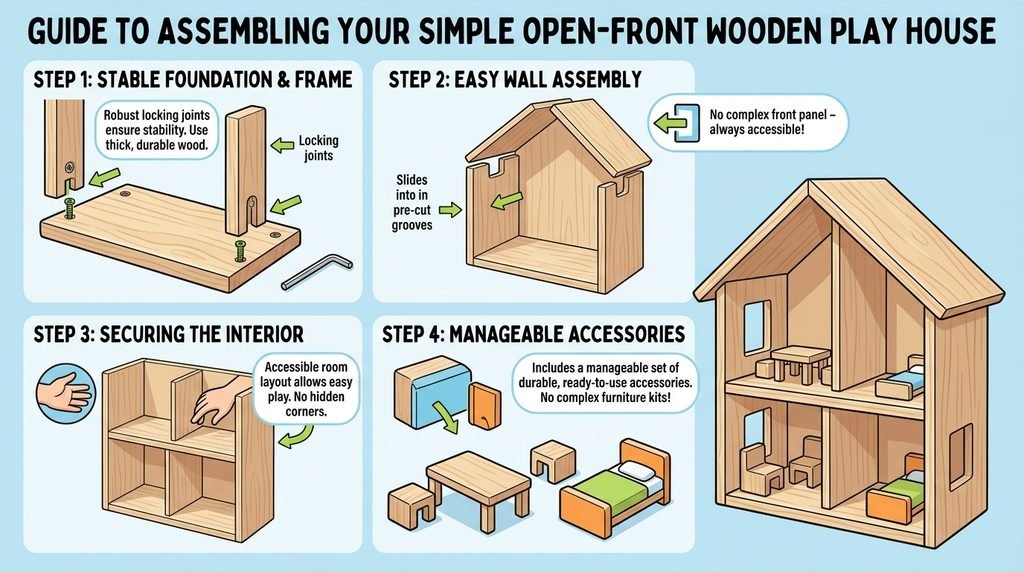
| Open-front house | Accessible everyday play | Doesn’t need to be pulled away from a wall | Good visibility and interior access | Less enclosed and sometimes less suitable for display |
| Fold-away or portable design | Shared rooms and flexible storage | Can reduce its footprint when stored | Useful where play space changes | Hinges, closures, and moving sections need careful inspection |
| Miniature display house | Older users and decorative projects | Often designed for a narrow shelf | Supports detail and customization | May not be suitable for rough child-led play |
What to Check Before Buying
1. Build and Material Quality
Wooden dollhouses can be made from solid wood, plywood, engineered wood, or combinations of these materials. The material alone doesn’t tell you whether a model is well made. Look for clear information about the panels, joints, finish, and any plastic or metal components.
Panels should sit squarely, and the structure should be stable once assembled. Thin materials aren’t automatically unsuitable for a compact house, but a lightweight structure may be more vulnerable to tipping or damage if children move it frequently.
Check whether the seller identifies the finish as painted, stained, sealed, or unfinished. If that information isn’t provided, don’t assume the surface is sealed or washable. A painted finish may also vary slightly between production batches.
2. Size and Fit
Measure the intended location before ordering. Record the maximum width, depth, and height available, then leave some clearance for children to reach the rooms and for adults to clean around the house.
Pay attention to these measurements:
- Overall width: Important for desks, shelves, and narrow furniture.
- Overall depth: Often overlooked, especially for houses with balconies or rear panels.
- Overall height: A tall model may not fit beneath a shelf or window.
- Room opening size: Determines whether hands and accessories can reach the interior.
- Door and staircase clearance: Affects how easily children can move figures and furniture.
Don’t measure only the house itself. Include roof overhangs, balconies, chimneys, handles, and any removable features that extend beyond the main body.
3. Design and Appearance
Appearance is subjective, but it matters more when a dollhouse will stay in a living room or bedroom. Neutral finishes and simple silhouettes tend to blend with more interiors, while colourful painted houses can feel more toy-like and immediately inviting to children.
Look at how much of the design is decorative and how much supports actual play. Balconies, shutters, and roof details may look attractive, but they don’t necessarily add useful interior space. An open-back or open-front layout can be more practical than a highly detailed exterior that limits access.
Buyers should also consider whether the house is intended for a particular doll size. A dollhouse can look spacious in photographs but feel cramped if the figures or furniture are too large for the rooms.
4. Features and Functionality
Useful features depend on the user’s age and play style. A child who enjoys role-play may benefit from several accessible rooms. An adult miniature enthusiast may care more about scale, realistic proportions, and surfaces that can be decorated.
Potential features include:
- Multiple rooms or flexible open-plan areas
- Removable roofs or panels for better access
- Opening doors and windows
- Built-in stairs or room dividers
- Handles for carrying or repositioning the house
- Included furniture, figures, or decorative pieces
- Plain surfaces suitable for repainting or wallpapering
A longer feature list isn’t automatically better. Moving parts can add play value, but they can also create more points of wear. A compact house with fewer features may be the better choice if stability and easy storage matter most.
5. Assembly and Difficulty
Many wooden dollhouses arrive flat-packed. Assembly difficulty depends on the number of panels, the clarity of the instructions, the type of fasteners, and whether pieces need to be glued or painted.
Before buying, verify whether the package includes all required hardware and tools. Product listings aren’t always consistent about this. Some designs may be suitable for an adult to assemble with a child nearby, while others are better treated as an adult construction project.
Allow enough space to lay out the parts during assembly. A compact finished house can still require a surprisingly large work area while it is being built. If the instructions are unclear or replacement parts aren’t readily available, repairs may be frustrating.
6. Durability and Maintenance
Durability is influenced by material thickness, joint design, finish quality, and how the dollhouse is used. A display-oriented model may remain in one place, while a child’s playhouse may be carried, rearranged, and exposed to more knocks.
Wooden surfaces should generally be kept dry unless the manufacturer specifically states that they can be wiped with a damp cloth. Avoid assuming that a painted finish is waterproof. Dust can usually be removed with a soft, dry cloth, while small accessories should be stored separately to reduce loss.
Inspect the house periodically for loose fasteners, damaged edges, unstable sections, or peeling finish. If a model includes small pieces, keep them away from children who may place objects in their mouths.
7. Included Accessories
Some dollhouses are sold as shells, while others include furniture, figures, or room accessories. A low initial price may not represent good value if the house requires a large collection of separately purchased items to become playable.
Read the contents list carefully. Product images may show decorative pieces that aren’t part of the package. The same applies to dolls, lighting, bedding, plants, and miniature kitchen items.
Accessories can also affect size compatibility. Furniture designed for one scale may not fit another compact wooden dollhouse, even if both products are marketed for children or miniature play.
8. Customer Feedback and Common Complaints
Customer reviews can reveal issues that aren’t obvious from a product description, such as confusing instructions, missing hardware, fragile decorative parts, or a smaller-than-expected interior. They should be read as individual experiences rather than guaranteed outcomes.
Pay attention to repeated patterns instead of isolated comments. Several buyers mentioning the same assembly problem deserves more attention than one vague complaint. Reviews may also vary by seller, production batch, shipping condition, and region, so confirm the return and replacement policy before ordering.
Choosing the Right Size for a Small Room
The best compact wooden dollhouses for small spaces are not necessarily the shortest or narrowest models. They are the ones that leave enough room for comfortable play and safe storage after they arrive.
For a bookshelf, a single-level or narrow model may be easier to position. A tall multi-storey house can save floor width, but only if the shelf height and stability are suitable. For a shared table, an open-front design may be more practical because children can play from opposite sides.
If the house will be stored in a cupboard, check whether its roof, balconies, and accessories can be removed. A fixed decorative feature can make an otherwise compact model awkward to store.
Think About Access, Not Just Footprint
A small footprint is useful only when the interior remains usable. Deep rooms, narrow windows, and fixed upper floors may make it hard to place furniture or retrieve figures. Children may lose interest if they can see a room but can’t reach it easily.
For younger users, a lower house with wide openings can be more practical than a tall model with more rooms. Older children and adults may accept tighter access in exchange for extra levels and greater detail.
Safety and Age Suitability
Always check the manufacturer’s recommended age range and warnings. A compact wooden dollhouse may contain small furniture, decorative parts, magnets, cords, or removable pieces that aren’t appropriate for very young children.
Stability matters too. A narrow, tall house should sit on a level surface and be positioned where it can’t be easily pulled down. If children are likely to climb on furniture or use the dollhouse as a support, a smaller, sturdier design may be a safer choice.
Paint and surface information should come from the manufacturer or seller. If the listing doesn’t clearly identify the finish or intended age group, ask for clarification before purchasing rather than relying on assumptions.
Recommendations by Buyer Type
For Beginners
A simple open-front or single-level wooden house is usually easier to understand and maintain than a highly detailed kit. Prioritize clear instructions, stable construction, accessible rooms, and a manageable number of accessories.
For Small Bedrooms or Shared Rooms
Focus on depth and storage as well as width. A narrow design, fold-away model, or house that can sit on a shelf may work better than a larger play centre. Measure the location with the storage position in mind.
For Appearance-Focused Buyers
Look for a finish and shape that suit the room where the dollhouse will remain visible. Consider whether the exterior details are durable enough for occasional handling and whether the colour may vary from the photographs.
For Creative Older Children and Adults
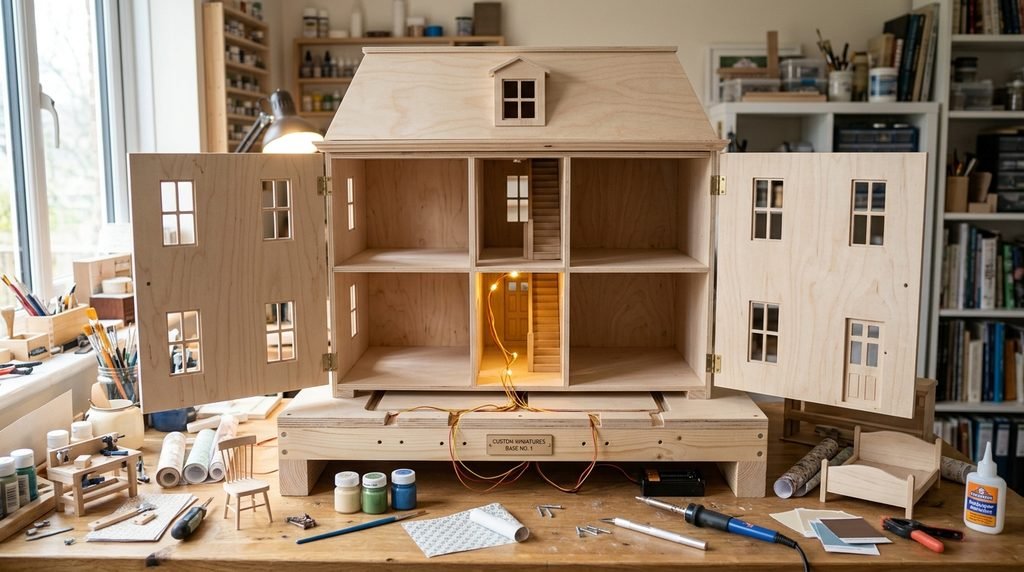
A plain or semi-finished wooden house can provide a better base for painting, wallpapering, lighting, and custom furniture. Confirm the room proportions and construction materials before investing in modifications.
For Buyers Focused on Value
Compare the complete setup cost, not just the price of the empty house. A model that includes useful furniture may offer better practical value than a cheaper shell, depending on the accessories needed afterward.
Who May Prefer Another Type of Dollhouse?
A compact wooden dollhouse isn’t the right fit for every household. Consider a larger model if several children need to play at once or if the user wants space for a growing miniature collection.
Plastic may be preferable where easy cleaning, lighter weight, or frequent relocation is more important than a wood-like appearance. Soft or fabric playhouses can also be easier to store, although they provide a different feel and may not suit miniature furniture or detailed decorating.
For serious miniature work, a specialist dollhouse kit may offer better control over scale and materials. These projects often demand more assembly, finishing, and patience, so they’re a different purchase from a ready-to-play children’s dollhouse.
Questions to Ask Before Ordering
- Will the assembled dimensions fit the intended surface with room to spare?
- Is the product sold as a complete playset or as a house shell?
- What age range and safety warnings does the manufacturer provide?
- Can children reach every room without moving the entire house?
- Does the package include tools, hardware, and clear assembly instructions?
- Are the pictured furniture and accessories actually included?
- Is the finish suitable for the intended use and maintenance routine?
- What happens if panels, fasteners, or decorative parts arrive damaged?
- Will compatible furniture and dolls be easy to find later?
FAQ
What should I look for in a compact wooden dollhouse?
Start with assembled width, depth, and height, then check interior access, stability, age suitability, materials, assembly requirements, and included accessories. A compact design should save space without making the rooms difficult to use.
Are wooden dollhouses suitable for young children?
Some are, but suitability depends on the manufacturer’s stated age range, construction, finish, and included small parts. Always check safety warnings and supervise children when removable accessories or small furniture are present.
Is a narrow multi-storey dollhouse better than a single-level model?
It depends on the available space and the user’s age. A multi-storey model can use vertical space efficiently, while a single-level house is often easier to reach, arrange, and supervise.
Do compact dollhouses include furniture?
Some do and some are sold as empty structures. Product photographs may include props that aren’t in the box, so read the package contents carefully before comparing value.
How do I know whether a dollhouse will fit on a shelf?
Compare the shelf’s usable width, depth, and height with the assembled product dimensions. Include roof overhangs, balconies, handles, and any clearance needed to access the rooms.
Can a wooden dollhouse be left assembled permanently?
Usually, that depends on the construction and the environment. Keep it on a stable, dry surface, protect it from excessive moisture, and inspect joints and finishes periodically. Follow the manufacturer’s care instructions where available.
Final Verdict
The best compact wooden dollhouses for small spaces are worth buying when they balance a manageable footprint with stable construction, accessible rooms, and realistic storage needs. The smallest model isn’t automatically the most useful; a house with poor access or incompatible accessories can become frustrating despite fitting neatly on a shelf.
Measure first, confirm what the package includes, check age and safety information, and compare the finished setup rather than the empty shell alone. Buyers who need easy everyday play may prefer a simple open-front or single-level design, while older users may value a narrow multi-storey or customizable house. Choose according to the room, the user, and the intended style of play, and compact wooden dollhouses can be a practical, attractive addition without overwhelming a small space.