
The best creative dollhouse building kits turn a small-scale house into a hands-on design project. They appeal to adults, older children, collectors, and anyone who enjoys crafting, painting, decorating, or miniature interiors. The right kit can be relaxing and rewarding, but choosing one isn’t simple: photographs may hide the true difficulty, materials vary, and included accessories can differ sharply between listings.
Size, scale, assembly method, lighting, furniture, and the amount of finishing work all affect the experience. This guide explains how dollhouse kits work, which features matter most, where buyers commonly encounter frustration, and how to choose a project that matches your available time, skill level, space, and creative ambitions.
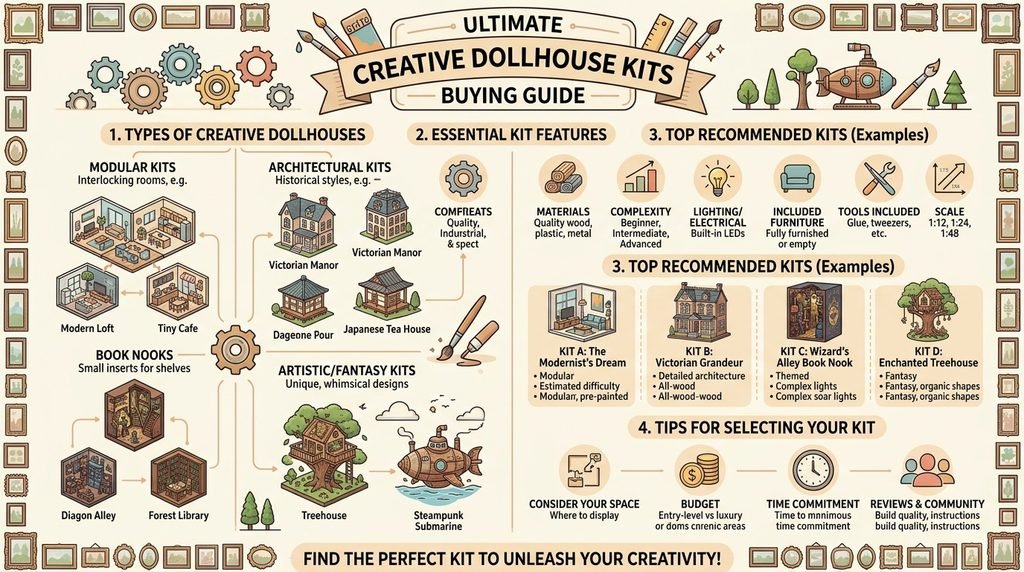
What Are Creative Dollhouse Building Kits?
Creative dollhouse building kits are miniature construction projects that usually include the main structural pieces for a small house or room scene. Depending on the design, a kit may contain wooden panels, flooring, windows, doors, furniture, decorative items, fabric, wiring, lighting components, paint, or adhesive.
Some kits are designed as traditional dollhouses with separate rooms and an open front. Others create a single miniature shop, bedroom, greenhouse, café, library, or cottage. Many are intended to be displayed rather than used as toys, particularly when they include delicate furniture, tiny accessories, or electrical lighting.
Buyers should also understand that “kit” doesn’t always mean “ready in one sitting.” A model may require cutting, gluing, painting, sanding, wiring, paper fitting, and careful interpretation of diagrams. Product descriptions often differ in how clearly they explain what is included, so check the contents list before ordering.
Are Dollhouse Building Kits Worth Buying?
For the right hobbyist, a dollhouse kit can offer more creative control than a finished miniature house. You choose the colours, textures, furniture arrangement, lighting mood, and finishing details. The building process is part of the appeal, not merely a step before display.
These kits are particularly appealing to people who enjoy detailed crafts and want a project that can be completed gradually. They can also make thoughtful gifts, although the recipient’s age, patience, dexterity, and interest in assembly matter more than the appearance of the finished model.
A kit may be a poor choice if you want an immediately finished display, have little workspace, or dislike repetitive precision work. In those cases, a pre-assembled dollhouse, a simpler room box, or a miniature furniture set may provide more enjoyment with less commitment.
Good Reasons to Buy One
- You enjoy painting, crafting, decorating, and miniature scenes.
- You want a project that can be completed in stages.
- You prefer customisation over a finished, fixed design.
- You have a stable work surface and somewhere to store the model.
- You are comfortable checking instructions and solving small construction problems.
Reasons to Consider an Alternative
- You need a display piece immediately.
- You don’t want to buy extra tools, glue, paint, or finishing materials.
- You have limited eyesight, dexterity, or patience for very small parts.
- You need a toy that can tolerate rough handling.
- You don’t have room for a project that may remain unfinished for some time.
Types of Creative Dollhouse Kits
“Dollhouse kit” covers several different formats. Identifying the format first makes the rest of the buying decision easier.
| Kit type | Best suited to | Typical creative focus | Potential limitation |
|---|---|---|---|
| Traditional multi-room house | Collectors and longer projects | Architecture, room planning, furniture, and decoration | Can require more space, time, and finishing work |
| Room box or single scene | Beginners and focused projects | Interior styling and storytelling | Offers less room for expansion |
| Miniature shop or café | Display-focused crafters | Signage, shelving, products, and themed décor | Tiny accessories may be difficult to handle |
| Lighting-focused kit | Experienced hobbyists | Atmosphere, wiring, and illuminated interiors | Electrical work can add complexity |
| Child-oriented construction kit | Older children with supervision | Basic assembly and imaginative play | May use simpler details or less durable components |
There isn’t one universally best format. A beginner may get more satisfaction from a compact room scene, while an experienced builder may prefer a larger house with several rooms and customisation options.
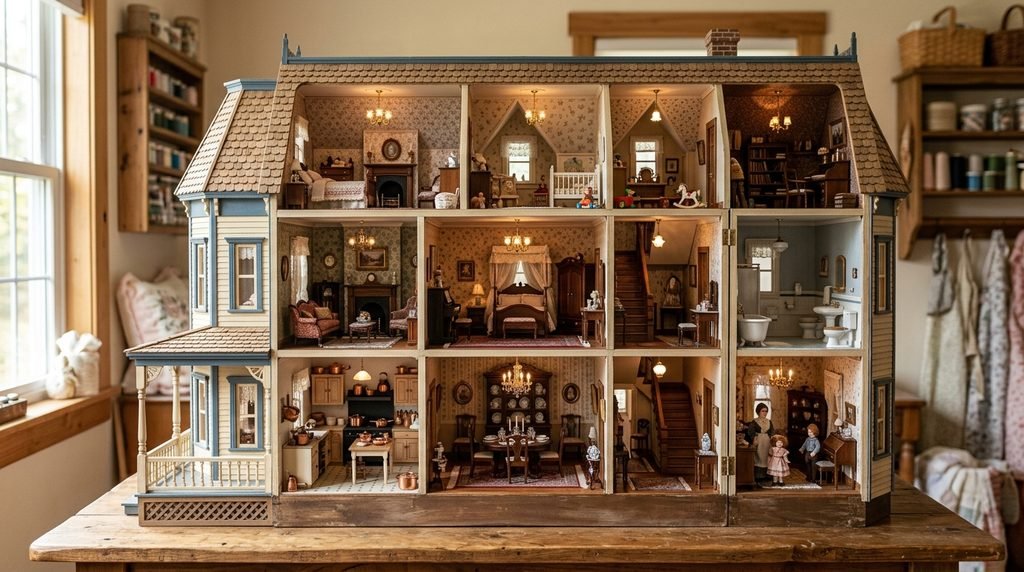
Key Features to Check Before Buying
Build and Material Quality
Look for clear information about the structural materials. Wooden panels, plywood, card, plastic, resin, and fabric each behave differently during assembly.
Wood can create a convincing architectural finish, but thin pieces may warp or split if handled roughly. Card-based components can be easy to customise but may need careful gluing and sealing.
Pay attention to photographs of unfinished parts when available. Cleanly cut edges, consistent panel thickness, and well-defined openings usually make construction easier. If the listing provides only polished images of the completed model, treat those images as a style reference rather than proof of kit quality.

Scale and Overall Size
Scale describes the relationship between the miniature and a real object. A 1:12 dollhouse, for example, is based on the idea that one inch in the model represents one foot in real life. Other scales may use smaller furniture and accessories.
Scale matters because furniture from one range may not fit another. Check the stated scale before buying additional décor, figures, lighting, or replacement parts. Also measure the assembled footprint, depth, and height—not just the package size.
Think about display space early. A model may fit on a table while being built but become difficult to move once decorated. If the kit has an open back, roof, or removable panel, allow room to access those areas.
Design and Appearance
Style is subjective, but the design should match the kind of creative work you want to do. Some buyers prefer a realistic cottage or period house; others want a modern apartment, whimsical shop, or fantasy-inspired room.
Consider whether the kit gives you a strong starting point or dictates too much of the final look. A highly themed set may be visually cohesive from the beginning, while a plain shell may offer more freedom for wallpaper, flooring, paint, and furniture choices.
What Is Included?
Never assume that a photographed accessory is included. Listings may show a fully decorated example even when the package contains only the structural shell. A reliable product description should separate included components from decorative suggestions.
Check for the following:
- Structural panels, floors, walls, roof sections, and trim
- Windows, doors, stairs, railings, or other architectural parts
- Furniture, miniature accessories, fabric, wallpaper, or flooring
- Lighting, wiring, switches, batteries, or connectors
- Glue, paint, brushes, tools, and other consumables
- Printed instructions, diagrams, templates, or assembly videos
Missing glue or paint isn’t necessarily a problem; many experienced builders prefer their own supplies. It does affect the real cost and the time needed before assembly can begin.
Difficulty and Assembly Method
Difficulty depends on more than the number of parts. A small kit with intricate curtains, miniature food, and working lights may demand more patience than a larger kit with simple panels.
Look for information about age guidance, skill level, estimated build time, and the tools required. These details may be inconsistent between sellers, so compare the instruction quality and customer photographs when possible.
Glue-together models are common, but some kits use tabs, screws, magnets, or snap-fit pieces. Each method has trade-offs. Adhesive allows flexibility but can become messy; snap-fit construction may be faster but offers less tolerance if a part is misaligned.
Lighting and Electrical Features
Lighting can transform a miniature interior, but it adds another layer of work. Determine whether the kit includes a complete lighting system or merely has space for one. Check how power is supplied and whether the wiring remains visible after the walls and furniture are installed.
For younger builders, exposed wires, small batteries, and hot glue tools may require adult supervision. If instructions are vague, a non-lit version may be the more practical choice.
Durability and Maintenance
Miniatures collect dust, and delicate details can be difficult to clean. A design with accessible rooms and sturdy surfaces is easier to maintain than one packed with fragile accessories.
Paint, paper, and fabric may fade or loosen with humidity, direct sunlight, or frequent handling. Display the finished model away from damp areas and strong sunlight. A clear protective finish can help in some cases, but it should be compatible with the materials and tested on a discreet area first.
How to Judge Customer Feedback
Customer reviews can reveal practical problems that product photographs don’t show, but they should be read carefully. A complaint about difficulty may reflect a genuinely complex design—or a mismatch between the kit and the buyer’s experience level.
Look for repeated comments rather than isolated reactions. Several buyers mentioning incomplete parts, unclear diagrams, poor-fitting panels, or fragile accessories deserve attention. Photos of unfinished builds are often more useful than polished final images because they show the actual parts and assembly stages.
Useful Review Signals
- Repeated reports of warped, cracked, or poorly cut pieces
- Comments about whether instructions are complete and easy to follow
- Photographs showing the real scale and finished footprint
- Reports of missing components or inconsistent contents
- Information about extra tools, glue, paint, or batteries required
- Feedback on whether furniture and accessories fit the stated scale
Seller, model, production batch, and region can affect the contents of a kit. Verify the latest listing and return policy before buying, especially when the product has several similar versions.
Practical Buying Criteria
Choose the Project Before Choosing the Brand
The “best brand” isn’t automatically the best choice for every buyer. Start with the project you want to build: a traditional house, a single room, a business interior, or a lighting display. Then compare kits that meet that purpose.
Match Complexity to Your Available Time
A dollhouse can be an enjoyable long-term hobby, but an ambitious project may lose its appeal if you expected a quick weekend activity. If you want a manageable first attempt, choose a compact scene with fewer rooms, limited wiring, and clear instructions.
Calculate the Complete Cost
The purchase price is only one part of the budget. Additional costs may include:
- Craft glue and precision applicators
- Paint, sealant, brushes, and masking materials
- Craft knives, files, tweezers, rulers, and cutting mats
- Furniture or accessories not included in the box
- Lighting, batteries, wiring supplies, or replacement parts
- Display furniture or a protective cover
A cheaper shell can become less economical if it excludes nearly all finishing materials. Conversely, an inclusive kit may save time even if its initial cost is higher. Compare contents, not just the headline price.
Check Return and Missing-Part Support
Before ordering, confirm how the seller handles damaged or missing components. This matters more for kits with many small parts, where one absent panel or fitting can stop progress.
Keep the packaging and inventory the contents as soon as the kit arrives. If something is missing, photographs and prompt communication make resolution easier.
Ease of Assembly: What the Process Usually Involves
Most creative dollhouse projects are completed in stages rather than one uninterrupted build. A sensible sequence often includes checking the parts, dry-fitting the structure, assembling the main shell, adding surface treatments, installing lighting if applicable, and decorating the rooms.
- Read the instructions and identify every part before applying glue.
- Dry-fit walls, floors, and large panels to check alignment.
- Prepare paint, wallpaper, flooring, and other surfaces before sections become difficult to reach.
- Assemble the structural shell gradually, allowing adhesive to set.
- Install wiring before closing areas that will be hard to access later.
- Add furniture and tiny accessories after the main construction is stable.
- Protect and display the finished model where it won’t be frequently knocked.
Rushing is the most common avoidable mistake. A small alignment error at the base can affect walls, doors, and roof pieces later. Patience, dry-fitting, and a clean work area usually matter more than advanced craft skills.
Recommendations by Buyer Type
For Beginners
Start with a room box or compact scene rather than a large multi-room house. Prioritise labelled parts, clear diagrams, low electrical complexity, and a manageable number of accessories. A kit that leaves room for creative decoration can teach useful techniques without creating an overwhelming first project.
For Experienced Miniature Builders
Look for a kit with a strong architectural shell and scope for custom work. Experienced builders may value replaceable flooring, open-ended room layouts, compatible scale, and enough space for personal furniture or lighting. A less decorated base can be an advantage if you already own supplies.
For Appearance-Focused Buyers
Study the completed model’s proportions, window style, roofline, and room layout. Check whether the attractive finish depends on extensive repainting or upgraded accessories. The box image may represent a styled example rather than the exact result from the included components.
For Value-Focused Buyers
Compare the complete contents and likely extras. A modest kit with basic materials may offer better value than a more elaborate-looking option that requires separate furniture, tools, lighting, and finishing supplies.
For Gift Buyers
Choose based on the recipient’s interests, not just the model’s appearance. Include information about the required tools and expected difficulty. For children, check the age guidance and supervise small parts, sharp tools, adhesives, and electrical components.
Common Mistakes to Avoid
- Buying based only on the finished product photograph.
- Ignoring the kit’s scale and later discovering accessories don’t fit.
- Failing to measure the completed model’s footprint.
- Assuming glue, paint, batteries, or furniture are included.
- Starting construction without inventorying the parts.
- Installing wallpaper or flooring before checking structural alignment.
- Adding lighting without planning access to the wiring.
- Expecting a detailed miniature house to be suitable for rough play.
Alternatives to Dollhouse Building Kits
A pre-assembled dollhouse is the simplest alternative for buyers who care more about immediate display than construction. It may still need furnishing, but it removes much of the cutting, gluing, and alignment work.
Room boxes are another practical option. They provide a contained creative project and usually need less display space. Miniature furniture kits can be suitable for people who already have a house shell or want to focus on individual crafting skills.
For children who want imaginative play, a sturdier toy dollhouse may be more appropriate than a delicate adult craft kit. The best choice depends on whether the priority is making, displaying, collecting, or playing.
Frequently Asked Questions
What is the best dollhouse kit available?
There is no single best option for every buyer. The right kit should match your preferred scale, available space, experience level, desired style, and willingness to purchase additional tools or accessories. A compact room scene is often a sensible starting point, while experienced builders may prefer a larger customisable house.
Are dollhouse kits suitable for adults?
Yes. Many are designed around detailed construction, decoration, miniature furniture, and lighting rather than rough play. Adult-oriented kits can require patience and precision, so check the difficulty and included materials before purchasing.
What does a 1:12 dollhouse kit mean?
A 1:12 scale generally means that one unit in the model represents twelve of the same units in real life. It is a common scale, but buyers should still confirm compatibility before adding furniture or accessories.
Do dollhouse kits include everything needed to build them?
Not always. Some include the structure and decorative components but exclude glue, paint, tools, batteries, lighting, or furniture. Read the contents list carefully and check what the seller means by “complete.”
How difficult are miniature house kits to assemble?
Difficulty ranges from straightforward room scenes to demanding projects involving wiring, tiny accessories, and extensive finishing. The part count alone isn’t a reliable guide. Instruction quality, scale, materials, and required tools also affect the experience.
How can I keep a finished dollhouse clean?
Keep it away from direct sunlight, damp areas, and heavy traffic. Use gentle dusting tools and avoid soaking paper, fabric, wood, or electrical components. A display case can reduce dust and accidental damage if its size allows adequate ventilation and access.
Final Verdict
The best creative dollhouse building kits are worth buying when you want a hands-on miniature project rather than an instant display piece. They reward patience, planning, and personal design choices, but the real commitment includes workspace, tools, finishing materials, and time. Before ordering, verify the scale, assembled dimensions, contents, difficulty, lighting requirements, and support for missing parts.
Beginners should lean toward smaller, clearly documented scenes, while experienced builders may prefer larger structures with room for custom decoration. Compare complete project costs instead of relying on product photographs alone, and the right kit can become a satisfying long-term craft rather than an unfinished box on a shelf.