
Finding the best modern dollhouses that are easy to assemble means balancing style, construction, scale, and the amount of time you want to spend building. Contemporary dollhouses appeal to children, collectors, hobbyists, and adults who prefer clean lines over traditional Victorian details, but “easy assembly” can mean very different things from one kit to another. Some arrive partly built, while others require careful fitting, decorating, and tool use.
This guide explains what to check before buying, where simplified construction helps, and which compromises may come with a beginner-friendly design. Because no specific model list or verified specifications were supplied, the advice below focuses on practical category-level buying decisions rather than unsupported product rankings.
What Modern Dollhouses Are
Modern dollhouses are miniature homes designed around contemporary architecture and interiors. They may feature open-plan rooms, large windows, flat or gently sloped roofs, minimalist walls, balconies, neutral finishes, or layouts that resemble current apartments and houses.
Most are sold as kits. The buyer typically joins wall panels, floors, trim, and roof sections, then adds paint, wallpaper, flooring, furniture, lighting, or other decorative details. Some products are sold fully assembled or partly assembled, but those options are less flexible and may cost more to ship.
The phrase “easy to assemble” usually describes the construction process, not the entire project. A kit can have straightforward panels and still require sanding, gluing, painting, drying time, and careful alignment. Buyers should read the assembly instructions and product description closely rather than assuming that a modern appearance guarantees a simple build.
Are Easy-to-Assemble Modern Dollhouses Worth Buying?
For many buyers, yes. A simplified dollhouse kit can provide the visual appeal of a contemporary miniature home without the complexity associated with highly ornate designs. It can also be a better starting point for a first project, especially when the structure uses fewer decorative components.
The right choice depends on what you want from the dollhouse. A child may need a sturdy, safe design that tolerates regular play.
An adult hobbyist may care more about scale accuracy, customization, and realistic finishes. A collector may prefer a display piece, while a gift buyer may value a shorter assembly process.
An easy-build kit may not be the best option for someone who wants extensive architectural detail or a long-term craft project. In that case, a more advanced kit, a partly assembled model, or a finished dollhouse could be more suitable.
Good Reasons to Buy
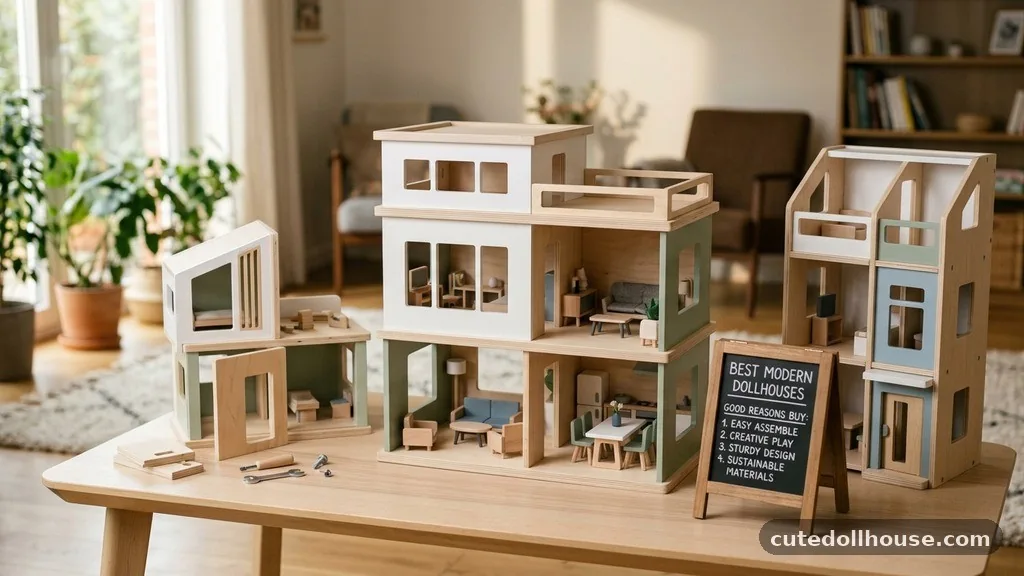
- You want a contemporary miniature home rather than a traditional ornate design.
- You’re new to dollhouse construction and prefer a less complicated starting point.
- You enjoy decorating and want a blank or partly finished interior to personalize.
- You need a display project that can be adapted to a modern room or office.
- You’re buying for someone who enjoys crafts, interiors, miniatures, or model-making.
Reasons to Consider an Alternative
- You need a dollhouse that can be used immediately without construction.
- You’re buying for a young child who may handle the structure roughly.
- You don’t have space for a large permanent display.
- You want a highly detailed collector’s model with advanced electrical or architectural features.
- You dislike painting, gluing, sanding, or troubleshooting small parts.
What to Check Before Buying
Build and Material Quality
The main structural panels should be sufficiently rigid, cleanly cut, and resistant to bending during assembly. Wood-based panels are common in dollhouse kits, while some products use plastic, composite materials, or a combination of materials. The material alone doesn’t determine quality; panel thickness, connection points, surface finish, and instruction quality matter just as much.
Inspect the product description for information about the structural material and finish. If the listing doesn’t state what the main parts are made from, buyers should avoid assuming that the product is solid wood or professionally finished.
Check customer photographs where available. They can reveal warped panels, visible gaps, rough edges, or differences between promotional images and the finished result. These reports are user experiences, not guaranteed outcomes, but repeated complaints may signal a pattern worth investigating.
Design and Appearance
A modern dollhouse should look contemporary without becoming visually plain. Look for the features that matter to you, such as open rooms, large windows, balconies, clean rooflines, or a neutral interior that can be decorated in several ways.
Keep in mind that promotional images may show furniture, lighting, plants, wall art, and finished decoration that aren’t included in the box. Read the included-items list carefully. A beautifully styled photograph doesn’t necessarily represent the contents of the kit.
Size, Scale, and Available Space
Size affects far more than where the dollhouse will sit. It determines how much room you’ll have to assemble it, whether furniture will fit, how easy it is to reach interior corners, and how practical it will be to move after completion.
Scale is equally important. A dollhouse intended for 1:12 accessories won’t necessarily suit furniture made for a smaller scale. If you already own miniature furniture or plan to buy accessories separately, verify the scale before ordering.
Measure the intended display area, including height clearance. A roof, balcony, or removable section may extend beyond the basic width and depth shown in a listing.
Assembly Difficulty
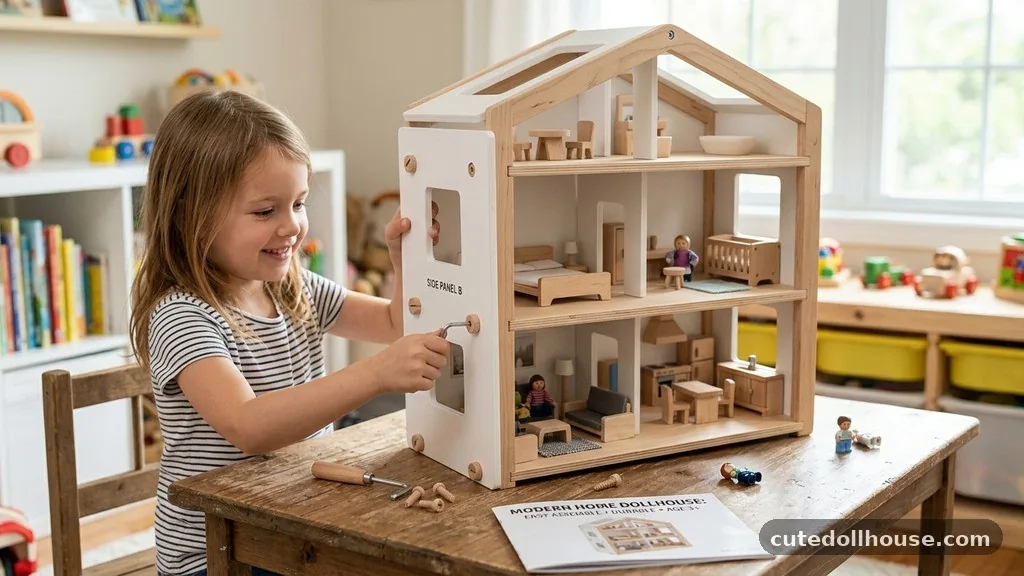
Assembly difficulty is influenced by the number of parts, the quality of the instructions, the type of connections, and the amount of finishing required. “No tools required” may still mean that adhesive, pressure, alignment, or drying time is involved.
For beginners, useful signs include numbered pieces, clearly labelled diagrams, pre-cut openings, tabs or slots, and a short sequence of structural steps. Unclear photographs, vague glue instructions, and unlabelled parts can turn a small project into a frustrating one.
Before buying, confirm whether the kit requires:
- Glue, screws, nails, or specialized tools.
- Paint, wallpaper, flooring, or other finishing materials.
- Separate lighting components or batteries.
- Adult supervision for assembly or use.
- Extra time for adhesive to cure between stages.
Included Accessories and Furnishings
Some modern dollhouses are sold as structural shells, while others include furniture, decorative pieces, lighting, or fabric elements. The more accessories included, the more complete the finished display may look, but accessory quantity shouldn’t replace checking the quality and compatibility of the main structure.
If the dollhouse is intended for play, consider whether the included pieces are practical to handle and store. Tiny decorative objects may suit adult collectors but can be unsuitable for younger children. Always review the manufacturer’s age guidance and safety information.
For general toy-safety information, buyers can consult the U.S. Consumer Product Safety Commission’s toy safety guidance.
Durability and Maintenance
Miniature structures collect dust and may be difficult to clean if they contain delicate furnishings, fabric, or working lights. A simpler open layout can be easier to maintain than a heavily decorated model with narrow corners and fragile details.
Think about how the dollhouse will be used. A display model that stays on a shelf may remain in good condition for years with careful dusting. A playhouse that is moved, opened, and handled regularly needs stronger joints and less fragile decoration.
Wooden and composite surfaces may need protection from moisture. Keep the finished model away from damp areas and direct sunlight if the materials or decoration could fade or swell.
Customer Feedback and Common Complaints
Customer feedback is most useful when it describes a specific issue rather than simply saying that a product is good or bad. Look for repeated comments about missing pieces, confusing instructions, poor fit, fragile accessories, or a final result that differs from the listing images.
Also look for positive details that explain why buyers were satisfied. Helpful comments may mention clear labelling, attractive proportions, manageable assembly, useful included accessories, or good support from the seller.
Feedback can vary by production batch, seller, shipping condition, and user skill. Treat isolated comments cautiously, but don’t dismiss multiple reports of the same structural or assembly problem.
Comparison: Which Type of Modern Dollhouse Fits?
Because no named products or verified specifications were provided, the table below compares common modern dollhouse formats rather than ranking individual models.
| Product Type | Best For | Typical Difficulty | Key Feature | Main Drawback | Overall Value Consideration |
|---|---|---|---|---|---|
| Basic modern kit | Beginners and casual crafters | Low to moderate | Simpler structure and contemporary styling | May require separate decoration and furniture | Good if you want a flexible starting point |
| Furniture-included kit | Buyers wanting a more complete setup | Moderate | Structural parts plus miniature contents | Included accessories may vary in quality | Compare the contents, not just the piece count |
| Partly assembled dollhouse | Display buyers and time-conscious users | Low to moderate | Less structural construction | Reduced customization and possible shipping concerns | Useful when convenience matters most |
| Advanced modern kit | Experienced hobbyists | Moderate to high | More detail and customization potential | Longer build and greater finishing demands | Better for a serious, hands-on project |
| Finished modern dollhouse | Immediate display or gifting | Minimal assembly | Ready-made appearance | Less personalisation and usually less control over materials | Worth considering when construction isn’t the goal |
How to Assemble an Easy Modern Dollhouse
Even a beginner-friendly dollhouse benefits from preparation. Assemble on a flat, protected surface where parts can remain undisturbed while adhesive sets. Sort the components before starting, and compare them with the parts list if one is provided.
- Read the full instruction booklet before joining anything.
- Separate structural panels, trim, accessories, and hardware.
- Check that openings, tabs, and connection points line up before applying adhesive.
- Build the main structure first, leaving decoration until the shell is stable.
- Allow glue or paint to dry according to the product instructions.
- Test furniture placement before permanently attaching interior details.
- Keep spare parts, packaging, and paperwork until the project is complete.
Don’t rush alignment. A small error at the base can become more noticeable as walls, floors, and roof sections are added. If a part doesn’t fit, avoid forcing it; check whether another panel is reversed or whether excess material needs careful removal.
Recommendations by Buyer Type
For Beginners
Choose a kit with labelled parts, illustrated instructions, straightforward structural panels, and limited decorative complexity. A basic modern design is often a sensible first project because clean lines can reduce the number of ornate trim pieces that need to be fitted accurately.
For Experienced Hobbyists
Look for a structure that leaves room for customization. Removable walls, open interiors, compatible scale, and accessible rooms can make it easier to add wallpaper, flooring, wiring, or custom furniture later.
For Appearance-Focused Buyers
Pay close attention to the finished dimensions, window design, roofline, and interior layout. Confirm which features are included rather than judging only from staged photographs. A plain kit may look excellent after finishing, but it may need additional materials and time.
For Value-Focused Buyers
Compare the full project cost, not only the initial kit price. Adhesive, paint, flooring, furniture, lighting, tools, and replacement parts can change the total investment. A cheaper shell may become less economical if many essential components are sold separately.
For Buyers Who Want Convenience
A partly assembled or completed model may be a better fit than a flat-pack kit. Verify how much work remains, how the item will be packaged, and whether its size makes returns or relocation difficult.
Potential Drawbacks to Consider
Modern styling doesn’t eliminate the usual challenges of miniature construction. Small parts can be easy to lose, instructions may not be equally clear across brands, and the finished product may require more decoration than expected.
- Assembly can take longer than the listing’s brief description suggests.
- Glue, paint, tools, and furnishings may not be included.
- Decorative parts can be more fragile than the main structure.
- Scale differences can make separately purchased furniture unsuitable.
- Large models need a stable, dedicated display area.
- Pre-assembled options may offer less customization.
These aren’t automatic reasons to avoid modern dollhouses. They are reminders to match the project with your available time, space, patience, and intended user.
Frequently Asked Questions
What is the best type of modern dollhouse for a beginner?
A basic kit with labelled parts, clear diagrams, a simple structure, and limited finishing requirements is usually the most approachable. Verify whether glue, paint, and furnishings are included before buying.
Are easy-assembly dollhouses suitable for children?
Some may be, but suitability depends on the manufacturer’s age guidance, small-part warnings, materials, and intended use. A construction kit may be better for supervised building, while rough play calls for a sturdier toy designed specifically for children.
Do modern dollhouse kits include furniture?
Not always. Some include furniture and decorative accessories, while others provide only the structural shell. Read the contents list and product photographs carefully because staged images may show items sold separately.
What scale should I choose?
Choose a scale that matches the furniture and accessories you already own or plan to purchase. A common scale may offer more accessory options, but the correct choice depends on the specific model and its stated measurements.
Is a finished dollhouse better than an assembly kit?
It depends on your goal. A finished model is more convenient and requires less construction, while a kit offers more opportunity to customize the layout, finishes, and decoration.
How can I tell whether a dollhouse is genuinely easy to assemble?
Check for labelled parts, detailed instructions, pre-cut components, simple joining methods, and clear information about required tools and materials. Reviews that describe the assembly process are more useful than a general “easy to build” claim.
Final Verdict on the Best Modern Dollhouses — Easy to Assemble
The best modern dollhouses that are easy to assemble are a strong choice for buyers who want contemporary styling without committing to the most demanding type of miniature construction. The safest purchase is one that clearly states its materials, dimensions, scale, included contents, required tools, and expected difficulty. Don’t judge the kit by its display photograph alone.
Choose a basic model for a first project, a more customizable kit for serious hobby work, or a partly assembled design when convenience matters more than the building process. Before ordering, confirm the final size, accessory list, safety guidance, and seller return policy. With those checks in place, a modern dollhouse can be a worthwhile creative project or display piece—but only if its construction demands match your expectations.