
Choosing among the best Eco-Friendly Wooden Dollhouses takes more thought than picking the prettiest miniature home. Materials, finishes, construction, scale, assembly, and the child’s age all affect whether a dollhouse becomes a durable play space or an awkward, fragile decoration. Wooden models can offer a warmer feel and longer useful life than many plastic alternatives, but “eco-friendly” isn’t a universal product standard, so buyers still need to check what the manufacturer actually means.
The right choice should suit the child’s play style, the available room, and the adult’s expectations for safety and maintenance. This article explains the main options, practical trade-offs, and questions to ask before buying.
What Makes a Wooden Dollhouse Eco-Friendly?
An eco-friendly wooden dollhouse is generally designed with materials and manufacturing choices intended to reduce environmental impact. That may include wood from responsibly managed forests, recycled or recyclable packaging, water-based finishes, durable construction, or a design intended to last through years of play.
However, the term is used inconsistently. One seller may focus on the wood source, while another highlights non-toxic paint or minimal packaging.
A dollhouse should not be treated as environmentally responsible simply because it is made from wood. Adhesives, coatings, composite panels, plastic fittings, transport packaging, and the expected lifespan all matter.
Buyers should look for clear information about the following:
- The type of wood or wood-based panel used.
- Whether paints, stains, and sealants are water-based or low-emission.
- Whether the manufacturer identifies any relevant safety testing or material standards.
- How much plastic is included in the structure and accessories.
- Whether replacement parts or additional furniture are available.
- How easily the dollhouse can be repaired, cleaned, stored, or passed on.
Some details vary by model, seller, region, and production batch. If a listing uses broad language such as “natural,” “green,” or “non-toxic” without explaining the finish or testing, treat that as a prompt to ask questions rather than as proof of a particular standard.
Why Choose a Wooden Dollhouse?
Wooden dollhouses appeal to families who want a tactile, open-ended toy with a classic appearance. The material often has more visual warmth than molded plastic, and a well-designed structure can work as both a plaything and a permanent feature in a child’s room.
They also encourage flexible play. Children can arrange furniture, invent family stories, create shops or schools, and redesign rooms instead of following one fixed activity. A plain wooden dollhouse may be especially useful for creative play because it leaves room for the child to decide what each space becomes.
There are practical reasons to consider one, too:
- Long-term play: A sturdy house can remain interesting as children change how they play.
- Repairability: Wooden panels and simple fittings may be easier to mend than thin molded components.
- Appearance: Natural wood and restrained finishes suit many bedrooms and playrooms.
- Customization: Some designs can be painted, wallpapered, furnished, or decorated.
- Reduced reliance on plastic: A wood-forward construction may appeal to families trying to limit plastic toys.
None of these advantages is automatic. A poorly finished wooden house can splinter, wobble, or use more composite material and plastic than expected. Build quality matters more than the word “wooden” on the package.
Are Eco-Friendly Wooden Dollhouses Worth Buying?
For the right household, yes. An eco-conscious wooden dollhouse can be a worthwhile purchase when it is safe, stable, appropriately sized, and likely to receive regular use. The value is strongest when the structure supports open-ended play and can remain useful for several years rather than being quickly outgrown.
It may be less suitable when space is limited, the child prefers portable toys, or the available models require complicated assembly and extensive accessories before they become playable. Large wooden dollhouses can also be difficult to move, and high-quality materials or detailed construction may increase the purchase cost.
A plastic dollhouse may be more practical for a child who carries toys between rooms or outdoors. A miniature kit may suit an older hobbyist who wants realism and enjoys construction. A simple open shelf or room box can be a better alternative for families that want dollhouse play without a full-size structure.
When This Category Makes Sense
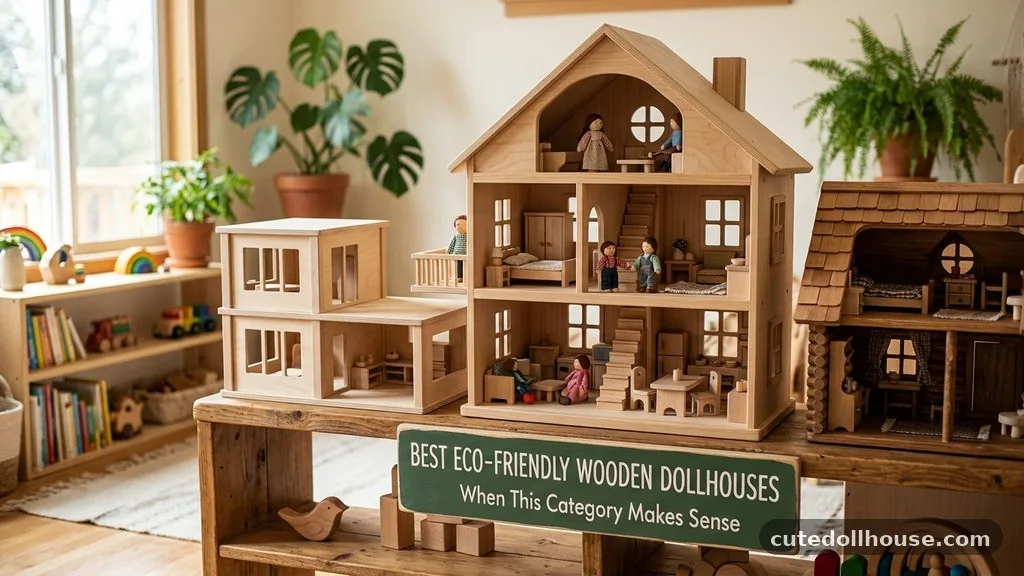
- You want a durable centerpiece for imaginative play.
- You prefer wood, restrained finishes, and a less disposable toy.
- The child has enough room to play comfortably around the house.
- An adult can check the construction and complete any required assembly.
- You’re comfortable verifying material and finish details with the seller.
When to Consider an Alternative
- You need something lightweight, foldable, or easy to travel with.
- The child is likely to lose interest in role-play quickly.
- The house is intended for delicate adult miniatures rather than child-led play.
- You cannot confirm age guidance, finish information, or small-part warnings.
- Your available space cannot accommodate the house and its surrounding play area.
Types of Eco-Friendly Wooden Dollhouses
Not every wooden dollhouse serves the same purpose. Understanding the broad design categories can make product listings easier to compare.
| Type | Best For | Typical Strength | Potential Limitation |
|---|---|---|---|
| Open-front playhouse | Young children and shared play | Easy access and visibility | Less enclosed detail and limited dust protection |
| Room-style house | Flexible layouts and compact spaces | Simple to furnish and rearrange | May feel less like a complete home |
| Multi-level house | Children who enjoy several play zones | More room for storytelling | Can be taller, heavier, and harder to access |
| Plain unfinished house | Craft projects and customization | Allows painting and personal decoration | May require extra work before use |
| Detailed decorative house | Older children, collectors, and display use | Stronger visual character | Delicate details may not suit rough play |
Open-front designs are often the most practical for children because small hands can reach every room. Enclosed or highly detailed houses may look more realistic, but doors, balconies, stairs, railings, and narrow spaces can complicate both play and cleaning.
Buying Criteria That Matter Most
Wood and Material Quality
Look beyond the product title. A dollhouse may be made from solid wood, plywood, medium-density fibreboard, particleboard, or a mixture of materials. Each can be suitable, but the construction should be clearly described.
Solid wood can provide a substantial feel, though it may add weight and cost. Plywood can offer good structural stability when properly made.
Composite panels may keep the price lower, but edges and surfaces should be sealed smoothly. If a listing does not identify the main material, contact the seller before buying.
Inspect available images for rough edges, exposed fasteners, uneven paint, thin-looking panels, and unsupported balconies. Product photographs cannot confirm every detail, but they can reveal whether the design appears intended for active play or mainly for display.
Finishes, Paint, and Adhesives
Finish information is particularly important for a toy that children may touch frequently. Terms such as “non-toxic” can be useful, but they are not detailed enough on their own. Ask whether the paint or sealant is water-based, whether the finish has been tested for the intended market, and whether the manufacturer provides age guidance.
Painted surfaces should be even and fully cured when supplied. Unfinished wood may reduce the number of coatings, but it can also require sanding or sealing before use. Never assume that an unfinished model is automatically safer or more environmentally responsible.
For general toy-safety background, buyers can consult the U.S. Consumer Product Safety Commission’s toy safety guidance. Local requirements may differ, especially outside the United States.
Design and Appearance
Appearance is subjective, but it affects whether the dollhouse becomes part of the room or gets stored away. Natural wood, simple windows, and neutral colors tend to blend easily with existing furniture. Bright paint and detailed façades may be more appealing to children who enjoy recognizable rooms and traditional house designs.
Consider the interior, not just the front. Are the floors deep enough for furniture? Can children reach the back corners?
Is there space for figures to stand? A beautiful exterior cannot compensate for an interior that is difficult to use.
Size, Scale, and Room Fit
Size is one of the easiest details to underestimate. Measure the floor area and height available, then allow additional space for children to sit, move figures, and place furniture around the house.
Scale matters just as much. Dollhouse furniture and figures are not universally sized, so accessories from one range may not fit comfortably in another. Check internal room dimensions and the manufacturer’s recommended figure or furniture scale where provided.
A tall house may provide more rooms without taking much floor space, but it can be harder for younger children to reach upper levels. A wider, lower design may be easier to use but require more room.
Features and Functionality
Useful features include accessible rooms, removable roofs, wide openings, stable floors, and enough wall strength to support light decorations. Doors and windows should be functional only if they are sturdy and sized appropriately for the intended age group.
Be cautious with unnecessary detail. Tiny railings, loose shutters, miniature glass-like parts, and fragile decorative pieces may add realism while reducing durability. A simpler structure can deliver better everyday play.
Assembly and Difficulty
Many wooden dollhouses arrive flat-packed. Assembly may involve screws, dowels, glue, or a combination of methods. The listing should identify whether tools, glue, paint, or extra finishing work are required.
Before ordering, check:
- Whether assembly is intended for an adult.
- How clearly the instructions are described or shown.
- Whether the structure needs to be anchored or supported.
- Whether the panels are pre-finished.
- Whether furniture and figures are included or sold separately.
- Whether replacement hardware is available.
A straightforward assembly process is not only more convenient; it can also reduce the risk of a wobbly structure caused by misaligned panels. If customer feedback repeatedly mentions missing hardware or unclear instructions, take that pattern seriously, while remembering that individual experiences can vary by batch or seller.
Durability and Maintenance
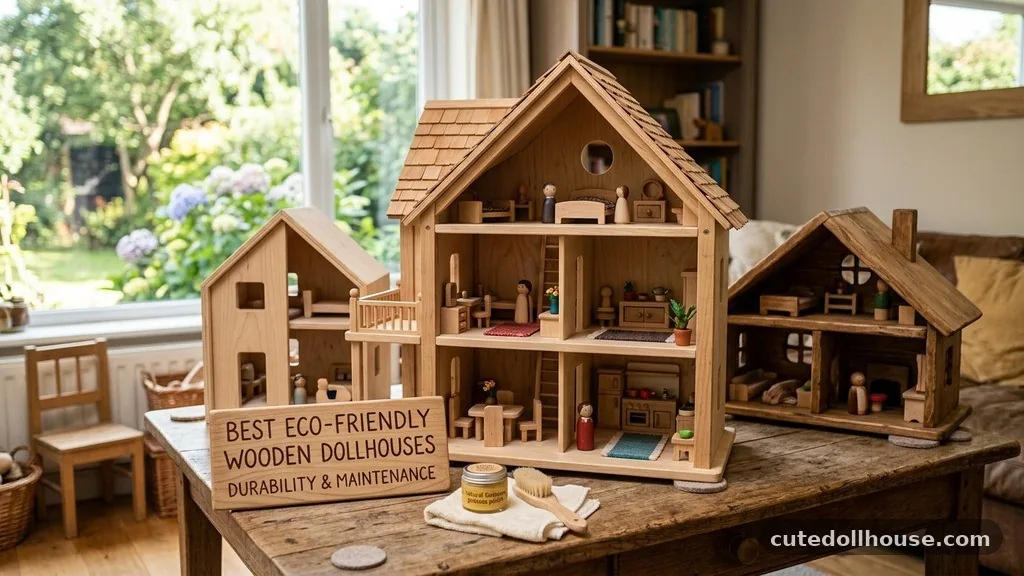
Durability comes from more than thick panels. Stable joints, reinforced corners, smooth edges, and a finish that tolerates ordinary handling all contribute to a longer life.
Wood should generally be kept dry and cleaned with a soft, slightly damp cloth unless the manufacturer gives different instructions. Avoid soaking unfinished surfaces. Direct heat and prolonged dampness can affect wood and some composite materials.
Look for a design that can be repaired rather than discarded. Replaceable roofs, stairs, or hardware are useful, but only if the company supports spare parts or provides enough information to source compatible pieces.
Included Accessories and Ongoing Cost
A dollhouse may be sold as a bare structure, with furniture, or as part of a larger play set. Compare the complete setup rather than the initial box alone. A lower-priced house can become a more expensive purchase if it needs a full set of compatible furniture, figures, and room decorations.
On the other hand, a plain wooden house can be valuable for families who enjoy making furniture or decorating rooms together. Its simplicity may be a feature, not a missing component.
Customer Feedback and Common Complaints
Customer comments can reveal practical issues that specifications leave out. Look for repeated themes rather than a single enthusiastic or negative review.
Useful patterns include:
- Whether the finished house feels stable on a flat surface.
- Whether the instructions match the actual parts.
- Whether paint arrives chipped or edges need additional sanding.
- Whether the stated dimensions match the delivered product.
- Whether furniture fits as expected.
- Whether packaging protects corners and decorative elements.
Feedback can differ between marketplaces, production runs, and third-party sellers. Check the exact model number and seller before treating a review as relevant.
Safety and Age Considerations
Age guidance should be treated as a starting point, not a substitute for supervision. A wooden dollhouse can contain small furniture, loose accessories, removable fittings, or narrow components that are unsuitable for younger children.
Inspect the finished product before giving it to a child. Run a hand over accessible edges, check that joints are tight, and look for loose paint or splinters. If a component breaks, remove it until it can be repaired or replaced.
Stability is important for taller models. Place the house on a level surface and follow any anchoring guidance supplied by the manufacturer. Children may pull themselves up on a dollhouse, even when the product is designed only for imaginative play.
How to Choose by Buyer Type
For Beginners
Choose a compact, open-front model with clear dimensions, simple assembly, and widely available compatible furniture. Avoid a design that requires extensive painting or delicate finishing unless an adult specifically wants a craft project.
For Appearance-Focused Buyers
Pay attention to façade details, finish consistency, roof design, and how the house looks from the sides and back. A display-friendly model may have narrower access, so confirm that appearance does not compromise playability.
For Creative Families
An unfinished or lightly finished wooden house can provide a useful decorating project. Check whether the surface is suitable for the intended paint or wallpaper and whether modifications could affect structural stability.
For Small Rooms
Measure height as carefully as width. A tall house may save floor space but require a safe step or adult help for upper rooms. A compact room box or low, wide design could be easier to use.
For Value-Focused Buyers
Compare the total cost of the house, furniture, figures, delivery, and any finishing supplies. A durable basic structure can offer better value than a heavily decorated model if the child enjoys furnishing and customizing spaces.
For Premium Buyers
Look for transparent material descriptions, careful joinery, replacement-part support, and a finish that is appropriate for the intended use. Premium pricing should correspond to better construction or service, not only a more elaborate appearance.
Common Mistakes to Avoid
- Assuming wood means eco-friendly: Check the source, coatings, packaging, and expected lifespan.
- Ignoring scale: Furniture and figures may not fit even when the house looks large in photographs.
- Buying by exterior dimensions alone: Interior access determines whether children can actually play comfortably.
- Forgetting assembly requirements: Glue, tools, paint, and extra curing time may be necessary.
- Overlooking small parts: Detailed accessories can be unsuitable for younger children.
- Trusting vague safety wording: Ask for specific finish and testing information.
- Skipping seller checks: Confirm that the specifications and return terms apply to the exact model.
Frequently Asked Questions
What should I look for in an eco-friendly wooden dollhouse?
Look for clearly identified wood or panel materials, transparent information about paints and sealants, limited unnecessary plastic, durable construction, recyclable packaging where stated, and a design that can be used for years. “Eco-friendly” claims should be supported by specific product information.
Are wooden dollhouses safe for young children?
Safety depends on the individual design, age guidance, finishes, stability, and accessories. Check for small parts, inspect edges and joints, and supervise children according to the manufacturer’s instructions. Taller houses may also need extra stability precautions.
What is the best wood for a dollhouse?
There is no single best choice for every buyer. Solid wood can feel substantial, plywood can provide stable panels, and composite boards can support affordable designs. Smooth construction, strong joints, safe finishes, and suitable dimensions matter as much as the wood category.
Do wooden dollhouses come with furniture?
Some do and some are sold as structures only. Read the included-items list carefully and check whether the furniture shown in photographs is part of the package. Also confirm the scale before buying additional pieces.
Are unfinished wooden dollhouses a good option?
They can be a good choice for families that want to paint, decorate, or build accessories together. They may require sanding, sealing, or other preparation, so verify the manufacturer’s instructions and make sure any added products are suitable for children’s toys.
How can I maintain a wooden dollhouse?
Keep it dry, dust it with a soft cloth, and follow the care instructions for the finish. Check joints, stairs, balconies, and small fittings periodically. Repair loose or damaged parts before continued play.
Final Verdict
The best Eco-Friendly Wooden Dollhouses are not defined by wood alone. The strongest choices combine clear material information, smooth construction, sensible safety details, accessible rooms, and a design that will remain useful beyond the first few weeks. Buyers should also account for scale, assembly, furniture, available space, and the child’s actual play habits.
This category is worth buying for families who want a durable, imaginative centerpiece and are prepared to verify environmental and safety claims before ordering. A simpler wooden house may be the smarter choice than a highly detailed one, especially when everyday play matters more than display. Compare the exact model and seller carefully, then choose the house that fits your room, budget, and expectations rather than relying on the label alone.