
The best dollhouses for kids ages 3 to 5 should invite imaginative play without creating unnecessary safety, assembly, or space problems. At this age, children usually benefit from a sturdy, easy-to-reach design with large enough accessories, simple room layouts, and materials that can handle regular play. The challenge is that dollhouses vary widely in size, construction, age guidance, and the number of small pieces included.
A beautiful house may be too delicate, while a highly accessorized model may overwhelm a younger child. The right choice depends on your child’s play style, available space, supervision level, and expectations about durability. This guide explains the main dollhouse types, practical features, potential drawbacks, and the questions worth answering before buying.
What Makes a Dollhouse Suitable for Ages 3 to 5?
A dollhouse is a miniature play setting that lets children create stories using rooms, furniture, dolls, animals, and everyday objects. Children can act out familiar routines such as cooking, sleeping, visiting, cleaning, or caring for a baby. The house itself becomes a backdrop for open-ended pretend play rather than a toy with one fixed way to use it.

For children between 3 and 5, the best designs are usually simple enough to understand and sturdy enough for enthusiastic handling. Wide openings, accessible floors, and furniture that is easy to move can matter more than intricate decoration. Younger children may not use a dollhouse according to an adult’s intended layout, so a practical design should leave room for experimentation.
Age guidance is an important starting point, but it isn’t the only factor. A product marked for ages 3 and up may still contain small accessories that require supervision, particularly if a child still puts objects in their mouth or plays roughly. Always check the current manufacturer’s warning label, included-parts list, and instructions before purchasing.
Are Dollhouses Worth Buying for Young Children?
A dollhouse can be a worthwhile purchase if a child enjoys pretend play, arranging objects, or acting out stories. It may support language development, sequencing, social play, and fine-motor practice as children move furniture, open doors, place figures, and create imaginary situations. Those benefits come from the play process, not from a particular brand or decorative style.
The category is less suitable when a child has little interest in role-play or when the available space cannot accommodate the house safely. A large model that stays in storage may offer less value than a compact playset that can be brought out easily. Likewise, a child who prefers vehicles, construction, puzzles, or active outdoor play may not use a traditional dollhouse often.
A Dollhouse May Be a Good Choice If:
- Your child enjoys pretend families, home routines, or storyte
lling. - There is a stable play area where the house can remain set up.
- You want a toy that can support independent or cooperative play.
- You are comfortable checking small accessories and supervising younger children.
- The design matches the child’s reach, strength, and ability to handle movable parts.
An Alternative May Be Better If:
- Your child prefers open-ended building rather than role-play.
- Floor space is limited and the dollhouse would need frequent moving.
- The child is likely to become frustrated by furniture, figures, or assembly.
- You need a toy with fewer detachable parts and simpler cleanup.
- The intended play area cannot keep the house away from pets or younger siblings.
Types of Dollhouses for Kids Ages 3 to 5
There isn’t one universally best dollhouse for every preschooler. Different formats suit different homes and play habits.
Wooden Dollhouses
Wooden dollhouses often appeal to buyers who want a substantial-looking toy with a more traditional appearance. They may use engineered wood, solid wood components, or a combination of materials, so the product description should be checked carefully rather than assuming every “wooden” house is made entirely from solid timber.
These models can be visually attractive and may remain appealing as a child grows. Their drawbacks can include greater weight, more involved assembly, and a higher likelihood of chipped paint or visible wear if handled roughly. Some wooden houses also have fixed room layouts that leave less flexibility for play.
Plastic Dollhouses
Plastic designs are often easier to wipe clean and may be lighter than wooden alternatives. Rounded edges, molded furniture, and colorful surfaces can make them approachable for younger children. Plastic may also tolerate spills better, though durability varies by thickness, construction, and the quality of hinges or connectors.
Some plastic houses are compact and easy to store. Others use many small accessories that can be lost quickly. Check whether the house has removable parts, how the doors and windows operate, and whether replacement accessories are available.
Foldable or Portable Dollhouses
Foldable designs can suit families who need to clear the floor after play. Their portability is useful, but folding sections, latches, and hinges introduce additional points that should be inspected. A portable house may also offer less room for furniture than a full-size open-front model.
Before buying, confirm the folded and assembled dimensions. A product can look compact in a listing photograph while still requiring a broad footprint when opened.
Large Open-Front Dollhouses
Open-front houses give children and adults a clear view of several rooms. They can work well for shared play because more than one child may reach the interior at the same time. The trade-off is that they usually need a permanent location and can be difficult to move once furnished.
Small Dollhouse Playsets
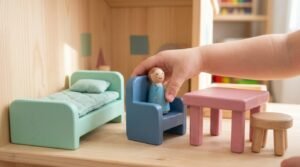
Compact playsets may be more manageable for a three-year-old or for a family with limited storage. They can be a sensible introduction to pretend-home play, particularly when the child is still learning how to arrange furniture and figures.
The smaller scale can also mean more fiddly accessories. “Small” should not automatically be treated as safer, so age warnings and part sizes still need attention.
What to Check Before Buying
1. Safety and Age Guidance
Safety should come before appearance. Review the manufacturer’s recommended age range and warning statements, then consider whether the child’s actual behavior matches that guidance. A mature five-year-old and a child who frequently mouths toys may need different levels of supervision.
Pay particular attention to:
- Small furniture, utensils, figures, animals, and decorative pieces.
- Hinges, folding panels, doors, windows, and other pinch points.
- Sharp corners, rough edges, exposed fasteners, or loose trim.
- Stability when a child reaches into an upper floor or pulls on the house.
- Paint, finish, and material information supplied by the manufacturer.
Product details can change between production batches or regional versions. If a listing provides vague safety information, look for the manufacturer’s current instructions rather than relying solely on retailer photographs.
2. Construction and Material Quality
Material choice affects weight, maintenance, appearance, and likely longevity, but the label alone doesn’t tell the whole story. A well-designed composite-board house may be more practical than a poorly finished wooden one. Likewise, a plastic house can be durable, but thin panels or weak connections may reduce its lifespan.
Look for clear information about the main structure, fasteners, hinges, surface finish, and included accessories. Customer feedback can reveal recurring concerns such as cracked panels, missing pieces, difficult assembly, or doors that stop working. One isolated complaint is not necessarily a pattern, and seller-specific reviews may not apply to every version of a product.
3. Size, Scale, and Reach
Size affects both playability and storage. A house should be large enough for a child to reach the rooms comfortably but not so deep that the back becomes difficult to access. Tall structures may look impressive, yet upper floors can be less useful if the child cannot see or reach them easily.
Check these measurements before ordering:
- Fully assembled height, width, and depth.
- Floor-to-floor spacing and doorway dimensions.
- Clearance needed around the house for play.
- Storage dimensions if the house folds or comes apart.
- Figure and furniture scale compatibility.
Scale matters because accessories from one playset may not fit another. If you plan to add furniture or figures later, confirm compatibility rather than assuming similarly named products use the same proportions.
4. Layout and Accessibility
Young children often play with both hands at once, moving figures from room to room while rearranging furniture. An open-front layout, broad windows, or removable sections can make this easier. Narrow rooms and deep interiors may look detailed but can limit practical play.
Consider whether the layout encourages storytelling. A few recognizable spaces, such as a bedroom, kitchen, or living area, may be enough. More rooms aren’t automatically better if they leave little space for figures or make the house hard to understand.
5. Included Accessories
Accessories can make a dollhouse ready to play with immediately, but quantity should not be the only consideration. A set with fewer, sturdier pieces may be more useful for a preschooler than one filled with tiny decorative items.
Check whether the package includes figures, furniture, pets, vehicles, or household objects. Also check which items are pictured but sold separately. Retailer images sometimes show optional accessories, room decorations, or additional figures that aren’t included in the base package.
6. Assembly Requirements
Some dollhouses arrive mostly assembled, while others require extensive construction. Assembly may involve multiple panels, screws, dowels, stickers, or decorative parts. The instructions, tools, estimated assembly time, and need for a second adult can vary by model.
For a three-year-old, adult assembly is normally expected even when the finished product is designed for children. Before purchasing, determine whether the house can be assembled securely and whether it will need to be moved immediately afterward. A complicated build may be acceptable for a permanent playroom but inconvenient for a living room that must be cleared daily.
7. Stability and Maintenance
A dollhouse should sit firmly on its intended surface. If it is tall, lightweight, or narrow, stability becomes especially important.
Use the supplied instructions and any recommended wall or furniture anchoring method. Don’t place a large house where a child can climb on nearby furniture to reach it.
Maintenance is usually straightforward, but the material affects cleaning. Plastic surfaces may tolerate a damp cloth, whereas unfinished or painted wood may require more cautious care. Avoid assuming that a finish is waterproof unless the manufacturer says so.
Comparison of Dollhouse Types
| Type | Best For | Typical Practical Strength | Potential Drawback | What to Verify |
|---|---|---|---|---|
| Wooden dollhouse | Families prioritizing a traditional appearance and substantial structure | Often visually appealing and suitable for a permanent play area | May be heavier and require more assembly | Board type, finish, stability, and hardware |
| Plastic dollhouse | Children who need easy-clean surfaces or a lighter design | Simple maintenance and potentially easier movement | Quality can vary between panels, hinges, and connectors | Plastic thickness, movable parts, and included accessories |
| Foldable dollhouse | Homes where toys must be stored after play | Can reduce storage demands when closed | Folding joints may affect durability or interior space | Folded dimensions, latches, hinges, and setup process |
| Large open-front house | Shared play and children who enjoy arranging multiple rooms | Good visibility and access from the front | Requires more floor space and may be difficult to relocate | Footprint, height, reach, and anti-tip guidance |
| Compact playset | First-time buyers, smaller rooms, or occasional play | Usually easier to store and position | May offer less room and include smaller accessories | Part size, scale, storage method, and age warnings |
How to Choose for a Three-Year-Old
A three-year-old often benefits from a low, accessible house with a straightforward layout. Look for large rooms, sturdy furniture, and a limited number of detachable pieces. If the child is still developing fine-motor control, tiny accessories may create frustration rather than add value.
Supervision matters more at this age. A dollhouse can be perfectly suitable while some of its accessories are not appropriate for unsupervised play. Consider storing small parts separately and introducing them gradually if necessary.
How to Choose for a Four-Year-Old
Four-year-olds may be ready for more detailed storytelling and role-play. A house with several recognizable rooms, a few movable furnishings, and enough space for figures can provide room for richer play without becoming excessively complicated.
At this age, ask whether the design supports independent setup. Children often enjoy deciding where objects belong, but they may still need help with stiff doors, heavy furniture, or fragile decorative parts.
How to Choose for a Five-Year-Old
A five-year-old may appreciate a larger or more detailed dollhouse, particularly if they already enjoy pretend families and structured stories. More accessories can be useful when they are durable, appropriately sized, and easy to organize.
Older preschoolers may also want to combine the house with existing dolls or figures. Check the scale before buying. A beautiful house that cannot accommodate a child’s favorite figures may receive less play than a simpler, compatible option.
Common Problems Buyers Should Watch For
Confusing Product Photos
Listings may show a furnished room, additional figures, or a decorated environment that differs from what arrives in the box. Read the included-items section carefully. If the information is unclear, contact the seller or manufacturer before ordering.
Overly Small Accessories
A large collection of miniature items can look appealing but may be hard for young children to handle and easy to lose. It can also increase cleanup time. For ages 3 to 5, useful accessories should support play rather than simply fill every room.
Unclear Assembly Instructions
Assembly complaints are more meaningful when several buyers describe the same issue, such as misaligned holes, missing hardware, or confusing diagrams. Still, reviews can refer to different sellers or production versions. Check the date, model number, and return policy where possible.
Insufficient Stability
A tall or narrow dollhouse needs a stable base and a safe placement area. Don’t assume that a heavy-looking design cannot tip. Follow the maker’s instructions and inspect the completed structure before allowing a child to play with it.
More Decoration Than Play Space
Some houses emphasize exterior styling, colors, or elaborate façades while offering limited room inside. For a young child, accessible interior space may matter more than decorative detail. Compare the actual floor dimensions and openings, not just the product photograph.
Recommendations by Buyer Type
Best Approach for First-Time Buyers
Start with a compact or moderately sized house that has a clear layout, sturdy surfaces, and a manageable accessory count. A simpler design makes it easier to learn what the child actually enjoys before investing in a larger play environment.
Best Approach for Small Spaces
Choose a foldable or compact model, but confirm both open and closed measurements. A house that folds is only useful if the folding process is practical and the structure can be stored safely between play sessions.
Best Approach for Shared Sibling Play
Prioritize front access, multiple reachable rooms, and a stable footprint. A narrow house may cause arguments if only one child can reach the interior at a time. Durable, easy-to-replace accessories can also make shared play less stressful.
Best Approach for Appearance-Focused Buyers
Wooden or traditionally styled houses may better suit a room where the toy remains on display. Inspect the finish, color accuracy, and construction details, but don’t sacrifice stability or usable interior space for appearance alone.
Best Approach for Value-Focused Buyers
Compare what is included rather than looking only at the purchase price. A less expensive house may require separate figures, furniture, or storage solutions. A higher-cost set may not be better value if the child will use only a few accessories.
Best Approach for Buyers Wanting Long-Term Use
Look for a flexible layout, compatible accessories, replaceable or widely available figures, and construction that can tolerate regular handling. Avoid designs that depend heavily on delicate decorative parts or a narrow proprietary scale unless those limitations are acceptable.
How to Read Customer Feedback Carefully
Customer reviews can help identify recurring practical problems, but they should be treated as one source of information. Look for repeated comments about assembly, missing parts, stability, dimensions, and whether the product matched its photographs.
Separate subjective preferences from factual concerns. One buyer may dislike a color that another appreciates, while repeated reports of broken hinges deserve closer attention. Reviews can also reflect seller handling, shipping damage, or a different version of the product, so check whether the comments apply to the exact model you intend to buy.
Frequently Asked Questions
What is a good dollhouse for a three-year-old child?
A good choice usually has a stable structure, accessible rooms, simple furniture, and age-appropriate accessories. Check the manufacturer’s warnings carefully, especially if the child still mouths objects or plays around younger siblings.
What is the best dollhouse for a five-year-old?
The best option depends on the child’s interests and existing figures. A five-year-old who enjoys detailed pretend play may prefer a larger house with multiple rooms, while another child may get more use from a compact set with fewer, sturdier pieces.
Are wooden dollhouses safer than plastic ones?
Neither material is automatically safer. Safety depends on construction, finish, stability, edges, moving parts, and the size of included accessories. Review the specific product rather than relying on the material label alone.
Do dollhouses usually come assembled?
Assembly requirements vary considerably. Some are largely ready to use, while others require several panels, screws, or decorative parts. Check the instructions and included hardware before buying, and allow adult assembly unless the manufacturer states otherwise.
What size dollhouse works best for ages 3 to 5?
A suitable size is one the child can reach comfortably and that fits safely in the intended room. Measure the assembled footprint, height, and surrounding play area. Large houses offer more room but may be harder to move and supervise.
Are small dollhouse accessories appropriate for preschoolers?
They may not be appropriate for every preschooler. Small parts can pose a risk to children who still mouth objects and can be difficult for some children to handle. Follow age warnings, supervise play when needed, and store loose accessories safely.
Final Verdict
The best Dollhouses for Kids Ages 3 to 5 are not defined by the most rooms, the most accessories, or the most elaborate exterior. A worthwhile choice is stable, reachable, appropriately sized, and matched to the child’s interest in pretend play. Before buying, verify the age guidance, dimensions, materials, included pieces, assembly requirements, and return terms.
For a first purchase, a simple, sturdy design is often the safest starting point. Families with more space may prefer a larger open-front house, while households that need easy storage may be better served by a compact or foldable model. Compare the actual play experience rather than relying on photographs, and the right dollhouse can become a flexible toy that grows with a child’s imagination.