
Choosing among the best wooden dollhouses with accessories takes more thought than picking the prettiest design. A sturdy house can become a long-lasting pretend-play space, while a poorly matched model may be too difficult to assemble, too small for its furniture, or unsuitable for the child’s age. Wooden dollhouses also vary widely in scale, layout, materials, included rooms, and accessory quality.
This matters to parents buying a first dollhouse, collectors seeking a more detailed display, and adults who want a customizable project. The right choice depends on who will use it, how much space is available, and whether the included furniture is genuinely useful or mostly decorative.
What Is a Wooden Dollhouse with Accessories?
A wooden dollhouse is a miniature house designed for imaginative play, display, or both. It usually includes several rooms, open sides or a front opening, and enough interior space for small furniture and figures. Some models arrive partly assembled, while others require the buyer to build the structure from panels, rails, stairs, and roof sections.
The term “with accessories” can mean very different things. One product may include only a few basic furnishings, while another may come with room sets, miniature appliances, people, pets, lighting, or decorative pieces. Buyers should read the contents list carefully rather than assuming that a fully furnished house is included.
Scale is another important consideration. Dollhouse furniture is not universally interchangeable. A chair that fits one house may look oversized in another, so check the manufacturer’s recommended accessories or compare interior measurements before adding furniture sets from another brand.
Are Wooden Dollhouses Worth Buying?
For many families, a wooden dollhouse is worth buying because it supports open-ended play rather than a single scripted activity. Children can create stories, arrange rooms, practise social roles, and revisit the toy over time. A well-designed house may also work as a display piece in a bedroom or playroom.
The category is not right for every household. Wooden dollhouses can take up significant floor or shelf space, and assembly may require patience.
Small accessories can be easy to lose and may not be suitable for very young children. A compact plastic dollhouse, foldable playset, or simpler wooden structure may be a better fit where storage, portability, or age suitability matters more than appearance.
Value depends less on the number of accessories than on how well the complete set matches the intended user. A house with fewer, better-sized pieces may provide more satisfying play than one advertised with a large assortment of tiny items that are difficult to handle.
What to Check Before Buying
Build and Material Quality
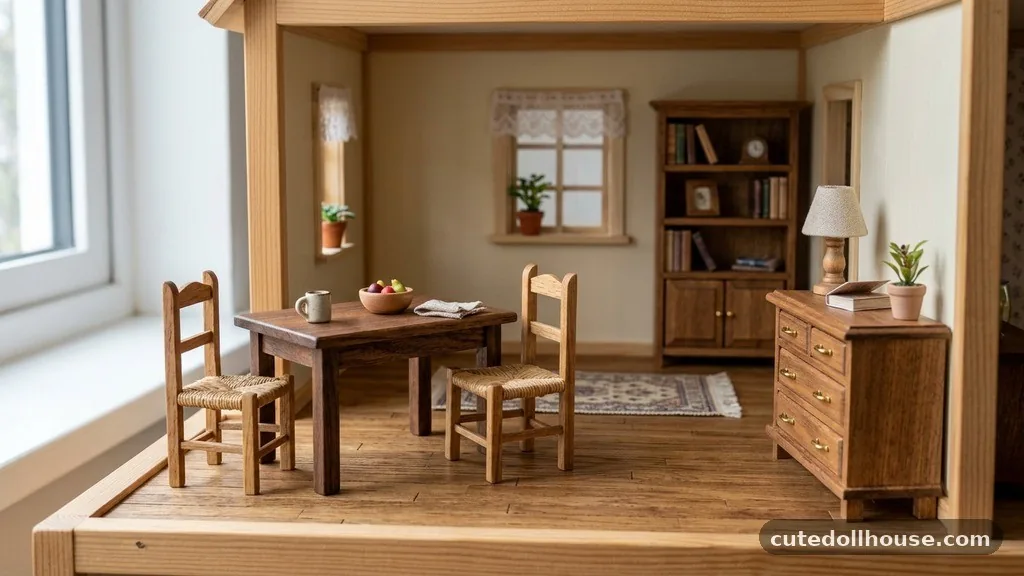
Wood construction can provide a solid feel, but “wooden” does not automatically mean heavy-duty. Products may combine solid wood, plywood, engineered wood, plastic fittings, cardboard elements, or fabric details. The product description should make those distinctions clear.
Look for cleanly finished edges, stable walls, securely attached rails, and hardware that does not appear unnecessarily delicate. Painted surfaces should be described as suitable for children where applicable. If the listing does not explain the materials or finish, that uncertainty is worth treating as a buying concern.
Design and Appearance
Appearance matters because a dollhouse often stays visible in a room. Traditional homes with pitched roofs and several rooms suit classic pretend play, while open-front designs may make furniture easier to reach. Contemporary layouts can look attractive but may offer less flexibility if the rooms are unusually narrow.
Consider whether the decoration is painted onto the structure or supplied as removable pieces. Fixed graphics require less maintenance, whereas removable details may allow more customization but can be easier to misplace.
Size and Available Space
Measure the shelf, table, or floor area before ordering. Check the house’s width, depth, and height, including roof overhangs and balconies. A product can fit on paper yet become impractical once children need space to stand or sit around it.
Also consider storage for accessories. Furniture, figures, and small decorative items need a box, drawer, or dedicated basket. Without one, even a well-designed dollhouse can quickly become difficult to keep organized.
Features and Functionality
Useful features may include hinged doors, movable shutters, accessible room openings, removable roofs, working lifts, or lighting. These additions can make play more engaging, but extra mechanisms also create more parts that may break or require assembly.
Prioritise features that support the way the child will actually play. A younger child may benefit more from wide openings and sturdy furniture than from delicate balconies or miniature lighting.
Included Accessories
Accessory counts need context. A set may list many items, but several may be tiny decorative objects rather than practical furniture. Before buying, check whether the package includes:
- Furniture for the rooms shown in the product images
- Figures, dolls, pets, or other characters
- Kitchen, bathroom, bedroom, and living-room pieces
- Stairs, rugs, lamps, plants, or decorative details
- Assembly hardware and clear instructions
- Storage guidance for the loose accessories
Product photography can be misleading if it shows optional furniture or additional sets. Read the “what’s included” section and, where necessary, ask the seller to confirm whether pictured accessories are part of the package.
Safety and Age Suitability
Age guidance should be treated as a practical safety requirement, not merely a marketing label. Small furniture and decorative pieces may present a choking hazard to young children. Parents should also check for accessible screws, sharp edges, fragile components, and parts that could detach during play.
For general toy-safety information, the U.S. Consumer Product Safety Commission’s toy safety guidance is a useful reference. Local requirements may differ, so buyers outside the United States should also consider their own region’s safety advice.
Assembly and Difficulty
Assembly is often the dividing line between a satisfying purchase and a frustrating one. A large wooden dollhouse may require aligning multiple panels, tightening screws, fitting decorative trim, and attaching a roof or staircase. Product listings do not always communicate how much time or care this takes.
Before ordering, look for:
- Clear assembly instructions with labelled parts
- Hardware that is included rather than sold separately
- Pre-drilled holes and accurately fitting panels
- Information about the tools required
- Instructions for securing the finished house if needed
If the house is intended for a child to use independently, remember that adult assembly and child-friendly play are separate issues. A complicated build can still result in an excellent playhouse, but the buyer should be prepared for the initial work.
Durability and Maintenance
Wooden dollhouses generally need to be kept dry and protected from rough handling that can loosen joints or damage trim. Dust can be removed with a soft, dry or slightly damp cloth, provided the manufacturer does not specify another method. Avoid soaking unfinished or porous surfaces.
Durability also depends on the accessories. Wooden furniture may withstand regular handling better than thin plastic or paper pieces, but heavier parts can put more stress on shelves and floors. A sturdy house with fragile contents is not the same as a fully durable playset.
Customer Feedback and Common Complaints
Reviews can help identify patterns that a product description leaves out, but individual experiences vary by seller, batch, delivery conditions, and assembly skill. Look for repeated comments rather than relying on one unusually positive or negative review.
Common complaints in this category can include missing hardware, unclear instructions, chipped paint, misaligned panels, smaller-than-expected rooms, and accessories that do not match the scale shown in photographs. These are not proof that every example has the problem; they are reasons to check return terms and seller support before purchase.
Comparison Factors at a Glance
| Factor | What to Look For | Why It Matters | Potential Warning Sign |
|---|---|---|---|
| Materials | Clear information about wood, engineered panels, paint, and plastic parts | Helps set realistic expectations for strength and finish | “Wooden” is used without explaining the construction |
| Size | External measurements and interior room dimensions | Confirms that the house and furniture fit the available space | Only lifestyle photos are provided |
| Accessories | A complete, itemised contents list | Prevents disappointment about optional or pictured items | Large accessory count with no breakdown |
| Assembly | Instructions, included hardware, and tool requirements | Shows how demanding the initial setup may be | No assembly information is available |
| Safety | Age guidance, finish information, and secure components | Helps match the house to the intended user | Small parts are shown without clear age guidance |
| Support | Seller responsiveness, returns, and replacement-part information | Useful if panels or hardware arrive damaged or missing | Unclear returns or no contact information |
Category Review: Wooden Dollhouses with Accessories
Overview
Wooden dollhouses with accessories are best understood as a broad product category rather than one standard format. They range from compact starter houses with basic furnishings to large, highly detailed structures intended for extended play or display. Because no specific model information was supplied for this review, it would be misleading to name a single product as the category winner or claim that one set includes features not verified by a manufacturer or seller.
The strongest buying decision comes from matching the house to the user’s age, available space, preferred scale, and appetite for assembly. Accessories should be assessed as part of the complete experience, not as a headline number.
Key Features to Prioritise
- A stable structure with smooth, well-finished edges
- Room dimensions that accommodate compatible furniture
- Open access for children to reach the interior
- Accessories that are appropriately sized and genuinely included
- Clear instructions and labelled hardware
- Age guidance that reflects the presence of small parts
- A design that fits the intended play area
What We Like About the Category
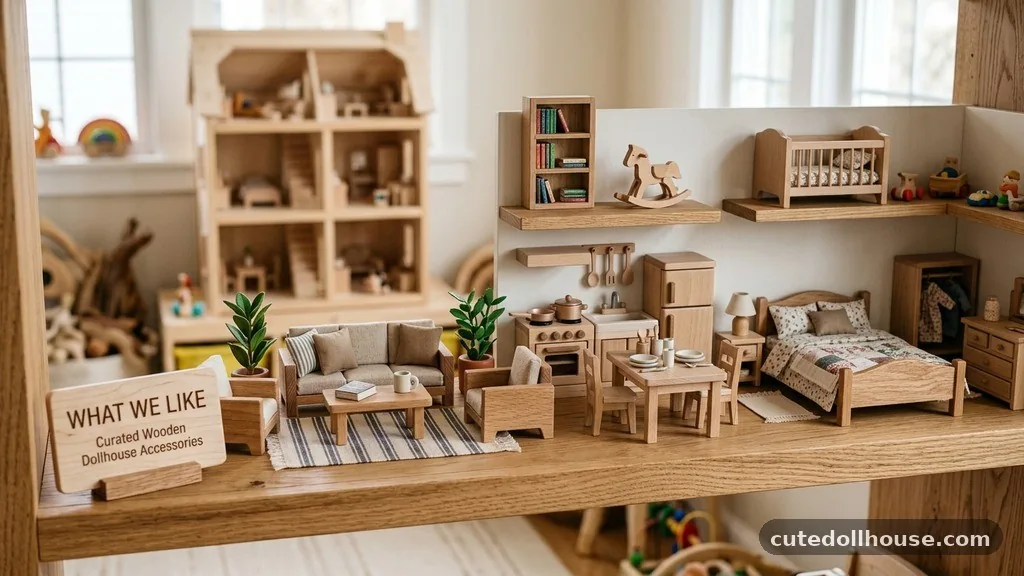
- Wooden construction can offer a more substantial feel than lightweight playsets.
- Open-ended layouts encourage children to rearrange rooms and invent stories.
- Furniture and accessories can make the house usable immediately after assembly.
- Many designs work as both toys and decorative pieces.
- Additional furniture may allow the play environment to evolve over time.
What Could Be Better
- Specifications are inconsistent from one seller or model to another.
- Assembly may be more involved than product images suggest.
- Large houses can be difficult to move or store.
- Small accessories may be unsuitable for younger children.
- Some listings blur the difference between included and optional items.
- Replacement parts may be difficult to obtain if the seller provides limited support.
Ease of Use or Assembly
Once assembled, an open-front wooden dollhouse is usually straightforward to use: children place furniture, move figures between rooms, and create their own scenarios. The more important question is whether the initial construction is manageable for the adult responsible for setup.
Buyers should reserve a clear work area, inventory the hardware, and avoid rushing alignment steps. If instructions are sparse or customer feedback repeatedly mentions fitting problems, a simpler model may offer better value even if it has fewer decorative details.
Quality and Durability
Quality cannot be confirmed from the word “wooden” alone. A durable model needs stable joints, a finish that can tolerate ordinary handling, and accessories that are not excessively fragile. Houses intended for frequent play should generally favour accessible, sturdy features over delicate decoration.
It is also sensible to inspect the finished structure before giving it to a child. Check that fasteners are secure, panels do not wobble, and no sharp edges or loose pieces remain. If something arrives damaged, photograph the issue and contact the seller before attempting a repair that could affect a return.
Who Is It Best For?
This category is a good fit for families who want a substantial imaginative-play centrepiece and have room to leave it assembled. It can also suit older children who enjoy arranging spaces, storytelling, and adding compatible wooden dollhouse furniture over time.
Adults who appreciate miniature interiors may enjoy more detailed designs as display pieces, although they should verify whether the house is built for play, decoration, or both. A fragile display model may not tolerate the handling expected from a young child.
Who Should Consider Alternatives?
A different format may be preferable for toddlers, frequent travellers, or households with limited storage. A foldable fabric or plastic playset can be easier to move, while a compact wooden house may be more suitable than a tall multi-level model in a small room.
Buyers who dislike assembly should avoid assuming that a premium-looking house arrives ready to use. Check the build requirements first. If there is no clear information, choose a product with a simpler construction or a seller that publishes detailed instructions.
Final Verdict
Wooden dollhouses with accessories can be worthwhile when the structure, scale, age guidance, and contents all match the buyer’s needs. Their main strengths are imaginative play, visual appeal, and the ability to customise rooms over time. Their main risks are unclear specifications, demanding assembly, limited storage, and accessories that may be smaller or fewer than expected.
Recommendations by Buyer Type
For First-Time Buyers
Choose a medium-sized design with accessible rooms, a clearly itemised accessory list, and straightforward assembly instructions. A simpler house is often easier to enjoy than a highly detailed one that creates setup or storage problems.
For Older Children and Experienced Users
Look for more room flexibility, compatible furniture options, and features that support customisation. Larger or multi-level houses may be rewarding, but measure the space and confirm that the child can comfortably reach every area.
For Appearance-Focused Buyers
Pay close attention to finish quality, colour accuracy, trim, roof design, and how the house looks from the side and rear. Decorative details are worthwhile only if the structure remains practical to access and maintain.
For Value-Focused Buyers
Compare the complete contents rather than the advertised accessory count. A reasonably priced house that includes useful furniture and reliable hardware may offer better value than a cheaper-looking deal that requires many additional purchases.
For Buyers Shopping for a Young Child
Age guidance and part size should come before style. Choose a design with sturdy, easy-to-reach features, and supervise play whenever the set includes small furniture, figures, or decorative pieces.
Frequently Asked Questions
What is the best-rated wooden dollhouse?
There is no single best-rated option for every buyer, and ratings can vary by retailer and model version. The better choice is the one with verified dimensions, suitable age guidance, clear assembly information, and accessories that match the intended use.
How do I choose the right wooden dollhouse?
Start with the user’s age and available space. Then compare construction materials, interior dimensions, scale compatibility, included accessories, assembly requirements, and the seller’s return and support policies.
Are wooden dollhouses suitable for toddlers?
Some may be marketed for younger children, but suitability depends on the specific design and its smallest parts. Always follow the stated age guidance and keep small accessories away from children who may place objects in their mouths.
Do wooden dollhouses include furniture?
Some do, but the amount varies considerably. Product photos may include optional furniture, so check the written contents list rather than relying on images alone.
Can I use furniture from another dollhouse brand?
Sometimes, but only if the scale and room dimensions are compatible. Measure doorways, floors, and ceiling height before buying additional sets, since dollhouse furniture sizes are not standard across all products.
How difficult are wooden dollhouses to assemble?
Difficulty ranges from basic panel assembly to a detailed build involving many screws and decorative parts. Look for instructions, pre-drilled holes, included hardware, tool requirements, and repeated customer comments about fitting or alignment.
Final Verdict
The best wooden dollhouses with accessories are not defined by size or accessory count alone. A worthwhile choice has a stable build, safe and suitable parts, realistic dimensions, useful furnishings, and instructions that make assembly manageable. Before buying, measure the intended space and confirm exactly what comes in the box.
For families wanting a long-term imaginative-play feature and willing to handle assembly, a well-matched wooden house can be a strong purchase. If portability, low maintenance, or toddler-friendly simplicity matters more, consider a smaller or non-wooden alternative. Compare the verified details carefully, and you’ll be in a better position to choose a dollhouse that gets used rather than simply displayed.