
Choosing among the best miniature dollhouse kits for adults takes more than picking the prettiest box. These projects combine model building, interior design, crafting, and patient handwork, so the right kit depends on your experience, available space, preferred style, and tolerance for tiny components. Some arrive as detailed wooden shells that need painting and decorating; others focus on room scenes, lighting, furniture, or enclosed miniature houses.
That difference affects both the workload and the finished display. This guide explains how adult dollhouse kits generally work, which features matter most, what common limitations to expect, and how to decide whether a beginner-friendly miniature house, a more involved wooden kit, or another craft would suit you better.
Because no specific product list or verified manufacturer specifications were supplied, the advice below focuses on reliable buying criteria rather than invented rankings, prices, or performance claims.
What Are Miniature Dollhouse Kits for Adults?
Miniature dollhouse kits are scaled-down building and decorating projects designed to create a small house, room, shop, greenhouse, library, café, or similar scene. A typical kit may include structural pieces, flooring, wall panels, furniture parts, decorative accessories, lighting components, fabric, paper, and instructions. The exact contents vary widely.
Unlike a ready-made dollhouse, a kit usually requires some combination of cutting, gluing, painting, sanding, assembling, wiring, and arranging. The word “adult” often describes the intended complexity, level of detail, or hobby market rather than a formal age standard. Buyers should still check the manufacturer’s recommended age, tool requirements, and any safety information.
Scale matters, too. A 1:12 dollhouse is a common traditional scale, while smaller formats may use 1:24 or another ratio.
A smaller scale can create an impressive scene in less space, but tiny furniture and decorative parts may be harder to handle. Before ordering, check the finished dimensions and not only the package size.
Miniature houses have a long history as decorative and social objects, and museum collections show how these small interiors can preserve details of domestic life and design. The Victoria and Albert Museum’s dolls’ house collection offers useful context for anyone interested in the craft’s broader history.
Are Adult Dollhouse Kits Worth Buying?
For the right person, a miniature dollhouse kit can be a rewarding long-term hobby rather than a quick craft project. It gives you a defined creative framework while leaving room for painting, furniture placement, lighting, fabric choices, landscaping, and custom decoration. A finished scene can also work as a display piece or a thoughtful handmade gift.
The main question is whether you want the process as much as the result. Many kits involve repetitive assembly and delicate parts. Instructions may be brief, pieces may require preparation, and included materials may not produce the same polished appearance shown in promotional photographs without additional work.
A kit is likely to be a good choice if you:
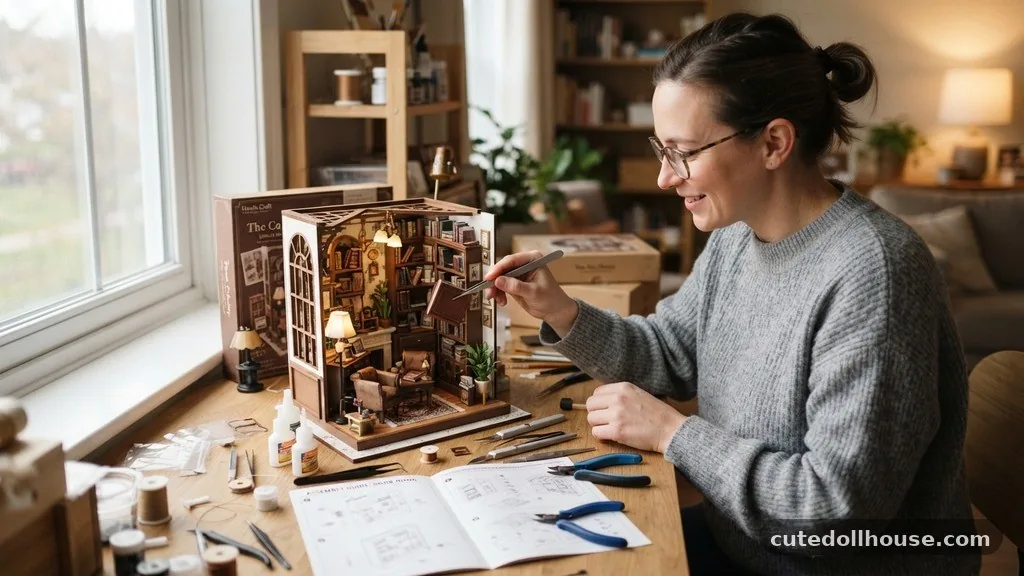
- Enjoy detail-oriented crafts and projects that develop gradually.
- Have a stable, well-lit workspace where small parts can remain undisturbed.
- Want to personalize a miniature interior rather than simply display a finished model.
- Are comfortable using craft glue, tweezers, a small ruler, and basic hand tools.
- Can accept that the finished result may differ from the product photograph.
Another hobby may suit you better if you:
- Want a project that can be completed in one short sitting.
- Dislike painting, trimming, sorting, or assembling very small parts.
- Need a completely finished decorative object immediately.
- Have limited space for storing materials between sessions.
- Prefer a predictable result with no need to source extra supplies.
How to Choose the Best Miniature Dollhouse Kits for Adults
1. Check the difficulty level honestly
Difficulty is one of the most important buying decisions, yet product listings don’t always explain it clearly. A kit marketed as beginner-friendly may still involve tiny paper decorations, fabric work, awkward joins, or miniature electrical components. Experienced crafters may find a simple room scene underwhelming, while beginners can become frustrated by an intricate multi-room build.
Look for clues in the listing and instructions, including whether the kit is described as pre-cut, pre-painted, partially assembled, or ready to decorate. “DIY” alone doesn’t tell you enough. A project with many included parts may take more patience even if the structural assembly is straightforward.
2. Examine the materials and construction
Wood, plywood, MDF, plastic, card, fabric, resin, and paper can all appear in miniature kits. Material choice affects how easy parts are to cut, glue, paint, and modify. Thin wood can be practical for small structures, but buyers should inspect whether panels are likely to need sanding or whether edges are already finished.
Pay attention to the description of the main shell and the furniture. A kit may have a wooden outer structure but paper or card accessories. That isn’t necessarily a flaw, but it changes expectations about strength and longevity.
Useful questions include:
- Are the structural pieces pre-cut?
- Are the parts labeled or numbered?
- Does the kit include a base or display case?
- Are decorative items made from wood, plastic, paper, fabric, or mixed materials?
- Are replacement components available if a small part is damaged?
3. Compare the design with your room and display space
A miniature house can occupy more room than expected once you account for the base, roof, lighting wires, and space needed to work around it. The listing should provide finished width, depth, and height. If those measurements are missing, treat that as a reason to verify before buying.
Enclosed designs can protect the interior from dust, but they may make access difficult during assembly and cleaning. Open-front or open-back models are easier to decorate and photograph, although their contents may be more exposed. Consider whether you’ll display the finished scene on a shelf, desk, cabinet, or dedicated hobby table.
4. Study the appearance beyond the promotional image
Photographs often show a fully decorated scene with carefully arranged accessories, additional furnishings, and ideal lighting. The kit may not include every item shown. Read the contents list closely and search for photos of the actual unassembled components when possible.
Style is personal. Victorian dollhouse kits, rustic cottages, cafés, bookstores, greenhouses, bedrooms, and modern interiors all create different decorating experiences. Choose a design you’ll enjoy working on for weeks, not merely one that looks attractive in a small listing image.
5. Confirm what is and isn’t included
Included accessories can make a major difference to the practical value of a kit. Some sets supply furniture, plants, books, dishes, lamps, curtains, and wall art. Others provide the structure and a limited selection of decorative parts, leaving you to purchase paint, glue, batteries, tools, or additional furnishings.
Before purchasing, look for a complete contents list. If the listing uses broad language such as “accessories included,” verify whether that means finished pieces or raw materials that still need to be made.
6. Consider lighting and electrical requirements
Lighting can transform a miniature interior, but it also adds complexity. Some kits include LED components; others leave lighting entirely to the builder. You may need to route wires, conceal a battery pack, drill or enlarge openings, and plan access for battery replacement.
Check whether the listing explains the power source, switch location, battery requirements, and wiring instructions. If these details are unclear, buyers who want a simple craft may prefer an unlit design. Never assume that a product photograph showing illuminated rooms means lighting is included.
7. Read customer feedback for recurring problems
Individual customer experiences can vary, but repeated comments often reveal practical issues. Look for patterns rather than treating one enthusiastic or negative review as conclusive evidence.
Common complaints in this category may involve:
- Instructions that rely heavily on diagrams or have translation issues.
- Small parts that are missing, fragile, or difficult to identify.
- Decorative pieces that look less refined than they do in listing images.
- Glue, paint, tools, batteries, or other supplies not being included.
- Dimensions that are smaller than shoppers expected.
- Lighting that requires more wiring work than anticipated.
- Parts that need sanding, trimming, or adjustment before they fit.
Feedback about missing components should be weighed alongside the seller’s replacement policy. Also check whether reviews refer to the exact model, because sellers sometimes group multiple variations under one listing.
Quick Comparison of Adult Dollhouse Kit Types
| Kit type | Best for | Typical difficulty | Key feature | Main drawback | Overall value consideration |
|---|---|---|---|---|---|
| Beginner room scene | First-time builders and short projects | Low to moderate | Smaller scope and fewer structural parts | Less room for large-scale customization | Useful when confidence and manageable workload matter most |
| Wooden miniature house | Builders who want a complete structure | Moderate to high | More substantial shell and display presence | May require sanding, painting, and careful alignment | More appealing when the structure is as important as the décor |
| Lighting-focused kit | People who enjoy atmospheric displays | Moderate to high | Illuminated interior or electrical components | Wiring and battery access add complexity | Worth considering only if the electrical work is clearly explained |
| Furniture or room-box kit | Decorators and miniature collectors | Low to moderate | Focus on styling a contained scene | Doesn’t provide the experience of building a full house | Often practical for limited shelf space |
| Large or multi-room kit | Experienced hobbyists seeking a long project | High | More space for rooms, furniture, and customization | Greater time, storage, and material demands | Best judged by project enjoyment, not just the number of parts |
Key Benefits of Miniature House Kits
Creative control
A kit gives you a framework without dictating every final detail. You can change wall colors, alter furniture placement, make curtains, add handmade books, or build a scene around a particular period or story. This makes adult dollhouse building more flexible than many paint-by-number or fixed-form craft projects.
A focused, screen-free activity
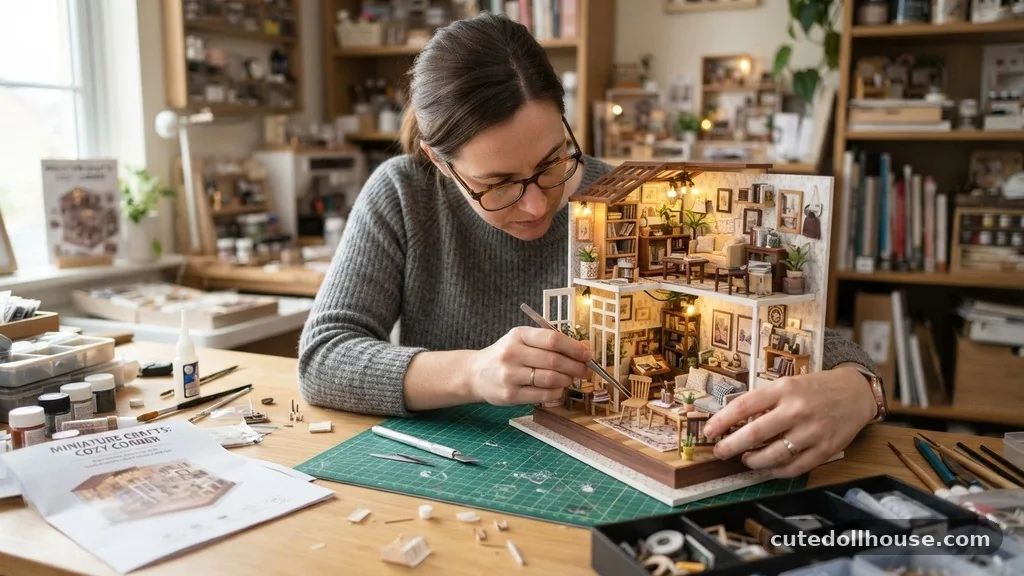
Small-scale assembly can encourage slow, concentrated work. It suits people who enjoy sorting parts, following sequences, and making gradual visual progress. That said, the experience is not automatically relaxing for everyone; fiddly construction and unclear instructions can be stressful.
A display piece with personal character
Finished miniatures can be more meaningful than mass-produced décor because the builder has shaped the details. A carefully selected kit can also complement a room’s style, particularly if its footprint and color scheme are considered before purchase.
Room for future customization
Even after the initial build, many scenes can be expanded with new furniture, handmade accessories, lighting changes, wallpaper, or landscaping. Buyers who enjoy ongoing projects may prefer a kit with accessible interior areas and standard-scale furnishings.
Potential Drawbacks to Consider
Miniature building is detail-heavy. A project that appears simple online may involve dozens or hundreds of small tasks, and a builder’s final result depends partly on patience and technique. There is no guarantee that the finished scene will match the photograph on the packaging.
- Instructions may be incomplete: Diagrams can be difficult to interpret, especially when several parts look similar.
- Extra supplies may be required: Glue, paint, brushes, tweezers, craft knives, rulers, batteries, or protective finishes may not be included.
- Small parts can be easy to lose: A dedicated tray or compartment box is useful during assembly.
- Dust is a maintenance issue: Open scenes need gentle, regular cleaning.
- Lighting can complicate repairs: Battery access and concealed wiring should be considered before final assembly.
- Replacement support varies: Verify the seller’s process before buying if missing or damaged pieces would be a serious problem.
Ease of Assembly: What Beginners Should Know
Start by checking all parts against the instructions before applying glue. Sorting pieces into labeled containers can save time and reduce mistakes, particularly when a kit contains multiple similar panels or furniture components.
Dry-fit major sections first. This means placing pieces together without adhesive to check alignment and understand how they connect. It is especially useful for walls, floors, windows, roofs, and any components that may be difficult to remove after gluing.
Work in stages. Build and finish structural sections before covering access points with flooring, wallpaper, furniture, or decorative panels. If a kit includes lighting, plan the wire route early rather than trying to force it through a completed scene.
A practical starter workspace
- A flat, well-lit surface that can remain undisturbed.
- A cutting mat and small ruler for accurate trimming.
- Fine tweezers for placing tiny accessories.
- Suitable craft adhesive, used according to the materials involved.
- Small containers or bags for sorting parts.
- Paper towels and a scrap surface for controlled gluing.
- Magnification if small print or components are difficult to see.
Don’t rush the decorative stage. A slightly uneven structural joint can become much harder to correct once it is hidden behind wallpaper, flooring, or furniture.
Quality, Durability, and Maintenance
Durability depends on the materials, construction quality, adhesive, handling, and display environment. A miniature house kept in a dry, stable indoor location should generally face fewer problems than one exposed to direct sunlight, dampness, temperature swings, or frequent handling.
Painted and paper-covered surfaces may fade or lift over time, especially in harsh light or humid conditions. Open-front scenes are convenient to access but collect dust more readily. A soft brush, gentle air blower, or carefully controlled low-suction cleaning method may be preferable to wiping delicate accessories with a cloth.
For a long-lasting display, avoid placing the finished piece where it can be knocked by doors, pets, children, or regular household traffic. If the kit includes electrical components, inspect wires and battery compartments periodically rather than leaving old batteries in place indefinitely.
Which Type of Buyer Should Choose Each Kit Style?
For beginners
Choose a smaller room scene or clearly labeled beginner kit with a limited number of structural steps. A project that can be completed in manageable sessions is more likely to build confidence than a large multi-room house with complicated wiring and extensive decoration.
For experienced crafters
Look for a wooden miniature house, larger scale build, or customizable interior with enough room for modifications. Experienced users may value structural detail, open access, and the ability to replace or upgrade included accessories more than a quick assembly.
For appearance-focused buyers
Prioritize the overall style, finished dimensions, window design, exterior finish, and quality of the included furniture. If the listing photo shows a highly styled scene, confirm which elements are supplied before assuming the same appearance is achievable straight from the box.
For small spaces
A room box, compact shop, or enclosed miniature scene may be more practical than a full dollhouse. Measure both the intended shelf and the area needed for construction. A project can fit the final display space while still needing a much larger temporary work surface.
For value-focused buyers
Compare the total project cost rather than only the kit price. A cheaper set may require additional tools, paint, glue, lighting, furniture, or replacement parts. A more complete kit can be better value if it includes the materials you would otherwise need to buy separately, but only if the included components are suitable for your expectations.
How to Assess an Online Listing Before Buying
Product descriptions in this category can be inconsistent. Before placing an order, read the specifications, contents list, dimensions, assembly notes, and return policy together. Don’t rely on the main image alone.
- Write down the finished dimensions and compare them with your available space.
- Confirm the scale and whether the furniture is compatible with it.
- List included structural parts, accessories, tools, glue, paint, and lighting.
- Check the stated difficulty and read reviews for repeated assembly concerns.
- Look for photographs of the actual kit contents, not only the finished scene.
- Verify battery, wiring, and replacement-part information where applicable.
- Review returns and seller support in case pieces arrive damaged or missing.
If a listing omits a detail that affects your decision, contact the seller before ordering. Clear answers are particularly important for finished size, lighting, materials, and what the photographs include.
Frequently Asked Questions
What are the best miniature house building kits for adults?
The best choice depends on experience, space, preferred style, and willingness to assemble small parts. Beginners generally benefit from a smaller, clearly documented project, while experienced builders may prefer a larger wooden house or a highly customizable scene.
Are miniature dollhouse kits difficult to assemble?
Difficulty varies considerably. Some involve simple room decoration, while others require structural assembly, painting, furniture construction, and wiring. Check the instructions, part count, scale, and customer feedback rather than relying only on the word “beginner.”
Do adult dollhouse kits include glue and paint?
Not always. Contents vary by manufacturer and seller, so check the exact listing for adhesive, paint, tools, batteries, and other supplies. Product photos may show materials that aren’t included.
What does 1:12 scale mean for a dollhouse?
It means the miniature is made at one-twelfth of typical full-size dimensions. A 1:12 kit may be easier to furnish with compatible traditional dollhouse accessories, but buyers should still verify the scale of the furniture and structure.
How long does it take to build a miniature house kit?
There is no dependable universal time because assembly speed depends on the kit, skill level, decoration, drying time, and whether lighting is installed. A detailed project should be treated as a multi-session hobby rather than a quick craft.
Can a miniature dollhouse kit be customized?
Usually, yes. Builders often change paint, wallpaper, flooring, furniture, lighting, and accessories. The amount of customization depends on the kit’s scale, accessibility, materials, and how permanently the included parts are attached.
Final Verdict
The best miniature dollhouse kits for adults are worth buying when you want a patient, hands-on project with a personal finish rather than an instant decoration. The strongest choice is not necessarily the largest or most detailed kit; it is the one whose difficulty, scale, included materials, dimensions, and style match your actual workspace and experience.
Before ordering, verify the contents, read recurring customer feedback, and budget for supplies that aren’t included. Beginners should start with a manageable room or simple house, while experienced builders can look for larger wooden structures, lighting, and customization potential. Choose carefully, and a miniature house can become a satisfying creative project as well as a distinctive display.