
Choosing the best modern dollhouses for kids is less about finding the most elaborate design and more about matching the house to a child’s age, play style, available space, and appetite for hands-on projects. Contemporary dollhouses can support imaginative play, storytelling, room design, and social play, but the options vary widely in scale, materials, assembly demands, and included furniture.
Some are ready for play straight from the box, while others are better suited to families who enjoy decorating and building together. The right choice should feel inviting without becoming frustrating, fit comfortably in its intended space, and offer enough flexibility to stay interesting over time.
What Makes a Dollhouse “Modern”?
Modern dollhouses usually have a contemporary visual style rather than a traditional Victorian or cottage-inspired appearance. They may feature clean lines, open-plan rooms, large windows, minimalist furniture, neutral colors, or a design that resembles a modern apartment or family home.
The term isn’t a strict technical category. A modern dollhouse might be made from wood, engineered board, molded plastic, or a combination of materials.
It may arrive fully assembled, partly assembled, or as a kit that requires construction and decoration. Product listings can also use “modern” to describe the interior accessories rather than the structure itself.
Before buying, treat the word as a design description—not a guarantee of quality, durability, size, or age suitability. The product specifications matter more than the label.
Are Modern Dollhouses Worth Buying?
A well-chosen dollhouse can be a worthwhile toy for children who enjoy imaginative worlds, small-scale furniture, pretend family routines, or arranging rooms. It can also become a shared activity when an adult helps with assembly, furnishing, or decorating.
That said, dollhouses take up more space than many conventional toys. Some also include small accessories that can be misplaced or may not be appropriate for younger children. A large house may look impressive but offer little value if it cannot be reached comfortably or stored safely.
A modern dollhouse is generally a good choice when:
- The child enjoys open-ended pretend play and creating stories.
- There is a stable, accessible place to keep the house between play sessions.
- The family is comfortable checking age guidance and small-part warnings.
- The design suits the child’s interests rather than only the room’s décor.
- Assembly and maintenance requirements match the time available.
An alternative may be better if space is limited, the child prefers active or outdoor play, or the intended recipient is not interested in miniature objects. Portable playsets, foldable houses, doll furniture sets, or open-ended building toys may provide similar imaginative value with less commitment.
Important Buying Criteria
Build and Material Quality
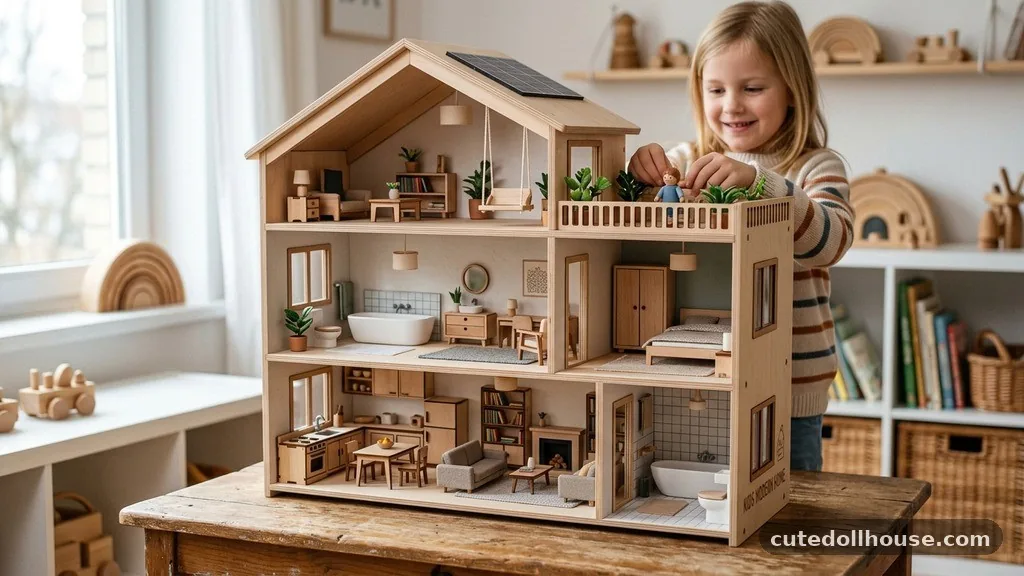
Look closely at the materials listed by the manufacturer. Wooden dollhouses can offer a substantial feel, but the quality depends on the type of wood or board, joint construction, surface finish, and hardware. Plastic models may be easier to clean and lighter to move, while thin panels or poorly finished edges can affect long-term satisfaction.
Check product photographs for practical details such as:
- Exposed edges, rough cutouts, or unfinished surfaces.
- How firmly walls, floors, balconies, and roofs connect.
- Whether doors and windows appear functional or decorative.
- Whether the base looks stable enough for regular play.
- Whether the finish is likely to show marks or fingerprints easily.
Marketing photographs often show a fully decorated room. Confirm which items are included before assuming that furniture, dolls, lighting, or accessories come with the house.
Design and Appearance
Contemporary styling can make a dollhouse fit more naturally into a bedroom, playroom, or shared living area. Minimalist colors may also provide a blank canvas for children who want to paint, rearrange, or add their own decorations.
Appearance should still serve play. A visually impressive house with narrow openings or fixed rooms may be less enjoyable than a simpler design with generous access. Open-front layouts, removable panels, and accessible floors can make it easier for children to reach the interior.
Size and Fit
Size is one of the easiest details to overlook. A dollhouse needs enough floor and vertical clearance for children to play comfortably, but it also needs a permanent home. Measure the intended location, including shelf depth, ceiling clearance, and space in front of the house for children to sit or stand.
Also check the scale of the house and its accessories. A dollhouse may look large while its rooms are too small for the furniture shown in the listing, or it may be designed for a particular type of doll that is not included. Scale compatibility matters if the child already owns miniature figures or furniture.
Features and Functionality
Useful features depend on the child. Some buyers value movable stairs, opening doors, balconies, elevators, working lights, or rearrangeable furniture. Others prefer a simple structure that leaves more room for free-form storytelling.
More features aren’t automatically better. Moving parts can add play value, but they may also create more components to lose or break. Electrical features introduce additional questions about batteries, switches, replacement parts, and supervision.
Ease of Assembly
Assembly difficulty varies considerably between dollhouse kits. A house that requires only basic attachment may be suitable for a family project, while a model involving many panels, fasteners, decorative elements, or painting steps can take substantially more time.
Read the assembly information before ordering. Look for:
- Whether tools are required.
- Whether an adult must complete the construction.
- Whether paint, glue, batteries, or additional supplies are excluded.
- Whether instructions are illustrated and available in the buyer’s language.
- Whether the completed house can be moved without disassembly.
Customer feedback can be helpful here, but treat individual assembly times cautiously. Experience, tools, and product batches can all affect the process.
Durability and Maintenance
Children may play gently, or they may move furniture, reposition figures, and carry accessories from room to room. A durable dollhouse should tolerate ordinary handling without panels loosening quickly or decorative elements detaching easily.
Maintenance is usually straightforward, but the material affects cleaning. Plastic surfaces may tolerate a slightly damp cloth, while painted wood, paper details, fabric accessories, and electronics may require more careful care. Follow the manufacturer’s cleaning and safety instructions rather than applying household products at random.
If the house will be stored, consider a container for small furniture and figures. Missing accessories can reduce play value and make a carefully designed set feel incomplete.
Age Guidance and Safety
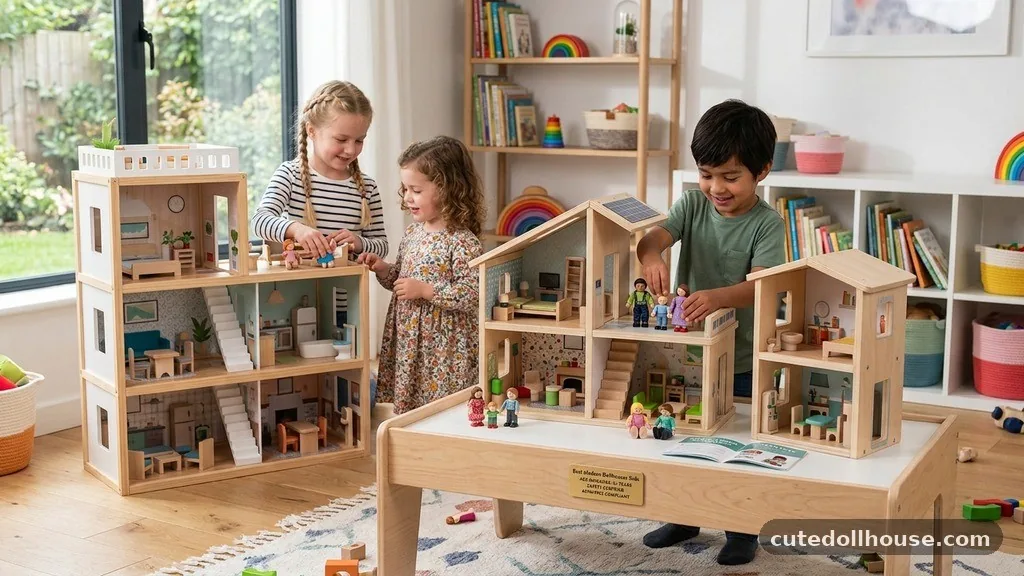
Always use the manufacturer’s recommended age range as a starting point, then consider the individual child’s habits. Small furniture, miniature figures, tiny utensils, and decorative pieces may create choking risks for younger children.
For general toy-safety information, buyers can consult the U.S. Consumer Product Safety Commission’s toy safety guidance. Families outside the United States should also check the safety standards and labeling requirements that apply in their region.
A responsible purchase also means checking for stability. Tall or narrow houses should be placed where they cannot easily tip, particularly if children may pull themselves up on furniture or reach high floors.
Modern Dollhouse Comparison Factors
Because no specific product models or manufacturer specifications were supplied for this review, the table below compares the main formats buyers are likely to encounter rather than ranking named products. Individual listings should be checked for exact dimensions, materials, included items, and assembly requirements.
| Format | Best For | Typical Difficulty | Key Feature | Main Drawback | Overall Value Consideration |
|---|---|---|---|---|---|
| Ready-to-play modern house | Children who want to begin playing quickly | Low to moderate | Minimal setup | May offer less customization | Strong if convenience matters most |
| Wooden dollhouse kit | Families who enjoy building and decorating | Moderate to high | Hands-on customization | Requires time, tools, and careful assembly | Good when the project is part of the value |
| Plastic contemporary playhouse | Frequent play and easier cleaning | Low to moderate | Lightweight, wipeable construction | May feel less substantial or decorative | Practical for everyday play |
| Large open-front house | Shared play and several children | Moderate | Good interior access | Needs considerable floor space | Worth considering only with suitable room |
| Compact or foldable model | Smaller homes and occasional play | Low to moderate | Easier storage | Reduced room size or accessory capacity | Useful when space is the deciding factor |
How to Read Customer Feedback
Reviews can reveal practical issues that product descriptions leave out, especially around assembly, packaging, missing pieces, and real-world size. They should be read as evidence about possible experiences, not as a guarantee that every buyer will have the same result.
Pay attention to repeated comments rather than one unusually positive or negative review. Several buyers mentioning unclear instructions, fragile components, poor fit, or inaccurate dimensions may indicate a meaningful risk. Isolated complaints can still matter, but they need context.
Useful questions to ask while reading feedback include:
- Do buyers describe the completed house as stable?
- Are the listed dimensions consistent with the delivered product?
- Do comments distinguish the house from the accessories?
- Are assembly problems linked to unclear instructions or damaged parts?
- Do users mention the child’s age and how the house was used?
- Are negative reports recent enough to reflect the current production version?
Seller, model, region, and production batch can affect packaging and included components. If an accessory list is unclear, confirm it with the retailer before purchasing.
Recommendations by Buyer Type
For Beginners
Choose a model with clear dimensions, straightforward instructions, and limited assembly. A simpler layout may be more satisfying than a complicated kit if the child wants immediate play.
For Families Who Enjoy Projects
A customizable wooden kit may be a better fit when painting, furnishing, and decorating are part of the experience. Confirm whether the required tools and finishing materials are included before treating the project as ready to start.
For Appearance-Focused Buyers
Prioritize clean construction, coherent colors, and a design that looks good from the front and sides. Don’t overlook play access, though. A beautiful house can become frustrating if children cannot comfortably reach its rooms.
For Space-Conscious Homes
Measure first, then look for a compact, foldable, or vertically efficient design. Include storage for loose accessories in the calculation. The house may fit on a shelf while its furniture does not.
For Value-Focused Buyers
Compare what is included, not just the headline product price. A less expensive house that requires separate furniture, tools, paint, and dolls may cost more to make playable than a better-equipped alternative.
For Premium Buyers
Focus on construction quality, stable assembly, finish consistency, replacement-part availability, and the clarity of the manufacturer’s documentation. Premium styling alone is not enough to justify a higher cost.
Common Reasons to Consider an Alternative
A modern dollhouse may not be the right purchase if the child has limited interest in miniature play or if the house will have to be packed away after every session. Large structures can also create storage problems, particularly in shared bedrooms.
Consider a different format if:
- You need a toy that travels easily.
- The child is too young for the included small accessories.
- There is no stable surface or safe play area for a tall structure.
- You want a toy that requires little adult assembly.
- The child prefers vehicles, construction, crafts, or outdoor activities.
A smaller room box, portable playset, or furniture-only set can still support imaginative play while reducing the space and maintenance commitment.
Frequently Asked Questions
What age is appropriate for a modern dollhouse?
There is no single ideal age for every model. Follow the manufacturer’s age guidance, check for small-part warnings, and consider whether the child can play safely without putting miniature accessories in their mouth.
What should be included with a dollhouse?
Inclusions vary. Some products contain only the structure, while others include furniture, figures, lighting, or decorative pieces. Read the contents list carefully and verify whether photographed accessories are sold separately.
Are wooden dollhouses better than plastic ones?
Neither material is automatically better. Wooden houses may appeal to buyers who want a more decorative or customizable structure, while plastic can be practical for lighter weight and easier cleaning. Construction quality matters more than material alone.
How much assembly do modern dollhouses require?
Assembly ranges from minimal attachment to a substantial building project. Check the instruction format, required tools, estimated setup information, and whether painting or gluing is necessary before ordering.
What is the best dollhouse for a small room?
A compact or foldable model is usually easier to live with, but compare its interior access and room dimensions carefully. Measure both the storage location and the space needed for children to play in front of it.
Do children outgrow dollhouses?
Some children lose interest as their play preferences change, while others continue using dollhouses for storytelling, design, collecting, or craft projects. Flexible layouts and durable furniture can help a house remain useful for longer.
Final Verdict
The best modern dollhouses for kids are not necessarily the largest or most decorated. The strongest choice is the one that fits the child’s play style, provides safe and comfortable access, suits the available space, and matches the family’s tolerance for assembly and upkeep. Buyers should verify dimensions, materials, age guidance, included accessories, and customer feedback before ordering.
Modern dollhouses are worth buying for children who enjoy imaginative miniature play, especially when the house can remain accessible and grow with their interests. If space, safety, portability, or limited enthusiasm is a concern, a smaller or simpler alternative may offer better value.