Finding the best open concept dollhouses for play is less about picking the biggest model and more about choosing a design children can reach, see, and use comfortably. These dollhouses keep rooms exposed rather than enclosing them behind deep walls or narrow openings, which can make imaginative play easier for younger children and more social for siblings. They also vary widely in footprint, material, assembly requirements, scale, and included furniture.
That makes comparison difficult, especially when product listings use similar language. This buyer’s guide explains how open-sided dollhouses work, which features matter most, what limitations to expect, and how to decide whether this style fits your child, available space, and play habits.
What Is an Open Concept Dollhouse?
An open concept dollhouse is a dollhouse designed with accessible rooms, broad front openings, or fewer enclosing walls than a traditional miniature house. Instead of requiring a child to reach through small windows or work inside a narrow interior, the layout usually leaves much of the structure visible and easy to access from the front or sides.
The purpose is simple: make pretend play more approachable. Children can move figures, furniture, and accessories without constantly bumping their hands against walls. Adults can also see what is happening during play, which may be useful for supervision or collaborative storytelling.
“Open concept” isn’t a single technical standard. One model might have a fully open front, while another may use a classic house shape with wide cutaway rooms. Buyers should inspect the product photographs, dimensions, and assembly instructions rather than relying on the label alone.
Why Families Choose This Dollhouse Style
Traditional dollhouses can be charming, but enclosed rooms sometimes create practical obstacles. Small openings may be difficult for young children to reach through, and deeper structures can hide toys from view. An open layout addresses some of those concerns while preserving the basic appeal of miniature domestic play.
- Better access: Children can reach rooms from the front without stretching over a deep façade.
- Shared play: Two children may be able to play from different sides or positions.
- Improved visibility: Parents and caregivers can more easily see the play area.
- Flexible storytelling: Open rooms can become homes, shops, schools, clinics, or other settings.
- Easier organisation: Larger openings may make it simpler to place and remove furniture.
That accessibility doesn’t automatically make every open dollhouse suitable for every child. A large model can still overwhelm a small bedroom, and a lightweight structure may shift during enthusiastic play. The best choice depends on the child’s age, motor skills, available space, and interest in miniature accessories.
Are Open Concept Dollhouses Worth Buying?
For many families, yes. An open design is often a sensible choice for children who are beginning pretend play, children who prefer hands-on access to toys, or siblings who want to play together. It can also suit playrooms, classrooms, and supervised therapeutic settings where visibility and approachability matter.
However, buyers shouldn’t assume that an open structure is automatically better than a traditional dollhouse. A classic enclosed design may be more appealing to children who enjoy detailed architecture, room decoration, or a more realistic house appearance. Some older children and adult hobbyists may also prefer a display-oriented model with finer details, even if it is harder to access.
An Open Layout May Be a Good Choice If:
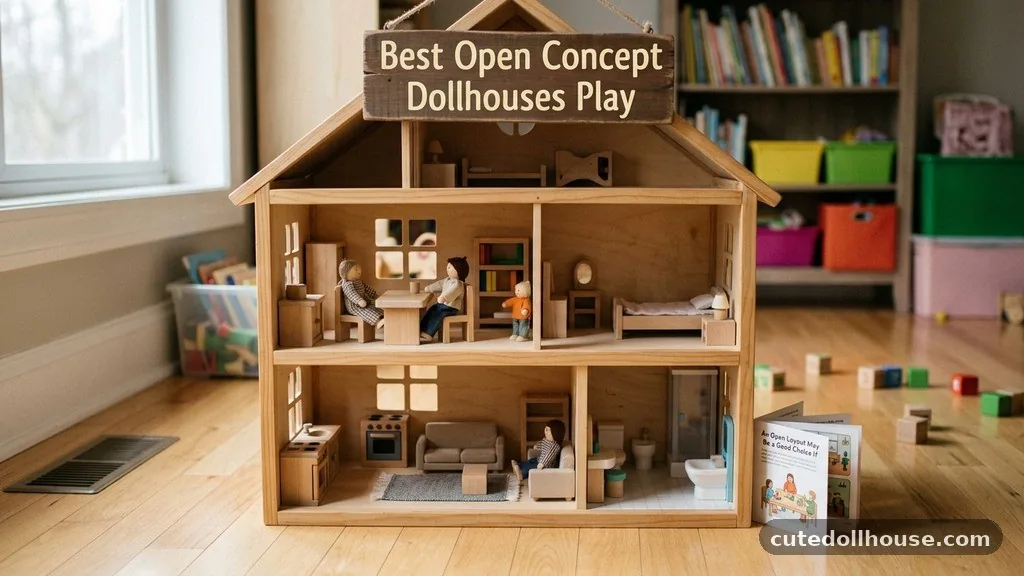
- The child is likely to move figures and furniture frequently.
- More than one child may play with the house at the same time.
- You want to supervise play without lifting or turning the toy.
- The dollhouse will be used for broad imaginative play rather than display alone.
- Reachability matters more than a fully enclosed architectural design.
Consider an Alternative If:
- Floor space is limited and the model has a large footprint.
- The child is primarily interested in collecting or displaying miniatures.
- You need a travel-friendly toy that can be packed away quickly.
- The product’s construction appears too lightweight for the intended play style.
- You need a specific miniature scale that the open model doesn’t support.
Important Buying Criteria
1. Build and Material Quality
Material affects more than appearance. Wood-based dollhouses can provide a substantial feel, but the exact construction varies.
Some use solid wood components, while others combine engineered wood, laminated panels, plastic parts, or cardboard-like decorative elements. Product descriptions don’t always make the difference clear.
Plastic models may be easier to wipe clean and could be lighter to move. Wooden designs often have a more furniture-like appearance, but they may require more careful assembly and can be vulnerable to chipped paint or damaged edges if handled roughly.
Before buying, check for:
- Rounded or smoothly finished accessible edges.
- Panels that appear thick enough for the size of the structure.
- Secure connection points and stable base support.
- Paint or surface finishes appropriate for children’s products.
- Clear information about the materials used in the frame and accessories.
When a listing only says “wooden” without explaining whether the material is solid wood or engineered board, treat that description cautiously and verify the construction with the seller or manufacturer.
2. Design and Appearance
Appearance matters because a dollhouse often remains visible in a child’s room or play area. Open concept designs can range from simple neutral structures to colourful houses with decorative roofs, balconies, stairs, and printed wall details.
A highly decorated model may attract attention quickly, but a simpler interior can leave more room for open-ended play. Think about whether the child will be more interested in arranging furniture, acting out family routines, or creating completely different settings.
Also consider the back and sides. A house that looks attractive from the front may have an unfinished rear panel or limited access from other angles. If siblings will play together, a design that can be approached from more than one side may be more practical.
3. Size, Footprint, and Reach
Dimensions should be checked before purchase, not after assembly. A dollhouse may be described as compact while still needing significant width, depth, or vertical clearance. Remember to leave extra room around it so children can sit, kneel, and move accessories without knocking the structure over.
Room height matters too. Very low ceilings can limit the figures or furniture that fit inside, while tall models may be difficult for smaller children to reach. The most usable size is the one that matches the child’s height and the scale of the accessories they already own.
Ask these practical questions:
- Can the child reach the back of each room?
- Will the house fit on the intended shelf, table, or floor area?
- Is there space to store loose furniture and figures nearby?
- Could a child pull the structure forward while reaching inside?
- Will the assembled size still work if the house needs to be moved?
4. Features and Functionality
Features should support play rather than simply increase the parts count. Open rooms, wide access points, movable furniture, stairs, balconies, and multiple levels may encourage different types of storytelling. Yet extra features can also add assembly time, loose components, and potential breakage.
Look for a layout that offers enough visual variety without making the house difficult to use. A child who is new to dollhouse play may benefit more from accessible rooms and a few sturdy accessories than from numerous tiny decorative pieces.
Check whether the product includes furniture or is sold as a structure only. Photos often show a fully furnished scene even when some or all of the displayed accessories are optional. This is one of the most important details to verify before ordering.
5. Ease of Assembly
Many larger dollhouses arrive flat-packed. Assembly can involve multiple panels, screws, dowels, stickers, or decorative pieces. The instructions, included hardware, and required tools can vary by model and production batch.
Don’t judge assembly difficulty from photographs alone. A visually simple house may have a complicated frame, while a more detailed model may use fewer major sections. If the listing doesn’t state an estimated assembly time or tool requirement, look for the instruction manual or ask the seller.
A sensible assembly checklist includes:
- Read the instructions before separating parts from the packaging.
- Check that all hardware and panels are present.
- Build on a flat surface with enough room to turn the structure safely.
- Don’t allow children to handle small hardware during construction.
- Confirm that the finished house sits level before adding accessories.
6. Durability and Maintenance
Durability depends on the frame, joints, finish, accessory design, and the way the house will be used. A dollhouse intended for daily imaginative play needs different qualities from one bought mainly for display.
Open structures can be easier to clean because the rooms are accessible. Dust can still collect on ledges, balconies, and small furnishings, and painted surfaces may require gentle cleaning rather than aggressive products. Check the care instructions before using water or household cleaners.
Customer feedback, where available, should be read for patterns rather than isolated complaints. Repeated reports of missing hardware, unclear instructions, loose rails, unstable bases, or easily damaged decorative parts deserve attention. Individual comments may reflect shipping damage, unusual assembly, or a particular seller, so verify whether the issue appears consistently across listings.
7. Difficulty Level and Age Fit
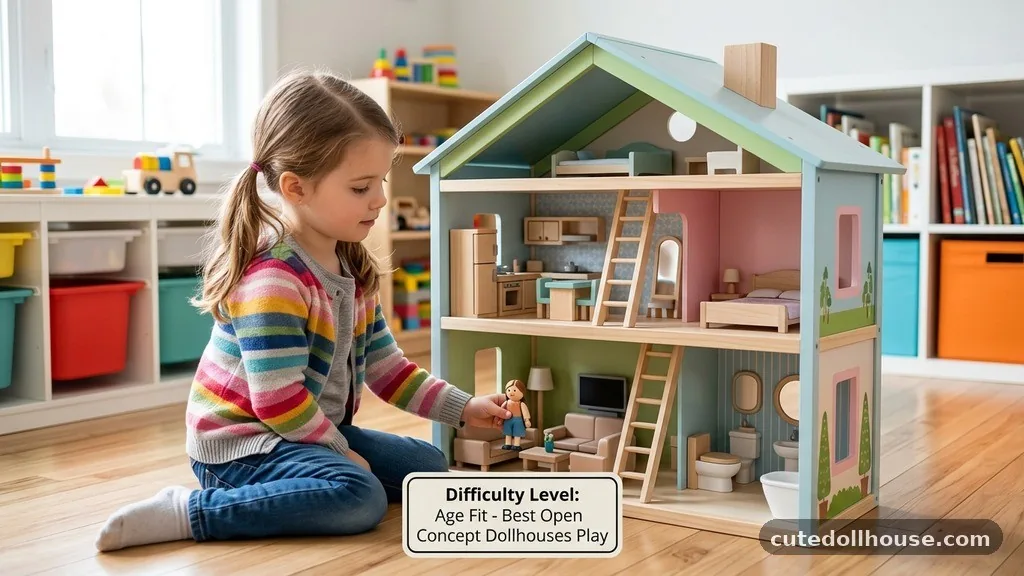
Age guidance is useful, but it doesn’t tell the whole story. A child’s ability to handle small accessories, follow pretend-play routines, and reach different levels can matter as much as the printed age range.
For toddlers, sturdy construction, large accessories, and easy-to-reach rooms are generally more practical than delicate miniature sets. Older children may value detail, customisation, and compatibility with specific dolls or furniture. Always follow the manufacturer’s safety guidance, especially where small parts are involved.
The U.S. Consumer Product Safety Commission’s small-parts guidance explains why tiny components require particular care around younger children.
8. Included Accessories
Accessories can make a dollhouse feel ready for play, but the quantity and quality may differ significantly between models. A listing may include furniture, figures, bedding, kitchen items, or decorative pieces—or it may show these only as styling examples.
Check the product description for a precise contents list. It is also useful to consider the durability of small accessories. Numerous fragile pieces can be frustrating for younger children and harder to store than a smaller set of robust, versatile items.
9. Value for Money
Value is not simply the lowest purchase price. A less expensive dollhouse may offer good value if it is stable, easy to assemble, and compatible with accessories the child already owns. A more expensive model may justify its cost through stronger construction, better access, replaceable parts, or a finish that suits long-term display.
Because prices, bundles, shipping charges, and availability can change by retailer and region, compare the complete purchase rather than the headline price. Include delivery, assembly requirements, required accessories, and the possibility of replacement parts.
Comparison Framework for Open Concept Dollhouses
No named products or verified product specifications were supplied for this article, so a factual product ranking would risk presenting assumptions as facts. The table below shows the criteria that should drive a side-by-side comparison when you have specific models in mind.
| Factor | What to Check | Why It Matters | Potential Concern |
|---|---|---|---|
| Access | Front opening, side access, room depth | Determines how easily children can reach and arrange items | Deep rooms may still be difficult despite an open front |
| Materials | Solid wood, engineered board, plastic, or mixed construction | Affects weight, finish, maintenance, and expected wear | Vague material descriptions make quality harder to assess |
| Size | Assembled height, width, depth, and room dimensions | Helps confirm fit and child reach | Photographs can make large products look smaller |
| Assembly | Instruction quality, hardware, tools, and number of panels | Indicates how much adult setup is required | Missing parts or unclear instructions can delay use |
| Accessories | Included furniture, figures, and decorative pieces | Shows whether the house is ready for play | Displayed items may not be included |
| Stability | Base design, weight, joints, and anchoring options | Important for active play and taller structures | Lightweight models may move when children reach inside |
| Value | Total cost, included parts, durability, and support | Gives a more realistic view of the purchase | A low initial price may exclude essential accessories |
Who Should Buy an Open Concept Dollhouse?
Best for Beginners
First-time dollhouse buyers should prioritise simple access, a stable frame, manageable dimensions, and clear assembly instructions. A basic open layout is often easier to understand than a multi-level model filled with tiny components.
Best for Shared Play
Families with siblings or playgroups should look for broad openings and, where possible, access from more than one angle. A house that forces every player into the same position may create unnecessary crowding.
Best for Appearance-Focused Buyers
If the dollhouse will remain on display, pay attention to finish quality, colour consistency, visible fasteners, and the appearance of the rear and side panels. A functional open design can still look polished, but decorative quality varies.
Best for Value-Focused Buyers
Compare what is actually included. A modestly styled house with useful furniture may offer better value than a more elaborate structure that requires a separate collection of compatible accessories.
Best for Older Children and Hobbyists
Older users may want customisable rooms, more precise scale compatibility, and a stronger emphasis on finish. They may also tolerate more involved assembly. For this audience, an enclosed or display-oriented miniature house could be a better alternative if realism matters more than quick access.
Who May Want a Different Type of Dollhouse?
An open concept dollhouse isn’t the right fit for every household. Families with limited storage may prefer a smaller portable model, foldable design, or dollhouse that can be packed away after play. Children who prefer carrying toys from room to room may use a portable dollhouse or playset more often than a large stationary structure.
Buyers seeking a long-term miniature hobby should also compare open playhouses with more detailed wooden kits. Those alternatives may provide finer architectural details, but they often require more patience, maintenance, and careful handling.
For very young children, the main alternative may be a larger-scale playhouse with fewer small pieces. The right option should match the child’s abilities rather than simply the adult’s preferred appearance.
How to Make a Final Buying Decision
Before placing an order, confirm the facts that product photographs cannot answer:
- Exact assembled dimensions and available room space.
- Materials used for the frame, panels, and accessories.
- Whether furniture and figures are included.
- Recommended age and small-parts warnings.
- Assembly tools, estimated difficulty, and instruction availability.
- Cleaning guidance and replacement-part support.
- Whether the seller, model, or region changes the included contents.
Read recent customer feedback for recurring practical issues, but separate product problems from delivery or seller problems. If reviews mention missing pieces, inspect the retailer’s support policy before buying. If the listing leaves out basic measurements or contents, that uncertainty is itself a reason to pause.
Frequently Asked Questions
What age is best for an open concept dollhouse?
There is no single best age. Younger children may benefit from wide access and larger, sturdier pieces, while older children may prefer detailed rooms and smaller accessories. Follow the manufacturer’s age guidance and consider the child’s ability to handle small parts.
Are open dollhouses safer than enclosed dollhouses?
Open access can make supervision and reachability easier, but it doesn’t make a product automatically safe. Stability, edge finishing, hardware, paint, and small accessories still matter. Inspect the assembled structure regularly for loose or damaged parts.
Do open concept dollhouses include furniture?
Some do and some don’t. Product images may show optional furniture or accessories, so check the written contents list before purchasing. If the information is unclear, ask the seller to confirm what arrives in the box.
What should I check before buying a wooden dollhouse?
Check the type of wood or board, panel thickness, finish, joint design, assembled dimensions, and assembly instructions. Also verify whether the structure is stable enough for the way the child is likely to play.
Can two children play with one open dollhouse?
Often they can, especially if the house has a wide front or access from multiple sides. The footprint and room layout still matter. A narrow design may leave children competing for the same position.
Are open concept dollhouses good for play therapy?
They may be useful in supervised play settings because the rooms are visible and easy to access, but suitability depends on the child, setting, materials, and professional requirements. A qualified practitioner should choose equipment for a specific therapeutic purpose.
Final Verdict
The best open concept dollhouses for play are the ones that match a child’s reach, play style, available space, and tolerance for small accessories. Their strongest advantage is practical access: children can move figures, arrange rooms, and share stories without working through narrow openings. That makes the format especially appealing for beginners and shared play.
Before buying, verify dimensions, materials, included contents, stability, age guidance, and assembly demands. Since no specific products were supplied here, a responsible ranking isn’t possible, but the buying principles are clear: choose access and construction quality over decorative extras, and treat vague listings cautiously. With those checks in place, an open concept design can be a worthwhile, flexible choice for imaginative play.