Choosing among the best educational dollhouses for kids involves more than picking the prettiest miniature home. A well-designed dollhouse can encourage storytelling, early planning, language practice, social play, and fine-motor skills, but the wrong size or complexity may quickly become frustrating.
Age, available space, construction materials, accessibility, and included furniture all affect whether a dollhouse becomes a lasting plaything or an oversized decoration. This guide explains what makes a dollhouse educational, which features deserve attention, where common drawbacks appear, and how to match a style of dollhouse to a child’s age and play habits.
What Makes a Dollhouse Educational?
An educational dollhouse is a play environment that gives children opportunities to make decisions, create stories, organize objects, and explore everyday routines. The learning comes mainly from open-ended play rather than from a formal lesson built into the product.
Children might arrange rooms, assign roles to figures, describe what characters are doing, or act out familiar experiences such as cooking, bedtime, visiting, and cleaning. Those activities can support communication and imaginative thinking while also giving children practice with sequencing and problem-solving.
Not every dollhouse marketed as educational will suit every child. A model with many small accessories may offer more pretend-play possibilities for an older child but create a poor experience for a toddler. Likewise, a large wooden structure may be sturdy and attractive but too difficult to move or store in a small room.
Are Educational Dollhouses Worth Buying?
For children who enjoy pretend play, a dollhouse can be a worthwhile long-term toy. Unlike a single-use activity, it can change as a child’s interests develop: first it may be used for simple object placement, then for storytelling, role-playing, and more elaborate games involving several characters.
The value depends on how well the dollhouse fits the child and the home. A basic, accessible design may provide more useful play than a highly decorated model that has limited floor space or fragile details.
Parents should also consider whether the child prefers imaginative play. A dollhouse is less suitable for a child who mainly enjoys construction, vehicles, puzzles, or physical outdoor activities.
Reasons to Consider One
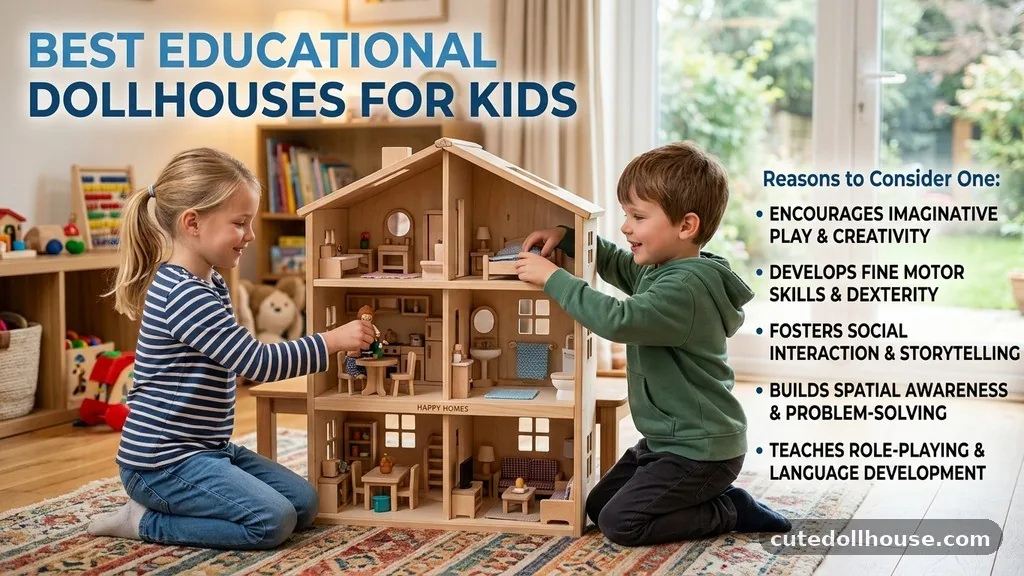
- It supports open-ended storytelling rather than one fixed way to play.
- Room layouts and furniture can encourage sorting, planning, and spatial awareness.
- Children can practise everyday language through role-play.
- Shared play may help siblings or adults discuss cooperation, turn-taking, and feelings.
- Many designs can grow with a child when additional figures or furniture are compatible.
Reasons to Choose an Alternative
- Limited floor space may make a large dollhouse inconvenient.
- Small accessories can be unsuitable for younger children.
- Some children may lose interest in role-play quickly.
- Assembly, wall anchoring, or ongoing tidying may be more work than expected.
- A dollhouse can become expensive if furniture and figures are sold separately.
Important Buying Criteria
Age Suitability and Safety
Age guidance should be treated as a starting point, not a substitute for supervision and judgment. The most important questions are whether the child still puts objects in their mouth, can handle small accessories safely, and understands how to use the structure without climbing on it.
For toddlers and preschoolers, look for larger pieces, rounded edges, stable construction, and easy-to-reach rooms. Older children may be ready for smaller furniture and more detailed accessories, provided the parts are appropriate for their abilities. Buyers can also consult toy safety advice from the American Academy of Pediatrics before choosing a model with small parts.
Check the current manufacturer guidance before buying because safety information can differ between models, versions, and regions. If a product is intended for a child under three, verify the small-parts warning carefully rather than relying on product photographs.
Build and Material Quality
Common dollhouse materials include engineered wood, solid wood, plastic, and cardboard-based components. Each has trade-offs.
- Wood: Often gives a substantial feel and may withstand repeated play, but it can be heavier and require more assembly.
- Engineered wood: Can make larger designs more affordable, although edge quality and resistance to moisture vary.
- Plastic: Usually wipes clean easily and may be lighter, but construction quality differs widely between models.
- Cardboard or fabric: Can be lightweight and easy to store, though it may not tolerate rough handling as well as rigid materials.
Inspect product photographs for exposed fasteners, thin-looking panels, unsupported balconies, and narrow connection points. Reviews may mention loose parts or difficult assembly, but those reports can reflect a particular batch, seller, or user’s assembly method. They are useful signals, not conclusive proof.
Size, Scale, and Available Space
Measurements should be checked before purchase, including the height, width, depth, and clearance needed to reach the back rooms. A dollhouse can fit on a shelf but still be difficult to use if the child cannot comfortably access its interior.
Scale matters too. Figures and furniture need to fit through doors and sit naturally in the rooms.
A house may look spacious in a product image but feel cramped once furniture is added. If accessories are not included, confirm which figures or furniture sets are compatible before assuming that standard pieces will fit.
For shared play, a wider open-front design may be easier for two children to use at once. A compact model may work better in a bedroom, classroom corner, or apartment, particularly if it can be moved without taking apart.
Design and Appearance
Appearance is subjective, but it can influence how often a child chooses the toy. Some families prefer a traditional house with several rooms, while others may favour a modern open-plan design, a foldaway model, or a simpler structure that leaves room for children to create their own layout.
Consider whether the decoration supports play or gets in the way. Printed details can make a house visually appealing, yet a neutral interior may give children greater freedom to imagine what each room represents. Bright colours are not automatically more educational, and a realistic finish is not necessarily more durable.
Features and Functionality
Useful features should make the toy easier or more interesting to play with, not simply add visual complexity. Buyers may see features such as opening doors, movable shutters, elevators, staircases, balconies, lighting, sound effects, or removable rooms.
Each extra mechanism introduces another point that may need repair or careful handling. A child who likes arranging furniture may benefit more from generous room dimensions than from electronic effects. If a product includes lighting or sound, verify whether batteries, tools, or additional accessories are required.
Included Accessories
Product images often show a fully furnished scene, but the box contents may be more limited. Read the included-items list closely. Determine whether the package contains the house only, a small furniture set, figures, decorative pieces, or a combination of these.
Accessories also affect educational value. Furniture that can be moved encourages children to make choices, whereas permanently attached decoration offers less flexibility. However, very small pieces can become easy to lose and may not be appropriate for young children.
Assembly and Ease of Use
Large dollhouses commonly require adult assembly. The number of panels, fasteners, and steps is not always obvious from the product listing, so buyers should look for a clear manual and realistic information about tools and assembly time.
A structure that is difficult to assemble may still be worthwhile if it offers the right size and quality, but adults should plan for a setup period before presenting it to a child. After assembly, check that doors open correctly, shelves are secure, and the unit stands level.
Foldable or partly assembled designs can be convenient, though their hinges and joints deserve particular attention. For taller models, follow the manufacturer’s guidance about stability and anchoring. Avoid placing a child inside, on top of, or against the dollhouse.
Durability and Maintenance
Durability depends on materials, construction, how frequently the toy is used, and whether children handle it gently. A robust frame cannot prevent damage from being dragged, climbed on, exposed to moisture, or overloaded with incompatible furniture.
Look for surfaces that can be dusted or wiped with a slightly damp cloth. Electronic features may need different care.
Fabric items can collect dust, while textured surfaces and deep grooves take longer to clean. Store loose pieces in a labelled container to reduce loss and make tidying easier.
Customer Feedback and Common Complaints
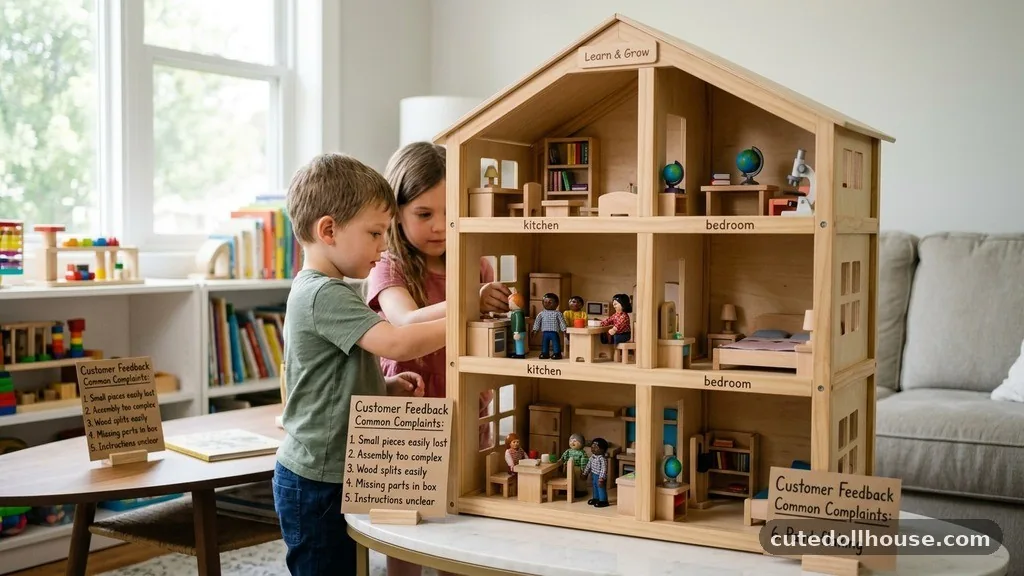
Customer reviews are most useful when several people describe the same issue in specific terms. Repeated comments about missing parts, unclear instructions, weak joints, undersized furniture, or misleading photographs deserve further checking before purchase.
One negative review does not establish that every unit has the same problem. Seller handling, shipping damage, production changes, and assembly mistakes can all affect individual experiences. Check the return policy, replacement-part process, and the exact model number where those details are available.
Comparison Checklist for Educational Dollhouses
Because no specific product models were supplied for this article, the table below compares the main design types rather than assigning unsupported rankings or prices. It can help narrow the search before reviewing individual listings.
| Design type | Best for | Typical difficulty | Key advantage | Main drawback | Value considerations |
|---|---|---|---|---|---|
| Compact tabletop house | Small rooms and younger users who need easy access | Usually low to moderate | Uses less space and is easier to supervise | Limited room for several children or large furniture | Good value when storage and accessibility matter most |
| Large multi-room house | Older children and extended imaginative play | Often moderate to high | More room for storytelling and furniture layouts | Needs substantial floor space and careful assembly | Worth considering if it will be used frequently |
| Plastic playhouse | Families prioritising wipe-clean surfaces | Varies by model | Often lighter and easier to clean | Some models feel less substantial or have limited detail | Compare construction quality rather than material alone |
| Wooden house | Buyers seeking a traditional appearance | Moderate to high | Can provide a solid frame and attractive finish | May be heavy, costly, or time-consuming to assemble | Check panel thickness, finish, and included contents |
| Foldable or portable design | Homes where storage and movement are important | Low to moderate | Can be put away more easily than a fixed structure | Folds, hinges, and latches may need careful handling | Useful if the toy must share space with other activities |
Choosing by Age and Play Style
For Toddlers
Toddlers generally need a simple, stable play environment with large components and minimal loose accessories. The structure should be low enough to access without pulling or leaning on it, and adults should inspect every part for small pieces.
A small pretend-play house, room set, or larger-scale activity centre may be safer and more suitable than a traditional detailed dollhouse. The best choice is the one that allows simple actions such as opening, placing, naming, and moving without overwhelming the child.
For Preschool Children
Preschoolers often enjoy repeating familiar routines and acting out short stories. A dollhouse with accessible rooms, sturdy furniture, and a manageable number of pieces can support this stage well.
Look for an arrangement that leaves enough open floor space for figures to stand and move. Too many tiny decorative items may add tidying work without adding much play value.
For Children Around Five to Seven
Children in this range may begin creating longer plots, assigning different roles, and changing the use of each room. A multi-room model can be engaging if the child already enjoys pretend play and has space for a more permanent setup.
At this stage, buyers can pay closer attention to compatibility with additional furniture and figures. Still, age labels vary by manufacturer, so use the child’s coordination, maturity, and interest as part of the decision.
For Older Children
Older children may appreciate realistic layouts, customisation, miniature furniture, and detailed storytelling. They may also be interested in building or decorating the house themselves, but that makes material quality and assembly requirements more important.
A basic house can remain engaging when children are allowed to rearrange rooms, create handmade accessories, or combine it with other imaginative toys. Buying more detail is not always the same as buying more play value.
Recommendations by Buyer Type
Best Approach for Beginners
Start with a stable, moderately sized model that includes enough furniture to begin playing immediately. A simpler house is easier to understand, easier to maintain, and less likely to create disappointment if the child’s interest changes.
Best Approach for Small Homes
Prioritise footprint, storage, and access over the number of rooms. A compact tabletop model or foldable design may be more practical than a tall structure that must remain permanently assembled.
Best Approach for Appearance-Focused Buyers
Look beyond staged photographs. Examine close-up images of edges, roofs, hinges, finishes, and room surfaces. An attractive exterior matters, but it should not come at the expense of stable construction or usable interior space.
Best Approach for Value-Focused Buyers
Calculate the likely total cost, including furniture, figures, batteries, storage, and replacement accessories. A cheaper house that requires many extra purchases may not offer better value than a simpler model with useful contents included.
Best Approach for Shared Play
Choose a design with open access from the front or sides and enough floor space for more than one child to reach the rooms. Stability becomes especially important when siblings or friends are likely to play together.
Common Mistakes to Avoid
- Buying based only on the room count without checking the actual measurements.
- Assuming every accessory shown in product photographs is included.
- Ignoring the size of figures and furniture relative to the house.
- Choosing a detailed model for a child who prefers active or construction-based play.
- Overlooking assembly requirements, tool needs, and wall-stability guidance.
- Relying on a single customer review instead of looking for repeated patterns.
- Placing a tall dollhouse where children can climb, pull, or tip it.
- Forgetting that very small pieces require extra supervision.
Frequently Asked Questions
What is the best dollhouse for children?
The best choice depends on the child’s age, play style, available space, and tolerance for small pieces. A stable, accessible design with correctly scaled furniture and clear safety guidance is usually a stronger choice than the most elaborate-looking option.
At what age should a child get a dollhouse?
There is no universal age because children develop coordination and pretend-play interests at different rates. Toddlers may use larger, simpler playhouses, while traditional dollhouses with small furniture are generally more appropriate for children who can safely handle those pieces.
What is a good dollhouse for a five-year-old?
Look for a sturdy model with reachable rooms, enough open space for figures, and accessories that match the child’s abilities. Confirm the manufacturer’s age guidance and avoid assuming that a large number of tiny pieces makes a house more educational.
Are wooden dollhouses better than plastic ones?
Neither material is automatically better. Wood may provide a traditional appearance and substantial construction, while plastic can be lighter and easier to wipe clean. The quality of the specific model, its stability, finish, and usability matter more than the material label alone.
What should I check before buying a large dollhouse?
Measure the intended location and compare it with the assembled dimensions. Check access to rooms, assembly instructions, included accessories, stability requirements, and whether the structure can be moved or stored safely.
Do educational dollhouses include furniture and figures?
Some do and some do not. Product images can be illustrative, so read the package contents carefully. If accessories are sold separately, confirm their dimensions and compatibility before adding them to the budget.
Final Verdict
The best educational dollhouses for kids are not necessarily the largest or most detailed. They are the ones that match a child’s age, play interests, motor skills, and home environment while providing enough flexibility for stories, sorting, movement, and shared play. Buyers should verify dimensions, small-parts guidance, included accessories, assembly needs, and stability before ordering.
An educational dollhouse is worth buying for a child who enjoys imaginative play and has a suitable place to use it. If space is tight, the child prefers other activities, or small accessories are a concern, a simpler room set or larger-scale pretend-play toy may be the better choice. Compare the full setup rather than the photograph, and choose the design that will genuinely be used.