
Finding the best modern dollhouses for collectors is less about choosing the largest model and more about matching design, scale, materials, and display needs. A well-made miniature house can function as a serious collection piece, a creative interior-design project, or a carefully preserved family heirloom. The difficult part is that listings often use similar language while hiding important differences in construction, assembly, lighting, furniture, and compatibility with accessories.
Collector-focused buyers also need to think beyond first impressions: a striking exterior may be difficult to assemble, while a simpler shell may offer more freedom to customise. This article explains the main formats, buying criteria, practical drawbacks, and signs of lasting value so you can make a considered decision.
What Modern Dollhouses Are
Modern dollhouses are miniature buildings designed to represent contemporary homes, apartments, studios, shops, or other architectural spaces. Unlike traditional Victorian-style models, they may use clean lines, open-plan rooms, large windows, minimalist façades, and neutral interiors. Some are sold as unfinished shells for customisation, while others arrive painted or partially furnished.
Collectors may display them as complete scenes, use them as a foundation for miniature interior design, or build a themed collection around architecture and furniture. The word “modern” describes the visual style, not necessarily the age of the product. A newly produced kit can imitate mid-century, Scandinavian, industrial, minimalist, or contemporary architecture.
Most models are built around a stated scale, such as 1:12 or 1:24. Scale affects almost every buying decision: furniture compatibility, room proportions, lighting, storage, and the amount of detail that can be added. A house with an attractive exterior is not a practical purchase if its rooms cannot accommodate the accessories you already own.
Historical context can also add meaning to a collection. For a useful overview of how miniature houses have developed as objects of design and social history, the Britannica overview of dollhouses provides helpful background.
Are Modern Dollhouses Worth Buying?
For the right collector, a modern dollhouse can be a worthwhile long-term project. It offers more than a decorative object: building, furnishing, photographing, and modifying the interior can all become part of the hobby. Contemporary designs are especially appealing to buyers who prefer architectural shapes, uncluttered rooms, and miniature spaces that resemble real homes.
The value depends heavily on the buyer’s expectations. A collector who wants a ready-to-display scene should look for a finished or substantially completed model. Someone who enjoys woodworking, painting, wiring, and interior design may prefer an unfinished kit with room for personal decisions.
When a Modern Dollhouse Makes Sense
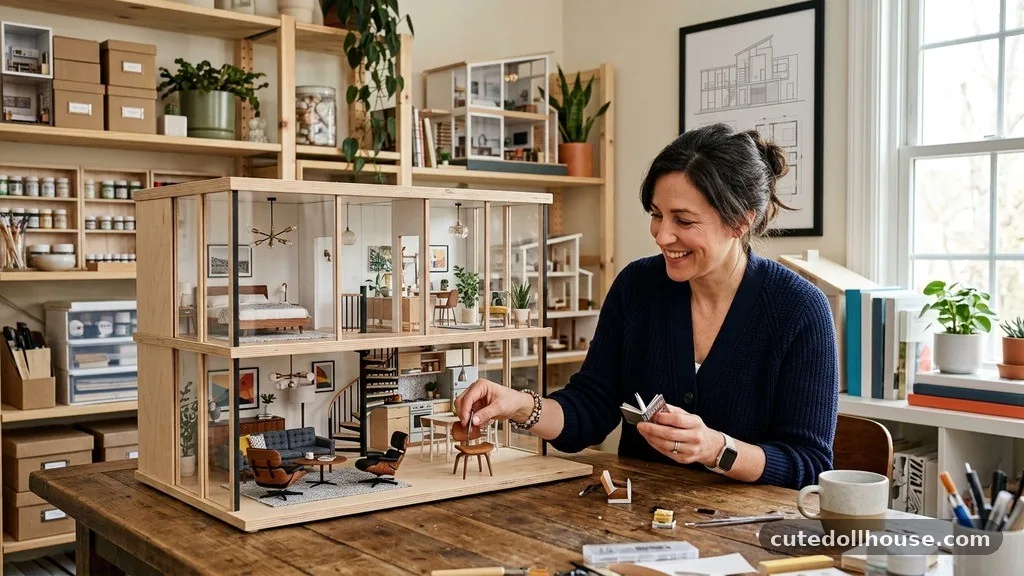
- You enjoy miniature interiors, architecture, or hands-on creative projects.
- You want a display piece that fits a contemporary decorating style.
- You already own furniture or accessories in a compatible scale.
- You have a stable display area away from moisture, direct sunlight, and heavy traffic.
- You’re comfortable checking measurements and completing at least some assembly.
When Another Option May Be Better
- You want an immediately finished display with no painting, wiring, or construction.
- You need a compact model but are considering a large multi-room house.
- You prefer highly traditional architecture, ornate details, or historical reproductions.
- You want a toy designed for frequent child-led play rather than collector display.
- You don’t have access to compatible furniture, lighting, or replacement parts.
Modern Dollhouse Formats to Consider
There is no single type of modern dollhouse. The best choice depends on whether the main goal is display, customisation, play, or collecting. Product descriptions can blur these categories, so buyers should read the construction details instead of relying only on photographs.
| Format | Best For | Typical Strength | Potential Drawback | Value Consideration |
|---|---|---|---|---|
| Unfinished construction kit | Experienced hobbyists and custom builders | Maximum freedom over paint, flooring, lighting, and layout | Requires time, tools, and careful fitting | Value depends on the quality of the shell and how much work is included |
| Partly finished kit | Collectors who want customisation with less preparation | Balances personalisation and convenience | Some finishing choices may already be fixed | Check exactly what is painted, assembled, or supplied |
| Ready-made display model | Appearance-focused buyers and gift recipients | Can be displayed with minimal preparation | Usually offers less scope for structural changes | Inspect the finish, scale, and included accessories carefully |
| Modular or room-box design | Small spaces and collectors building scenes gradually | Flexible display and easier storage | May not create the presence of a full house | Useful if you want to expand over time |
| Play-oriented contemporary house | Children or shared family use | Often simpler to handle and easier to access | May lack collector-level detail or delicate finishes | Prioritise safety, stability, and cleanability over realism |
How to Choose the Best Modern Dollhouses for Collectors
Build and Material Quality
Construction quality starts with the main shell. Panels should be described clearly, with information about the material and thickness where available. Wood-based construction can provide a solid foundation for painting and customisation, but not all composite boards have the same density, finish, or resistance to warping.
Look closely at photographs of corners, rooflines, balconies, staircases, and window openings. These areas reveal whether the design is cleanly finished or dependent on decorative angles that may be difficult to align. Thin trim can look elegant but may be fragile during assembly or relocation.
Material details are often incomplete in marketplace listings. If the seller does not identify the main structural material, ask before buying. Also check whether transparent windows, doors, flooring, and trim are included or shown only as styling examples.
Design and Appearance
A modern exterior should be judged as a display object as well as a building kit. Consider the roof shape, window arrangement, colour palette, room visibility, and how the model will look from the angles available in your home.
Open-front designs make interiors easier to see and photograph. Enclosed houses can look more architectural but may limit access to rear rooms. Large windows create a contemporary feel, yet they can leave fewer wall surfaces for artwork, shelving, or furniture.
Minimalist design is not automatically easier. A plain white wall can show uneven joints, brush marks, or gaps more clearly than a heavily decorated room. Buyers who want a clean modern finish should allow time for preparation and touch-up work.
Size, Scale, and Display Fit
Measure the intended display area before choosing a model. Include depth, not just width and height. A dollhouse that fits a shelf from the front may still overhang it, block access to nearby objects, or become difficult to clean.
Scale is equally important. The most common scales are not universally interchangeable, and even products described with the same scale can have slight differences in proportions. Check the interior room dimensions and compare them with the measurements of furniture, figures, vehicles, and lighting components you plan to use.
- Measure the display surface, including usable depth and overhead clearance.
- Confirm the stated scale from the manufacturer or seller.
- Check doorway and staircase widths if you plan to add furniture later.
- Leave space for cleaning, photography, and safe removal from the shelf.
- Consider whether the finished model can pass through doors and stairways.
Features and Functionality
Modern dollhouses may include removable panels, hinged walls, balconies, staircases, LED lighting, opening doors, or adjustable room dividers. These features can improve display and access, but each adds another point that may need careful assembly or maintenance.
Lighting deserves particular attention. A listing may show a brightly illuminated scene without making clear whether the lights, wiring, batteries, transformer, switches, or connectors are included. Never assume that a photographed feature is part of the package.
Removable sections can be useful for furnishing rooms and repairing small details. However, repeated handling may loosen joints or damage delicate trim. Buyers should decide whether access or structural simplicity matters more for their intended use.
Ease of Assembly
Difficulty varies widely. A small room box may require cutting, gluing, painting, and decorating, while a large architectural kit can involve many panels, trim pieces, windows, floors, and electrical components. “DIY” is not a precise difficulty rating.
Before ordering, look for an actual parts list and assembly instructions. Product pages that provide only lifestyle photographs make it harder to judge the workload. It is also useful to verify whether glue, paint, tools, wiring supplies, and furniture are excluded.
For a first project, a partly finished kit or simpler modular unit may be less frustrating than a large unfinished house. Experienced builders may welcome the extra work, especially if the structure supports substantial customisation.
Accessories and Interior Compatibility
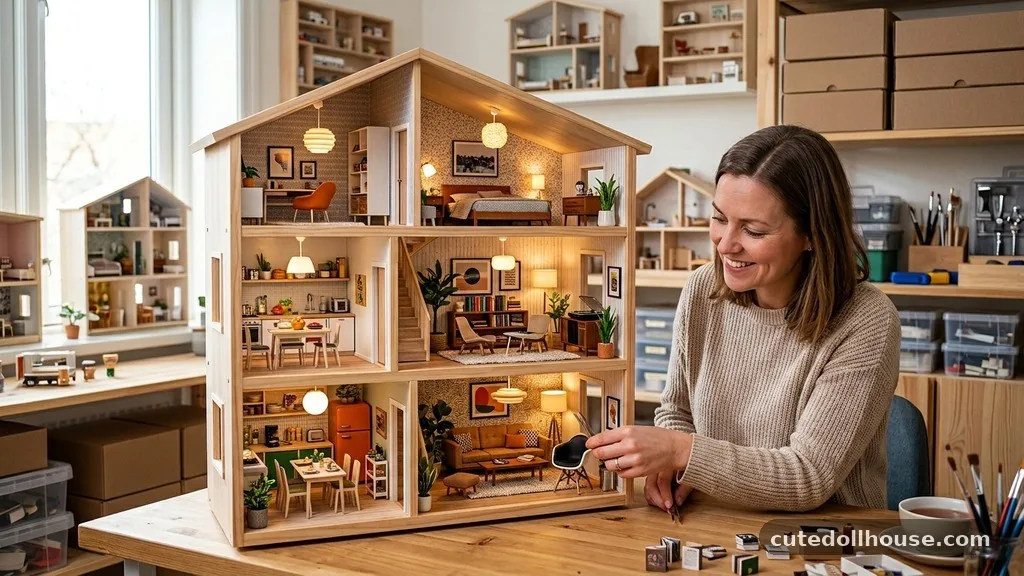
Accessories can change the total cost and time commitment. A modern house may be sold as an empty shell even though its promotional images show sofas, plants, kitchen units, artwork, books, and lighting. Read the included-items list line by line.
Furniture style matters as much as scale. Contemporary interiors often require clean-lined seating, modern kitchen units, glass features, rugs, art, and understated décor. Traditional miniature furniture may technically fit but look out of place.
If you plan to build a collection, choose a visual language that can be repeated. Matching flooring, lighting colour, trim thickness, and furniture scale will make separate scenes feel connected.
Common Advantages and Drawbacks
What Collectors Often Like
- Contemporary architecture can suit modern homes better than ornate historical designs.
- Open layouts make miniature rooms easier to view and photograph.
- Neutral surfaces provide a flexible base for personal interior design.
- Modular formats can allow a collection to grow gradually.
- Customisable kits offer a creative project rather than a fixed decoration.
What May Disappoint Buyers
- Photographs may show furniture, lighting, and decoration that are sold separately.
- Large models can require more display and storage space than expected.
- Minimalist finishes can make construction flaws highly visible.
- Scale differences may prevent existing accessories from fitting properly.
- Replacement parts and compatible components may be difficult to source.
- Assembly can take considerably longer than a casual product description suggests.
Quality, Durability, and Maintenance
Durability depends on both the materials and the way the model is handled. A permanently displayed house may remain in good condition for years if it is protected from sunlight, humidity, dust, and accidental knocks. Frequent relocation creates more stress around roof sections, balconies, doors, and loose decorative elements.
Dust is a practical issue. Open-front houses are easier to access but expose the interior to more airborne debris. Enclosed models provide some protection, although glass or clear panels can create reflections and may complicate cleaning.
Use a soft brush or suitable microfiber cloth for routine dust removal, and avoid applying liquid directly to painted surfaces or paper-based flooring. Any electrical system should be switched off before cleaning. Manufacturer care instructions take priority, especially for models with delicate finishes or integrated lighting.
Store unused furniture and removable pieces in labelled containers. This simple habit makes future rearrangement and repairs much easier. Keep assembly instructions, spare parts, and the original packaging if the model may need to be moved.
Customer Feedback and Seller Information
Customer reviews can reveal issues that product photographs do not. Look for repeated comments about warped panels, unclear instructions, missing parts, weak adhesive points, inaccurate dimensions, or differences between the pictured model and the delivered package.
A single complaint may reflect shipping damage or an unusual assembly problem. Repeated reports deserve more attention, particularly when they concern the same structural area. Feedback also varies by seller, production batch, region, and packaging method, so it should be treated as evidence rather than an absolute guarantee.
Before purchase, verify:
- The exact contents of the box.
- The finished dimensions rather than package dimensions alone.
- The scale and compatibility of accessories.
- Whether paint, glue, tools, wiring, and furniture are included.
- The seller’s process for missing or damaged components.
- Whether the listing describes a finished model, a kit, or a photo of a completed example.
Recommendations by Buyer Type
For Beginners
Start with a compact model, room box, or partly finished kit. The best beginner choice is not necessarily the smallest product; it is the one with clear instructions, manageable parts, and realistic information about what remains to be done.
For Experienced Builders
An unfinished architectural shell may offer the greatest creative freedom. Look for a strong layout, useful access to the interior, and dimensions that work with your preferred furniture and lighting systems. A plain structure can be more valuable than a heavily decorated model if you intend to redesign every room.
For Appearance-Focused Collectors
Prioritise façade proportions, window quality, visible room layouts, and finish consistency. Ready-made or partly completed models may make more sense than a demanding kit, but confirm which display elements are actually included.
For Small Homes or Apartment Displays
Modular rooms and shallow designs are easier to position than deep multi-storey houses. Measure the display location carefully and consider how the model will be cleaned, viewed, and moved before choosing a larger format.
For Buyers Focused on Long-Term Value
Choose construction quality, coherent scale, repairability, and a durable design over temporary decoration. Collectible appeal is difficult to predict, and no product should be treated as a guaranteed investment. A model is more likely to remain satisfying when it can be maintained and furnished with available accessories.
Questions to Ask Before Buying
- Is this a complete display model or an unfinished kit?
- What parts, accessories, lighting, and finishing materials are included?
- What are the finished width, depth, and height?
- Which scale does the model use, and are replacement accessories available?
- How much cutting, painting, wiring, or gluing is required?
- Can the structure be accessed easily after assembly?
- How will it be protected from dust, sunlight, moisture, and accidental damage?
FAQ About Modern Dollhouses for Collectors
What makes a dollhouse suitable for collectors?
Collector suitability usually comes from build quality, coherent scale, attractive design, display presence, and the ability to customise or maintain the model. A house does not need to be large or expensive to be collectible.
Are modern dollhouses difficult to assemble?
Some are relatively simple, while others require substantial cutting, painting, gluing, decorating, and electrical work. Check the instructions and included-parts list before assuming a model is beginner-friendly.
Do modern dollhouses usually include furniture?
Not necessarily. Many kits are sold as shells, and staged photographs may show optional furniture or décor. Confirm the package contents with the seller before buying.
What scale is best for a collector?
There is no universal best scale. Choose the scale that matches your existing furniture, figures, available display space, and preferred level of detail. Compatibility is more important than choosing a scale simply because it is popular.
Can a modern dollhouse increase in value?
Future value is uncertain and depends on condition, design, maker, rarity, documentation, and collector demand. Buyers should purchase because they enjoy the object, not because appreciation is guaranteed.
How should a miniature house be maintained?
Keep it away from direct sunlight, damp areas, and heavy traffic. Dust gently, avoid excess moisture, protect delicate pieces during moves, and retain instructions and spare parts for future repairs.
Final Verdict
The best modern dollhouses for collectors are the ones that fit the buyer’s scale, space, skill level, and preferred way of collecting. A finished model suits buyers who want immediate display, while an unfinished or modular kit is better for people who enjoy designing every detail. Before purchasing, verify dimensions, materials, included accessories, lighting, assembly requirements, and replacement-part support.
Modern dollhouses are worth buying when the project and display experience matter as much as the finished appearance. Choose carefully, treat seller claims as specifications to verify rather than promises, and prioritise a model you can realistically build, furnish, maintain, and enjoy for years.